These guidelines provide practical information for tradespeople on how to meet their duty to manage the risk of asbestos exposure when working with or near asbestos.
Download:
Key points
- Buildings built before 1 January 2000 are likely to contain asbestos-containing materials (ACMs). For buildings built after 1 January 2000, it is possible ACM is present but it is less likely.
- When asbestos is disturbed, tiny fibres can be released. Breathing them in can cause lung cancer, asbestosis, mesothelioma or other serious lung diseases.
- Tradespeople who work with or near ACMs have a duty to follow a prescribed risk management process to manage the risk of asbestos exposure to themselves, their workers, and others.
Note to readers
Use of ‘must’ and ‘should’
The words ‘must’ and ‘should’ indicate whether:
- an action is required by law, or
- is a recommended practice or approach.
| Term | Definition |
|---|---|
| Must | Legal requirement that you must comply with |
| Should |
Recommended practice or approach. Where the word ‘should’ is used it means that it is a recommended practice or approach, but it is not mandatory. Alternative approaches may be adopted, including those which provide for equivalent or greater levels of safety. |
Key terms
A list of technical words, terms, and abbreviations used in these guidelines can be found in the glossary at the end of these guidelines. The glossary explains the meaning of each technical word, term, or abbreviation.
Lists
Lists of examples used in these guidelines are not complete lists. They may list some examples, but not all possible examples.
Images
Images used in these guidelines are a guide only. Images are not intended to provide technical specifications
1.0 About these guidelines
These guidelines provide practical information for tradespeople on how to meet their duty to manage the risk of asbestos exposure when working with or near asbestos.
1.1 What are these guidelines about?
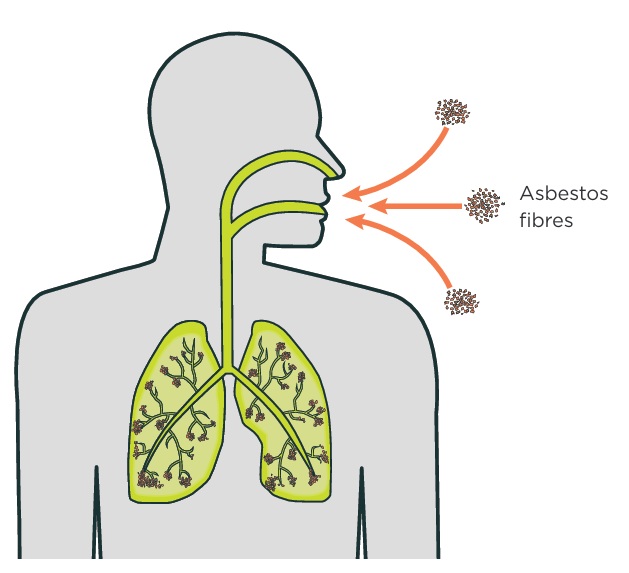
Tradespeople will often come across asbestos or asbestos-containing materials (ACMs) while doing their work. When asbestos is disturbed, tiny fibres can be released. Breathing them in can cause lung cancer, asbestosis, mesothelioma or other serious lung diseases.
Tradespeople have a duty to manage the risk of asbestos exposure to themselves, their workers, and others when working with or near asbestos or ACMs (referred to as asbestos-related work in these guidelines).
These guidelines provide practical information on how you can manage the risk of asbestos exposure and meet your duties under:
These guidelines cover general good practice principles that will apply to most asbestos-related work situations. They reflect a prescribed risk management process.
Detailed information sheets are also available that outline step-by-step instructions for doing specific asbestos-related tasks (for example, how to safely drill into asbestos cement board).
See Section 8 for a list of the available information sheets for specific asbestos-related work tasks. Where relevant, the information sheets should be used as well as these guidelines.
These guidelines do not cover:
- building refurbishment and/or demolition work (see Section 1.3 below for more information)
- licensed asbestos removal work
- unlicenced asbestos removal work. For example, removing less than 10m² of non-friable asbestos as part of other work.
For information on asbestos removal work see Asbestos removal – good practice guidelines.
1.2 Who should read these guidelines?
These guidelines are for tradespeople and their workers.
Under HSWA a tradesperson is considered 'a person conducting a business or undertaking' (PCBU). In these guidelines this includes:
- tradespeople who have other people working for them
- self-employed and sole traders
- tradespeople who are subcontracting out aspects of the work.
In these guidelines where reference is made to 'you' it means any of the above tradespersons and their workers.
These guidelines may also be useful for:
- people engaging tradespeople to do work at properties they own, manage, or control. For example:
- property owners
- property managers
- project managers
- health and safety professionals that provide health and safety advice to PCBUs.
For the purpose of these guidelines asbestos-related work means maintenance activities and servicing work (for example minor repairs or alterations, encapsulation or sealing), that may disturb ACM or cause asbestos fibres to be released into the air. This does not include any work related to refurbishment, demolition, or removal of asbestos/ACM.
Maintenance means care and/or upkeep that is planned, routine or urgent that keeps the building or structure in a proper condition or working order. It is incidental work that can be done quickly and safely with minimal control measures required to ensure safety.
Refurbishment means carrying out work in a building or structure with the emphasis on changing and/or upgrading it.
Demolition means work to demolish or dismantle a structure, or part of a structure, or that is loadbearing or otherwise related to the physical integrity of the structure.
Removal work means the complete removal or replacement of asbestos, ACM or asbestos-contaminated dust or debris, regardless of the quantity or whether it is friable or non-friable.
Before a building can be refurbished or demolished all asbestos must be positively identified, removed, and the building given clearance as required by the Asbestos Regulations. For more information see:
- Conducting asbestos surveys – good practice guidelines
- Asbestos removal – good practice guidelines
- Asbestos assessments – good practice guidelines
The following table includes examples of different tasks and whether they are covered by these guidelines or not:
| Examples of asbestos-related work/maintenance covered by these guidelines include: | Examples of refurbishment, demolition, or asbestos removal not covered by these guidelines include: |
|---|---|
|
|
Table 1: Examples of work covered and not covered by these guidelines
You do not need an asbestos removal licence to do asbestos-related work covered by these guidelines – but you do need to have the right equipment, skills, knowledge, training and experience in how to do the work in a way that will keep you and others safe from asbestos exposure.
1.4 Where to find other information about asbestos and asbestos management
These guidelines focus specifically on good practice for asbestos-related work. There is guidance available for other aspects of the management of asbestos.
It may be helpful to read these guidelines alongside the following guidance:
- Asbestos in New Zealand – information about what asbestos is, the risks of asbestos and why it should be managed
- Managing asbestos in your building or workplace – guidelines for PCBUs about how to manage asbestos in their building or workplace (including when to engage an asbestos surveyor to assist with this)
- Protective clothing and equipment for working with or near asbestos – guidance for PCBUs that carry out any work where there is a risk of exposure to asbestos fibres
- Conducting asbestos surveys – good practice guidelines
- Asbestos removal – good practice guidelines
- Asbestos assessments – good practice guidelines
- The Health and Safety at Work (Asbestos) Regulations 2016 – interpretive guidelines
- Asbestos-related work safe work practices – information sheets x13:
- ARW1: Drilling and boring through textured coatings
- ARW2: Drilling holes in asbestos insulating board
- ARW3: Drilling holes in asbestos cement and other highly bonded materials
- ARW4: Cleaning debris from gutters on an asbestos-containing roof
- ARW5: Cleaning weathered asbestos containing roofing and cladding
- ARW6: Repairing damaged asbestos cement
- ARW7: Painting asbestos cement products
- ARW8: Replacing cabling in asbestos cement conduits or boxes
- ARW9: Repairing minor damage in asbestos insulating board
- ARW10: Painting undamaged asbestos insulating board
- ARW11: Removing pins and nails from asbestos insulating board panel
- ARW12: Working on electrical switchboards containing asbestos
- ARW13: Inspecting asbestos composite friction materials
1.5 Overlapping PCBU duties
When more than one PCBU is working at the same worksite you must all work together to make sure any risks of asbestos exposure are managed appropriately. All PCBUs involved (such as the building owner and all other tradespeople that will be present) must, so far as is reasonably practicable:
- consult each other
- cooperate with each other
- coordinate their activities.
This can be done by:
- making sure everyone is aware of the locations of any asbestos at the worksite
- discussing what work activities are going to be carried out that may disturb asbestos
- agreeing on the degree of influence and control each PCBU has
- agreeing on who will manage the risk of asbestos disturbance, and how it will be managed
- monitoring and checking that agreed safe work practices are being followed as agreed.
Use the asbestos management plan (if there is one) as the starting point for these conversations.
Any arrangements you make with other PCBUs on how the risks will be managed (for example, arrangements to monitor control measures) should be sensible and proportionate so far as is reasonably practicable.
You cannot contract out of your duties, but you can make reasonable agreements with other PCBUs to meet your duties. Each PCBU is responsible for making sure their own duties are met.
You can read more about overlapping PCBU duties in Overlapping duties – quick guide
See Section 12.1 Scenario one: managing overlapping duties for a worked example of managing overlapping duties related to managing the risk of asbestos exposure during asbestos-related work.
2.0 What is the risk?
Many New Zealand buildings, structures, plant and equipment can contain asbestos and ACMs.
Asbestos and ACMs usually pose little risk as long as they are undisturbed and in good condition. But when they are disturbed, for example by cutting, drilling, sanding, grinding and other common construction or maintenance activities, they can release harmful invisible asbestos fibres into the air.
2.1 How can workers be harmed?
When asbestos or ACMs are disturbed, tiny fibres can be released. If you breathe in these fibres, they can lodge in your lungs and cause lung cancer, scarring of the lung tissue (asbestosis), cancer of the lung lining or abdomen (mesothelioma) or other serious diseases of the lungs and surrounding membranes.
Symptoms for most asbestos-related diseases take between 10 to 40 years before they start to appear and can include shortness of breath, a persistent cough, and chest pains.
Most asbestos-related diseases are caused by exposure to asbestos fibres at work. Even small jobs can be risky if the right procedures are not followed to minimise the spread of asbestos fibres.
For more information see Asbestos in Aotearoa New Zealand
You must ensure, so far as is reasonably practicable, the health and safety of any workers who work for you or who you influence or direct, and make sure that other persons are not put at risk by the work that you carry out. This is called the 'primary duty of care'. If you are self-employed, you must also ensure (so far as is reasonably practicable) your own health and safety at work. This includes protecting yourself, your workers, and others from the risk of exposure to asbestos fibres.
Others can be harmed too
If you do not follow safe work practices during asbestos-related work, you risk spreading asbestos fibres and exposing other people to asbestos fibres. For example:
- you may cause contamination of the work area where other people are also working
- you may cause contamination of someone's home, putting at risk the health of those who live there
- you may contaminate your work vehicle, putting at risk the health of anyone else who gets in that vehicle
- you may contaminate your own home (for example by wearing or taking home contaminated clothing), putting at risk the health of your own family.
Following the seven steps outlined in these guidelines will help make sure no one is exposed to asbestos fibres during asbestos-related work.
3.1 Seven steps for working safely with or near asbestos
Sections 4 to 10 of these guidelines cover seven steps that if followed, will help make sure you are managing the risks to yourself, your workers, and others when doing asbestos-related work
Remember asbestos-related work means any activity that may disturb asbestos/ACM or cause asbestos fibres to be released into the air that is not related to the removal of the asbestos/ACM. See Section 1.3 for more information on the difference.
The steps are listed below:
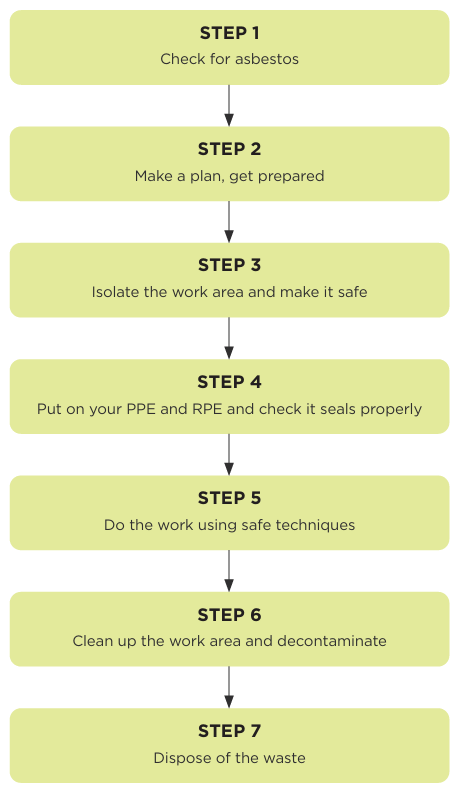
Vertical flowchart with arrows connecting each step:
Step 1: Check for asbestos
Step 2: Make a plan, get prepared
Step 3: Isolate the work area and make it safe
Step 4: Put on your PPE and RPE and check it seals properly
Step 5: Do the work using safe techniques
Step 6: Clean up the work area and decontaminate
Step 7: Dispose of the waste
End of text alternative.
If you or your workers have to disturb asbestos, you must not start work until you and your workers have the right information and training to work safely. You have a duty to give your workers information about the health risks of asbestos-related work and train them on how to manage those risks. You must give the following information and training to anyone likely to be carrying out asbestos-related work:
- how to identify asbestos or ACM (see asbestos awareness training below) the health risks and health effects associated with exposure to asbestos.
- See Asbestos in Aotearoa New Zealand for more information
- when personal protective equipment (PPE) and respiratory protective equipment (RPE) is required and how to use it properly. See Section 7.0 for more information
- the need for, and details of, health monitoring of a worker carrying out asbestos-related work. See Section 11.0 for more information
- good practices for safe handling of asbestos – including to minimise the spread of asbestos fibres while working with asbestos. See Asbestos-related work safe work practices information sheets
- for step-by-step guides on safe work practices.
You must keep a record of all training that is provided for each worker and save this information for at least five years after they stop working for you.
3.3 Asbestos awareness training
The best way to learn how to identify and safely handle asbestos and ACMs is to attend asbestos awareness training.
Courses are available across New Zealand. Before signing up, check if the course:
- is relevant to your trade
- will help you identify asbestos-related hazards in your work
- covers safe handling and appropriate control measures
- provides information about different forms and types of asbestos
- will cater to the needs of your workers – for example can the course be delivered in other languages if needed?
- is eligible for continuing professional development (CPD) points
- provides a relevant formal qualification or NZQA unit standard that workers could obtain.
WorkSafe also has asbestos identification posters relevant to the major trades to assist with ongoing asbestos awareness:
For more information about asbestos health risks and training, see Asbestos in Aotearoa New Zealand and Providing information, training, instruction or supervision for workers
4.0 Step 1: Check for asbestos
Before you start any work check if there is asbestos present in the work area.
There are several ways you can do this. Start by asking the property or building owner for what information they might have, then look around the work area yourself to see if any of the area where you will be working has material that may be or contain asbestos.
4.1 If the place you will be working is a workplace or a rented property
If the place you will be working is a workplace the building owner or PCBU in control of the building or workplace must have an asbestos management plan (AMP)1. If the place you will be working is a rented residential home, an AMP must be prepared before any work is done on the property. An AMP tells you the locations of any asbestos in the building or workplace, the condition of the asbestos, and information on how it should be dealt with.
- Ask the PCBU to view the AMP.
- Check the AMP to see if any asbestos has been identified in the area you are going to be working.
- Take note of the locations, types, and condition of asbestos at the site.
- Take note of any areas that have been 'presumed' to contain asbestos.
- If you find there is or may be asbestos present in the area where you will be working think about whether you will be able to adequately manage the risk associated with doing the planned work.
- Consider getting advice from an asbestos professional if you are unsure (see Section 4.4 for more information).
For more information on AMPs see Chapter 6 of Managing asbestos in your building or workplace – for PCBUs
1 If the building or workplace was built after 2000 it may not have an AMP because the PCBU may be confident that there is no asbestos present. If this is the case, you can go ahead with the work but be alert to the presence of asbestos because sometimes asbestos or ACM can still be present.
4.2 If the place you will be working is an owner-occupied residential home
Residential owner-occupiers (this excludes landlords) are not required to have an AMP and are unlikely to have one. Ask the owner-occupier questions to find out if asbestos could be present. For example:
- do they know of any asbestos in or around the house?
- when was the house built?
- have there been any renovations, refurbishments or extensions? When?
- has asbestos ever been found before? If so, where?
- what does the material look like?
- how much of it is there?
- what condition is it in – good, damaged, deteriorating?
- is anything blocking access to the area?
WorkSafe has published information for homeowners about asbestos. Consider sharing this guidance with the homeowner to help them understand the risks of working with or near asbestos and why you are required to put control measures in place. See Asbestos in the home
4.3 Look for yourself
Assess the work area yourself to see if any of the materials you will be working on may be, or may contain, asbestos. The following images show examples of common places you might find asbestos or ACMs.
The following table lists common (but not all) examples by trade of where asbestos or ACM is commonly encountered:
| Trade | Examples of ACM that could be encountered |
|---|---|
| Painting/decorating | Wall linings/window flashings/soffits/textured ceilings/sprayed coatings |
| Building/construction | Fibreboard/lino/vinyl flooring/laminated kitchen benchtops/sprayed coatings |
| Electrical | Fuse boxes/oven door seals/textured ceilings/switchboard backing and lining |
| Plumbing | Pipe lagging/water heater insulation/valve and boiler gaskets |
| Plastering | Textured ceilings/wall linings/fire-rated plasterboard/sprayed coatings |
| Flooring/tiling | Vinyl tiles/sheet flooring/underlay/flooring adhesive |
| Roofing | Roofing products such as 'Super 6' or 'decramastic' roof tiles/ACM soffits |
| Glazing | Windowsills/wall linings/floor tiles/splashbacks |
| HVAC (heating, ventilation and air conditioning) | Insulation/ducts/linings |
| Mechanics/mechanical engineering |
Gaskets/brake pads/disc brakes/mufflers (especially in older vehicles)/insulation. The ban on ACM did not extend to vehicle parts until 2016 so you will need to check vehicles imported or manufactured up until this date. |
Table 2: Examples by trade of where asbestos or ACM is commonly encountered
See Appendix 2 of the Good practice guidelines for conducting asbestos surveys for a detailed list with photographs of different types of asbestos and ACM.
There are also asbestos identification posters for each trade available – see trade specific asbestos awareness posters
![[image] potential asbestos locations in a commercial building](/assets/Topic/Asbestos/WKS-2-asbestos-where-it-can-be-found-1.jpg)
Diagram showing an industrial building with numerous callouts identifying potential locations of asbestos-containing materials.
Roof and upper structure:
Roof ventilators
'Super Six' or 'Super Eight' roof sheeting
Skylight and manhole frames
Asbestos cement vent pipe and capping
Fluted ridge capping used on plain roll, fluted saddle ridge, sawtooth ridge capping and ventilating ridge
Exterior walls and features:
Window moulding and louvre blades
Barge moulding
'Super Six', 'Super Eight' or architecturally designed wall cladding
Wall sheeting or compressed sheeting
'Super Six' awning
Gutters
Door mouldings
Rainwater heads
Side flashing
Woven fencing product
Interior and lower areas:
Sheeting or ceiling tiles used in the office area, kitchen, toilet, walls or mezzanine area
Compressed sheet flooring
Compressed wall sheeting used for toilet partitions
Vinyl floor tiles or sheet vinyl floor coverings
Asbestos cement downpipes
Backing to the switchboard and internal lining
Textile in the fuse holders
Gully trap surrounds
Moulded telecommunications pit or electrical pit
End of text alternative.
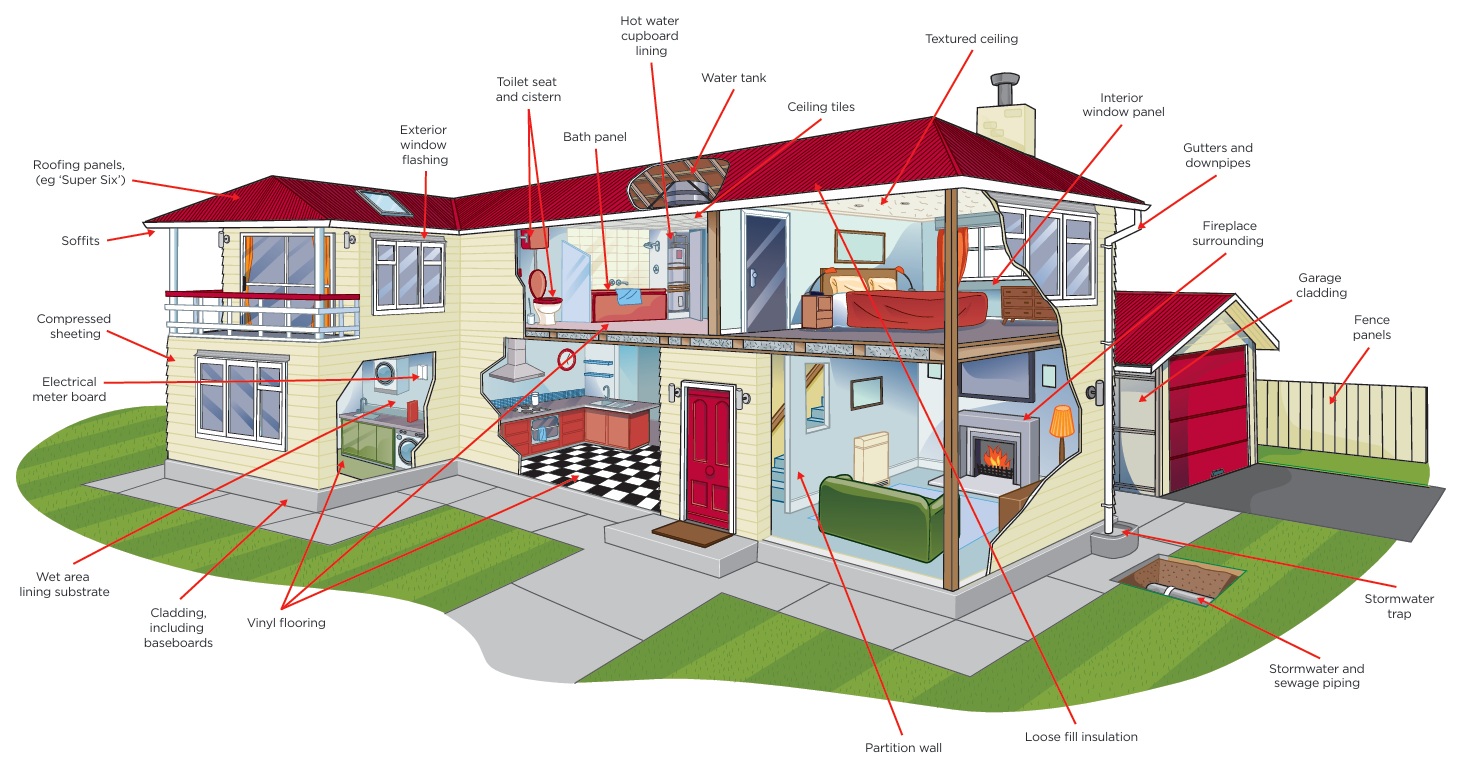
Diagram showing a cutaway view of a residential house with the front wall removed. Callouts identify potential locations of asbestos-containing materials throughout the property.
Roof and upper structure:
Roofing panels, (eg 'Super Six')
Soffits
Water tank
Ceiling tiles
Textured ceiling
Gutters and downpipes
Exterior walls and features:
Compressed sheeting
Exterior window flashing
Garage cladding
Fence panels
Interior spaces:
Interior window panel
Fireplace surrounding
Partition wall
Loose fill insulation
Bath panel
Toilet seat and cistern
Hot water cupboard lining
Flooring and lower areas:
Vinyl flooring
Cladding including baseboards
Wet area lining substrate
Infrastructure and services:
Electrical meter board
Stormwater trap
Stormwater and sewage piping
End of text alternative.
4.4 If you are unsure, consider seeking professional advice first
If the area where you are going to be working looks like there may be asbestos present but you are unsure of its type, condition or level of risk, and you have been unable to get this confirmed, consider getting advice from an asbestos professional before you decide what to do.
Workplaces and rented houses must have had a survey done and an AMP in place. If this has not been done, and you suspect asbestos may be present, you should request that a survey is completed of the area where you will be working before you begin work.
An asbestos surveyor, asbestos assessor, or other competent person should be able to confirm for you if there is asbestos present. They may also be able to give you advice on how best to manage working with or near it. It may be that the condition of the asbestos makes it too unsafe to be worked on or near, and it may need to be removed by a licensed removalist first.
Remember – engaging an expert before you start may be faster and cheaper than dealing with an accidental asbestos contamination and putting your workers, others, or your own health at risk.
4.5 If there is no asbestos identified in the work area
If after thorough investigation you are confident there is no asbestos or ACM in the work area you can continue the job as normal rather than follow the further steps below. But be wary, sometimes asbestos can pop up in unexpected places. Have a plan, and the right equipment available, in case of an unexpected discovery. See Section 4.6 below for details.
4.6 If you or your workers uncover or damage previously unidentified asbestos or ACM after the work has started
Following the above steps should make sure you are aware and prepared for any asbestos or ACM before works starts. If suspected asbestos or ACM is unexpectedly discovered after work has already begun:
- stop work immediately
- keep all people away from the area – close off the area, use barriers or warning tape if available
- close all window and doors to the area. Shut off any HVAC systems
- decontaminate yourself, and any tools and equipment that was used or may have become contaminated (see Section 9.0)
- advise the property owner or PCBU who controls the property as soon as practicable. The property owner or PCBU may need to get professional advice from an expert such as an asbestos assessor, licenced asbestos removalist, or a suitably qualified health and safety professional. They can help the property owner or PCBU determine the extent of contamination spread and if a licenced removalist may be needed to assist with clean up and decontamination of the work area and wider surrounding area.
5.0 Step 2: Make a plan, get prepared
Once you know the details of any asbestos or ACM in the work area, you will need to plan how you are going to manage the risk.
If there is an AMP you must follow any relevant management information it provides. In some cases, it may be safer and more cost-effective to have the asbestos removed first, especially if it is friable asbestos.
Remember if the work meets the definition of refurbishment, demolition or removal the following steps do not apply. You must follow the prescribed process for identification and removal as stated in the Asbestos Regulations. See Section 1.3 for more information.
5.1 Communicate with affected people
Talk to your workers and other people that may be affected by the work.
- Make sure your workers are aware that there will be asbestos present. Make sure they have the training necessary to do the asbestos-related work safely. Use your most competent and experienced workers or make sure you will be available to closely supervise less experienced workers.
- Make sure the person hiring you to do the work is aware that you will be disturbing asbestos while doing the work. Explain to them what control measures you will be using to manage the risk (for example, that you may need to isolate or clear the work area of furniture beforehand). They may also choose to have the asbestos removed by a professional first.
Asbestos in the home offers information for homeowners that may be helpful when explaining the risk of asbestos to homeowners, and any potential additional steps that have to be taken.
5.2 Plan to do the work when fewer people are around
Talk to the building or workplace occupants.
If you can, arrange to do the work when there are as few people as possible in the building or workplace (such as on a weekend our outside office or business hours).
Alternatively arrange in advance for people who would normally be near the work area to move somewhere else while the work is being done.
5.3 Get your equipment together
Make sure you have all the equipment you will need to do the work safely. Common items include:
- H-class vacuum cleaner with shroud attachments
- shroud for drills
- wet wipes or clean rags and water (with added detergent)
- heavy-duty plastic sheeting (see Section 6.2)
- asbestos waste disposal bags and labels (see Section 10.2)
- disposable PPE such as coveralls, gloves, and protective footwear (see Section 7.1)
- adhesive tape
- RPE that is fit checked for each individual worker (see Section 7.2)
- signage and barriers to isolate the area
- other materials that are listed in the information sheet for your specific asbestos-related work task.
6.0 Step 3: Isolate the work area, make it safe
Keeping people away from the work area and protecting the sounding area will help minimise the risk of exposure or contamination.
You must separate your work area from the rest of the workplace to keep people out of the area.
6.2 Move items out of the way or cover them
Clear the area of any movable objects, particularly personal items, soft furnishings, or items made of fabric. Put them somewhere where they are not at risk of being contaminated with asbestos fibres. Cover any remaining objects with plastic sheeting to keep them protected.
Place plastic drop sheets on the ground under and near the work area. Sheets should be heavy duty (200–500 micron) polythene, or robust and tear resilient/ high tensile strength plastic.
Any plastic sheeting used to cover items must be disposed of as asbestos contaminated waste at the end of the work. It must not be re-used on other jobs.
7.0 Step 4: Put on your PPE and RPE and check it seals properly
Using the right PPE and RPE is essential when doing asbestos-related work.
7.1 Use the right personal protective equipment (PPE)
The diagram below illustrates the required PPE for doing asbestos-related work.
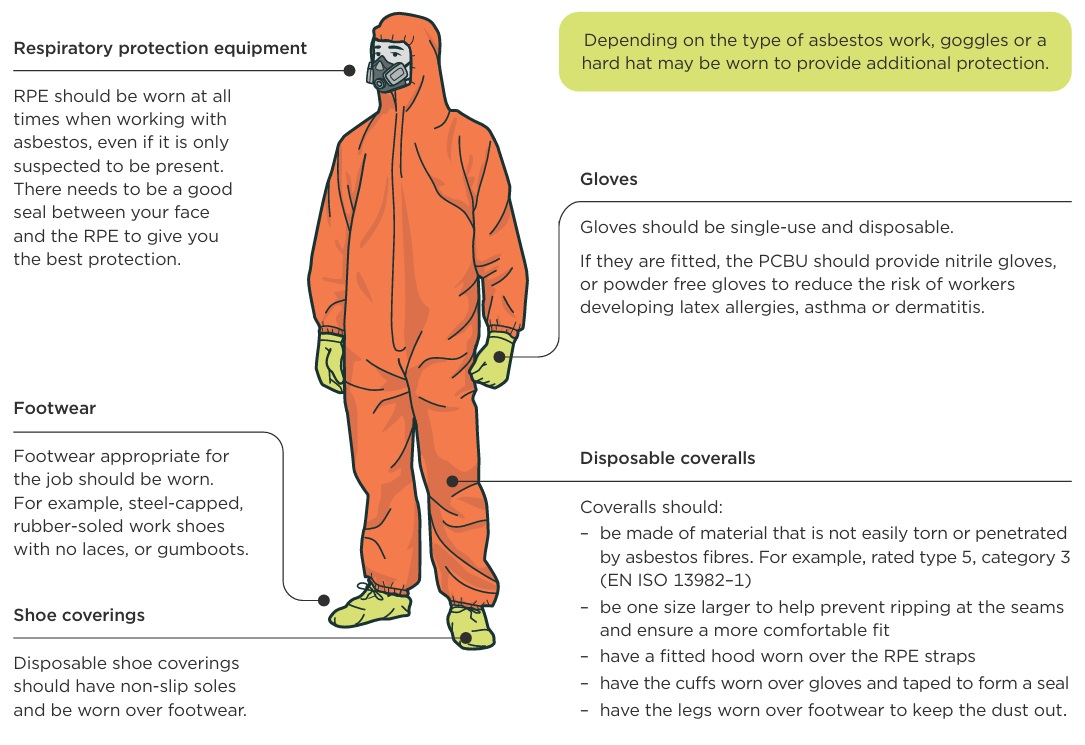
A figure wearing personal protective equipment:
Respiratory protection equipment: RPE should be worn at all times when working with asbestos, even if it is only suspected to be present. There needs to be a good seal between your face and the RPE to give you the best protection.
Gloves: Gloves should be single-use and disposable. If they are fitted, the PCBU should provide nitrile gloves, or powder free gloves to reduce the risk of workers developing latex allergies, asthma or dermatitis.
Disposable coveralls: Coveralls should:
- be made of material that is not easily torn or penetrated by asbestos fibres. For example, rated type 5, category 3 to ISO 13982-1:1)
- be one size larger to help prevent ripping at the seams and ensure a more comfortable fit
- have a fitted hood worn over the RPE straps
- have the cuffs worn over gloves and taped to form a seal
- have the legs worn over footwear to keep the dust out.
Footwear: Footwear appropriate for the job should be worn. For example, steel-capped, rubber-soled work shoes with no laces, or gumboots.
Shoe coverings: Disposable shoe coverings should have non-slip soles and be worn over footwear.
Depending on the type of asbestos work, goggles or a hard hat may be worn to provide additional protection.
End of text alternative.
For more information on PPE see Protective clothing and equipment for working with or near asbestos
Disposable coveralls
Wear disposable (single-use) coveralls to stop asbestos fibres getting onto your clothes.
You must make sure disposable PPE used in asbestos-related work is disposed of as asbestos waste when the work has been completed.
Wear coveralls a bit loose so they will not rip at the seams. You should wear coveralls that are at least one size larger than you would normally wear.
- Make sure the legs of the coveralls are taped tight over the top of footwear – do not tuck them in as this lets dust in to footwear.
- Respirator straps should be under the hood of the coveralls – this allows RPE to remain in place during the initial stages of decontamination.
- Never re-use disposable coveralls.
Do not use reusable coveralls
There are currently no commercially available laundries that can clean asbestos contaminated clothing. Asbestos contaminated clothing must not be taken home to be washed, it will need to disposed of as asbestos contaminated waste. Domestic washing machines cannot guarantee decontamination and could also expose the person washing the clothing to asbestos fibres (such as other family members).
For more information see Protective clothing and equipment for working with or near asbestos
Footwear
Footwear should be non-laced safety gumboots, or footwear that completely covers each foot. Coveralls should come down over the tops of gumboots.
Doing this will:
- stop asbestos debris and dust getting inside footwear
- prevent lodging of asbestos into the folds and spaces and fabric in and around the laces
- make decontamination easier.
Disposable boot covers (booties) can also be used. These should cover all of the footwear and be tucked up underneath the coveralls. They must also be disposed of as asbestos waste when the work has been completed.
For more information see Protective clothing and equipment for working with or near asbestos
7.2 Use the right RPE
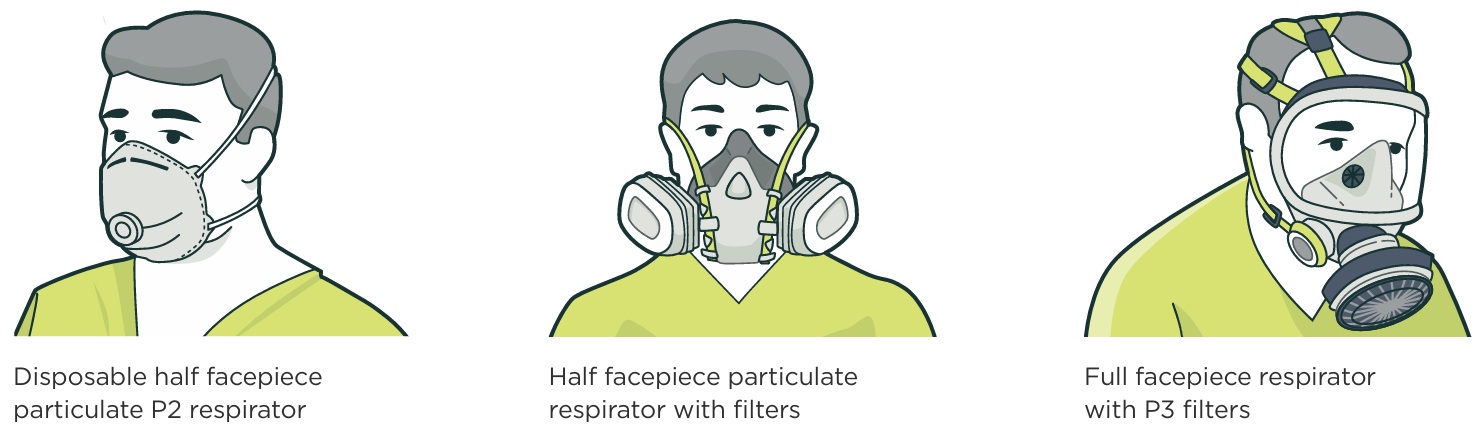
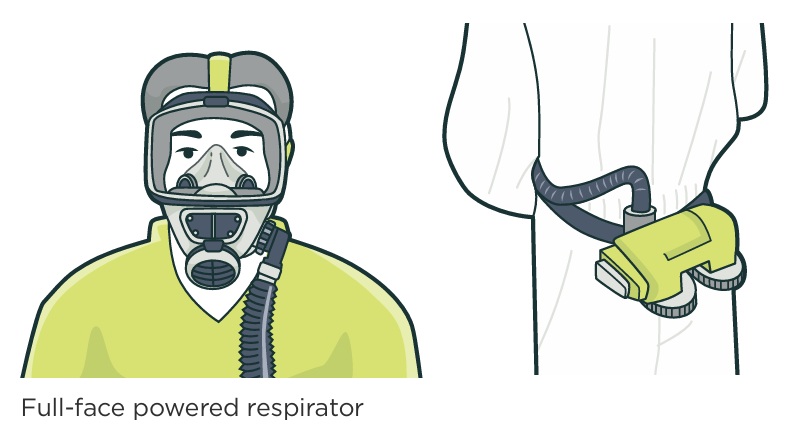
When working with or near asbestos, RPE is essential to help minimise the risk of breathing in asbestos fibres. Not all RPE will protect you from asbestos.
You must make sure your workers wear appropriate RPE whenever they are working with or near asbestos. The greater the risk of exposure to asbestos, the higher the level of protection the RPE must provide.
- Nuisance dust masks (including medical masks often used for public health reasons) will not provide the protection that you and your workers need. Do not use nuisance dust masks for asbestos-related work.
- A disposable (single-use) P2 respirator (with or without a valve) is the minimum needed.
- Face fit tested reusable RPE with the correct filters offers the best protection for asbestos-related work.
- Never re-use disposable respirators between jobs.
RPE will not work unless it fits properly
Make sure respirators fit properly. Workers must have respirators that fit their face, and have a good seal to stop asbestos fibres getting in. Workers must be trained by a competent person on how to check that their respirators are fitting/ sealed properly. They should check the seal every time before they start any work with or near asbestos.
See How to wear a disposable respirator safely and How to wear a reusable respirator safely for instructional videos for workers on how to check the seals on their RPE for asbestos work.
Facial hair and stubble can prevent respirators from getting a good seal between the face and most types of respirators. Workers who cannot shave should seek professional advice from an RPE or occupational health specialist about what is appropriate RPE for them
See Protective clothing and equipment for working with or near asbestos for detailed information on how to choose the right type of RPE for each worker and how to do fit checks to make sure they are working properly.
8.0 Step 5: Do the work using safe techniques
Following the recommended safe work practices and using only permitted tools will help make sure you are managing the risk of asbestos exposure.
Almost all asbestos-related work will require dust suppression techniques to be used. There are also specific tools that must never be used with asbestos or ACM. This section will cover these two important factors that apply to all asbestos-related work.
For detailed information and step-by-step instructions for doing specific asbestos-related work tasks select from the following information sheets:
- ARW1: Drilling and boring through textured coatings
- ARW2: Drilling holes in asbestos insulating board
- ARW3: Drilling holes in asbestos cement and other highly bonded materials
- ARW4: Cleaning debris from gutters on an asbestos-containing roof
- ARW5: Cleaning weathered asbestos containing roofing and cladding
- ARW6: Repairing damaged asbestos cement
- ARW7: Painting asbestos cement products
- ARW8: Replacing cabling in asbestos cement conduits or boxes
- ARW9: Repairing minor damage in asbestos insulating board
- ARW10: Painting undamaged asbestos insulating board
- ARW11: Removing pins and nails from asbestos insulating board panel
- ARW12: Working on electrical switchboards containing asbestos
- ARW13: Inspecting asbestos composite friction materials
8.1 Keep dust down by keeping asbestos or ACM damp
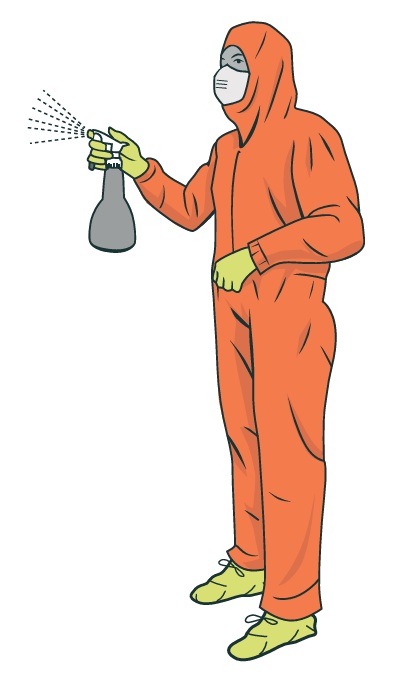
Always keep asbestos damp while you work. This is the best way to stop dangerous dust from getting into the air. This can be done in the following ways:
- Mist the asbestos or ACM using a low-pressure water spray such as a garden sprayer or a hand-held spray bottle immediately before starting the work.
- Use a mixture of eight parts water to one part washing-up liquid to make sure the water will soak into the material.
- Keep the material damp, but not too wet.
- When working with or near electrical sockets and wiring make sure to turn off mains power before misting.
- Continue wetting the asbestos or ACM while working to prevent it from drying out.
- Do not use a high-pressure hose as this could increase the risk of disturbing the asbestos or ACM and making it airborne.
- You can also use thickened substances, pastes, and gels to cover the surfaces of the asbestos or ACM being worked on – especially if it is drying out too quickly. Hair gel, asbestos encapsulant spray, and shaving cream are all effective.
8.2 Use an H-class vacuum cleaner to control dust
As some ACMs (such as asbestos boards or sheets) cannot be wetted all the way through, additional methods to control dust such as ‘shadow vacuuming’ may be needed.
Shadow vacuuming is where you have the vacuum cleaner nozzle positioned as close as possible to where the work is being done to immediately capture any dust that is produced (for example, when removing a screw from asbestos wall cladding hold the nozzle so that the nozzle sucks dust and debris away as soon as it is created).
Dust shrouds that connect to your H-class vacuum cleaner are used to maximise the amount of dust that can be captured (see Figures 9–10).
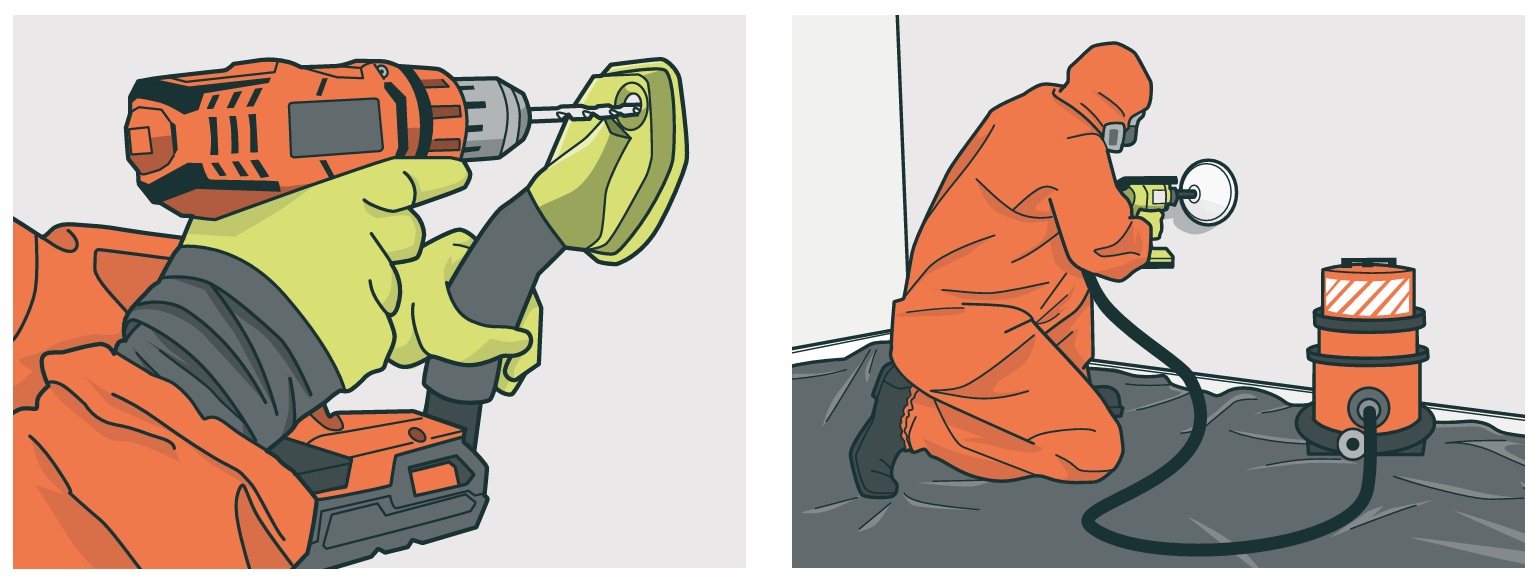
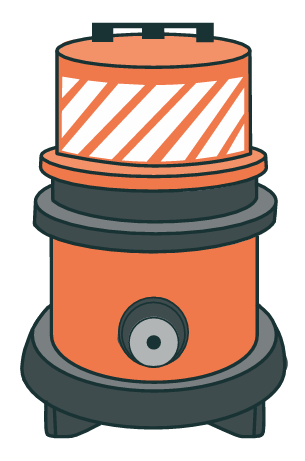
For any vacuuming involving asbestos or ACM you must use an H-class (high hazard) industrial vacuum cleaner with a suitable high-efficiency particulate air (HEPA) filter (see Figure 11). H-class vacuums can be used for removal of moist or dampened material, but not soaking wet material or water.
Do not use domestic or general-purpose vacuum cleaners – even those with HEPA filters.
For more information about vacuum cleaners used for asbestos work see Industrial vacuums and portable extractors for hazardous dust
8.3 Do not use certain tools
The Asbestos Regulations prohibit the use of power tools, brooms, and any other equipment that can cause asbestos to be released into the air when working with asbestos. Power tools and other equipment (including angle grinders, sanders, saws, drills, brushes, and brooms) may only be used on asbestos if:
- the equipment is designed to capture or suppress asbestos fibres and is used according to its design, or
- the equipment is used in a way designed to capture or suppress asbestos fibres safely. For example, through engineering control measures such as using a shroud filled with foam or extraction ventilation.
| Tools you must not use | Permitted exceptions |
|---|---|
|
High-pressure water sprayer This is water pressurised by positive displacement pumps that have an output capability of more than 350kPa (approximately 50 Psi), such as water blasters and pressure washers. |
May only be used for:
|
|
Compressed air This is air that is pressurised to greater than atmosphere pressure. Equipment that uses compressed air includes, for example, blasting equipment such as sand, ice or pellet blasters, or pneumatic tools such as air angle grinders. |
There are no exceptions. |
|
Brooms and domestic vacuum cleaners |
There are no exceptions. |
|
Power tools or any other implement that causes the release of airborne asbestos into the air. |
May be used when the following controls are in place:
Air monitoring may be required to make sure that the power tool is not producing airborne asbestos fibres – see Section 11.0 for more information. |
Table 3: Prohibited tools (with exceptions noted)
See Section 12.2 Scenario two: demonstrating safe work practices for a worked example that includes using safe work practices while doing asbestos-related work.
9.0 Step 6: Clean up the work area and decontaminate
As soon as the job is done you must clean up the work area and decontaminate any non-disposable gear, then decontaminate yourself.
9.1 Decontaminate tools and the work area
Decontamination is an important step to control the spread of asbestos fibres from the work area.
Before removing any potentially contaminated equipment from the work area you must either:
- fully decontaminate it (see Decontaminating tools and equipment below), or
- seal it in a container, label the container as possibly containing asbestos, and decontaminate the outside of the container.
Cleaning as you go to stop waste building up will make decontamination easier.
All single use or disposable equipment must be disposed of as asbestos waste as soon as the work is complete. See Section 10.0: Step 7 – Dispose of the waste for more information.
Decontaminating tools and equipment
Use a damp cloth or wet wipe to wipe down tools and surfaces to remove asbestos fibres:
- Do not re-use the cloth.
- Fold the cloth so that no part is used twice so as not to spread fibres and cause cross-contamination.
- Dispose of the cloth as asbestos waste (see Section 10.0).
Some tools are hard to clean perfectly. For these, wipe them down, then seal them in a labelled bag or container. Only open the sealed bag or container again when you are in the next asbestos work area and wearing PPE and RPE. This stops you from spreading contamination.
‘Quarantining’ difficult-to-decontaminate items will help to prevent cross contamination. See How to decontaminate tools safely for an instructional video for workers on how to decontaminate tools.
Decontaminating the work area
Use an H-class vacuum cleaner with a suitable HEPA filter, for more information see Industrial vacuums and portable extractors for hazardous dust
Never use domestic vacuum cleaners to clean up asbestos dust. Do not use a broom to sweep up waste. Using a domestic vacuum cleaner or a broom will spread asbestos fibres into the air.
Look closely at the work area before leaving the site – has it been cleaned thoroughly? Check under drop sheets and under asbestos waste bags and the waste area. No dust or debris should be visible.
Decontaminate the H-Class vacuum cleaner with wet wipes last after you have finished using it for decontamination of everything else.
9.2 Decontaminate yourself
Follow the below steps for personal decontamination. This will help limit the spread of any asbestos fibres trapped in your PPE or RPE.
You must decontaminate every time you leave the work area – otherwise you risk spreading asbestos fibres outside the work area.
As a PCBU doing asbestos-related work you must make sure your workers have the right training, facilities, and equipment they need to decontaminate properly.
You must keep RPE on until step 4.
Step 1
At the inside edge of the work area, remove any obvious dust or debris off your coveralls.
You can do this by either:
- vacuuming using either an H-class vacuum cleaner with a suitable HEPA filter
- lightly spraying coveralls with water and detergent mix to dampen down the coveralls then wiping them down with a damp rag (with detergent added to the water) or wet wipes.
Step 2
Clean footwear and RPE.
Using a damp rag or wet wipes, wipe down footwear and RPE (while you are still wearing it). Remember to use fresh wet wipes or fresh folds of cloth with each wipe so you are not just spreading the fibres around. If wearing disposable booties, dampen down with water (with added detergent).
Step 3
Remove coveralls, gloves and footwear.
While still wearing RPE, remove footwear, then coveralls, then gloves, turning the gear carefully inside out to trap any remaining contamination. Then place the inside out gear into a labelled asbestos waste bag.
Note: Never take coveralls home or wear them in vehicles. This will prevent cross-contamination and also prevent other people (such as family members) being exposed to asbestos fibres.
Step 4
Remove RPE.
If the RPE is reusable:
- clean it with a wet rag or wet wipe (but do not let water into the filter ports). Check RPE manufacturer instructions for what cleaning agents can be used.
- cap, seal, or remove used filters (dispose of used filters as asbestos waste)
- store it in a clean container that is clearly labelled that it may contain asbestos.
If the RPE is disposable, place it in a labelled asbestos waste bag or waste container.
See Taking off your respirator and PPE safely for an instructional video for workers on how to remove their PPE and RPE without contaminating themselves or the environment.
10.0 Step 7: Dispose of the waste
There are specific requirements for disposing of asbestos contaminated waste.
Waste from asbestos-related work includes:
- any small asbestos fragments or debris that was dislodged during the work (anything more than this becomes asbestos removal and the work must be treated as removal work)
- any tools or equipment that is unable to be safely decontaminated or quarantined
- used cloths, wet wipes and plastic sheets
- all disposable (single use) PPE and RPE (such as coveralls and disposable or respirators)
The above types of waste must be gently placed in a sealed bag and marked clearly to indicate the possible presence of asbestos (see 10.2 Double bag all waste for more details). This should be done before being taken from the asbestos-related work area while you are still wearing your RPE.
Bagged waste must be disposed of at an approved waste facility. An approved place is a place where asbestos is authorised to be disposed of, such as a hazardous waste landfill (tip) approved by a city or district council.
To find out where asbestos waste can be disposed of, look online or talk to your local council.
You must not dispose of asbestos-related work waste at a general landfill or with your normal rubbish.
If you are unable to take the waste to an approved disposal site immediately, there are specific storage requirements you must follow. For more information see Temporary storage of asbestos waste
All waste should be double-bagged in new, clearly labelled heavy-duty, robust and tear resilient/high tensile strength plastic bags.
To double-bag asbestos-related work waste:
- Only fill the bag halfway with waste to minimise the risk of tearing or splitting and to leave a long neck on the bag.
- Lightly spray the contents of the bag with a water and detergent mix. – Gently squeeze any excess air out.
- Twist the neck of the bag tightly, and seal with duct tape close to the base of the neck to fully enclose the contents.
- Clean the external surface of the bag with a wet wipe to remove any potential contamination.
- Place the used wet wipe in the upper neck of the bag (creating a pouch) then seal the neck of the bag above the wet wipe pouch.
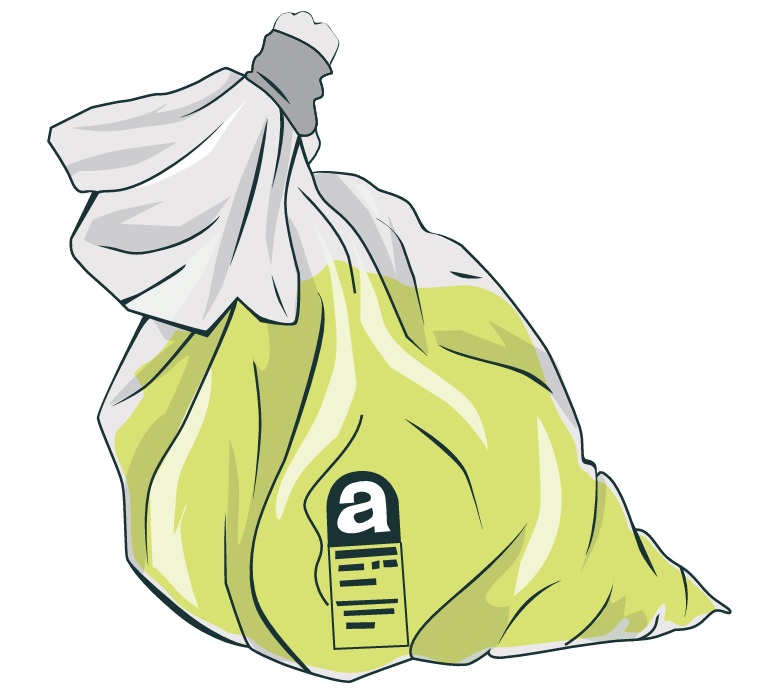
- Fold the neck over and seal it again near the base of the neck – trapping the pouch in the middle (creating a ‘gooseneck twist’). See Figure 12.
- Clearly mark the outer bag with Caution: Asbestos – Do not open or damage bag.
See Disposing of asbestos waste and PPE safely for an instructional video for workers on how to dispose of waste, including how to do a gooseneck twist on a waste bag.
11.0 Health monitoring and exposure monitoring
In some situations, health or exposure monitoring may be required.
Health monitoring tracks you and your workers’ health over time and monitors if it is being adversely affected by the work.
Exposure monitoring measures exposure to harmful substances (such as asbestos fibres in the air) to make sure control measures are keeping asbestos fibre levels below the legal limit.
What health and or exposure monitoring is needed will depend on how confident you are at managing the risk of possible exposure using approved good practice methods and how often there might be a risk of exposure. A health and safety professional such as a suitably qualified occupational health practitioner will be able to give you advice on this.
For occupational health practitioners you could look here:
- New Zealand Occupational Health Nurses’ Association(external link)
- The HASANZ Register of verified workplace health and safety professionals(external link)
- The Australian and New Zealand Society of Occupational Medicine(external link)
Things to consider when deciding if health or exposure monitoring is needed include:
| Situations where you might want to get advice from a health and safety professional | Situations you should get advice from a health and safety professional |
|---|---|
| You or your workers only occasionally have to do asbestos-related work (for example less than once a week or short duration tasks). | You or your workers are doing asbestos-related work frequently (for example more than once a week or for repeated long periods). |
| You or your workers will only be working with non-friable asbestos that is in good condition (the risk of fibre dispersal is less). | You or your workers are working with or near friable asbestos or non-friable asbestos in poor condition. |
| You or your workers are using the highest rated RPE available and are maintaining it correctly. | You or your workers are doing asbestos-related work in a confined space. |
| You or your workers are competent and experienced in following safe work practices for work involving asbestos and are following the safe work practices outlined in this guidance. |
Table 4: Things to consider when deciding if health or exposure monitoring is needed
See Section 12.3 Scenario three: incorporating health and exposure monitoring for a worked example of deciding when health and exposure monitoring is needed for asbestos-related work.
12.1 Scenario one: managing overlapping duties
Rental property bathroom maintenance with Viv, Roy and Herbie
Viv is the landlord of a 1970s rental home. She has just two days between tenancies to get the bathroom freshened up with a new heated towel rail, new bath and sink tap fittings and a new showerhead. Viv knows that because the house was built in the 1970s, some materials may contain asbestos. She already has an asbestos management plan (AMP) and asbestos survey for the property, which show asbestos-containing material (ACM) in the interior fuse box and in some areas of textured ceilings, but not in the bathroom walls and other surfaces where plumber Roy and electrician Herbie will be working.
Step 1 – Checking for asbestos
- Before confirming the work, Viv gives both Roy and Herbie a copy of the AMP and attached survey (which includes an asbestos register).
- Roy checks the bathroom fittings (and the surfaces they are attached, wired or plumbed in to) to be replaced and confirms none of them are on the asbestos register.
- Herbie reviews the AMP and sees that the fuse box (which is in the hallway right next to the bathroom door) that needs to be wired into is listed as containing asbestos backing board. He raises this with Viv.
Step 2 – Making a plan, getting prepared
- The three of them consult, cooperate and coordinate. They agree Roy will work in the bathroom first, and Herbie will only begin his task once Roy is finished, to avoid working on top of each other in confined areas.
- Viv confirms she has scheduled tenants to move in two days later, so the work must be carefully planned but also safely done.
- Herbie plans how he will work safely around the asbestos-containing fuse box without disturbing the board (for example, not drilling into it).
- They all confirm that if unexpected asbestos is found, work will stop and a licensed asbestos removalist will be called.
Step 3 – Isolating the work area, making it safe
- Viv ensures neither the departing nor incoming tenants are allowed on site. She also puts up signs so no one else enters while work is underway.
- Roy electrically isolates the bathroom area before he starts.
- Later, Herbie physically isolates the area around the fuse box and sets up barriers so nobody can accidentally approach while he is working.
Step 4 – Using PPE and RPE and fit checking it
- Roy uses standard PPE (gloves, overalls, safety glasses) for plumbing work. He does not need RPE as he is not working near asbestos.
- Herbie wears disposable coveralls and a P2 respirator in case he inadvertently disturbs dust around the fuse box. He checks the seal around his respirator before starting.
- Before starting work Herbie cleans his equipment and the area with the H-class vacuum cleaner and damp rags.
Step 5 – Doing the work using safe techniques
- Roy completes the shower head and fittings replacement in the bathroom, checking as he goes that no hidden asbestos linings are disturbed.
- Once Roy finishes, he tells both Viv and Herbie.
- Herbie then installs the heated towel rail wiring. At the fuse box, he uses safe techniques:
- again he cleans his equipment and the area with the H-class vacuum cleaner and damp rags
- he does not cut or drill into the asbestos board
- he avoids creating dust
- he keeps his work to the wiring only, following the AMP instructions.
Step 6 – Cleaning up the work area and decontaminating
- Roy cleans and tidies the bathroom, wipes surfaces, and removes his work waste.
- Herbie decontaminates by carefully wiping down his tools, removing his coveralls, and disposing of them in a sealed plastic bag. He washes his hands and face before leaving.
Step 7 – Disposing of the waste
- Any PPE and cleaning cloths used by Herbie are double-bagged, labelled, and disposed of as asbestos waste according to the local council's requirements.
- Roy's general plumbing waste goes into standard disposal, as it is non-asbestos.
Closing the loop
- At the end of the day, both Roy and Herbie confirm directly to Viv that the work was done safely and in line with the AMP.
- They also confirm with each other that their agreed schedule worked and no unexpected asbestos was disturbed.
12.2 Scenario two: demonstrating safe work practices
Plumber Kev installs new hot water cylinder with pipes going through cement sheeting
Kev, an Oamaru plumber, is installing a new vented hot water cylinder in a house. Kev confirms that the old hot water cylinder and asbestos lagging round its pipes and joins has been safely removed by a licensed asbestos removalist. He has seen the clearance certificate for the removal.
Installing the new cylinder requires running a pipe up through a partition wall. When inspecting the work area, Kev notices the cement sheeting around the planned drilling spot is from the early 1970s. From his asbestos awareness training, Kev knows this type of material often contains asbestos.
He checks if the homeowner has any asbestos management documentation. There is none, so Kev explains to the homeowner that the sheeting should be tested before work starts. The homeowner arranges for a sample to be taken by an asbestos surveyor (who confirms the material being sampled is in good condition). The sample is sent to an accredited lab who confirm that the sample contains asbestos.
Because the section he needs to drill is only 5cm², and the asbestos appears to be in good condition, and it is non-friable, Kev decides he will do the work himself – making sure he follows safe work practices.
Kev's safe work process:
- Sets up a small exclusion zone with hazard tape and 'Asbestos – Keep Out' signage.
- Wears disposable coveralls, gloves, and a P2 disposable respirator.
- Makes sure he has hand tools and a spray bottle of water mixed with a small amount of detergent.
- Lightly wets the 5cm² patch to suppress dust.
- Makes a shroud by piercing a hole in the top of the plastic cup, then attaches this to his drill bit, ensuring the drill bit protrudes slightly so he can see where he is drilling.
- Fills the cup and hole saw drill bit with shaving foam.
- With the lip of the cup flush to the cement board he drills the hole using a cordless drill on low speed.
- Puts the drilled waste, drill bit and cup straight into a 200 micron thick plastic bag.
- Wipes the surrounding area and drill hole with a damp cloth, and puts the cloth in the bag, then seals the exposed edge with PVA glue.
- Decontaminates by lightly spraying his coveralls and gloves and carefully peeling both off – inside out – while keeping his respirator on.
- Disposes of the gloves and disposable coveralls in the same bag.
- Lightly sprays the outside of the respirator to suppress any dust. Then carefully removes respirator and disposes of it in the asbestos waste bag.
- Gooseneck ties the waste bag with tape, then double-bags and gooseneck ties again, tapes again and labels it 'Asbestos – Hazardous Waste'.
- Kev then takes the sealed, double-bagged waste to a council-approved asbestos disposal facility and keeps the disposal receipt. He is confident he has safely complied with the law and looked after his own health.
For more information see WorkSafe's information sheet ARW3: Drilling holes in asbestos cement (AC) and other highly bonded materials
For more information see Asbestos in the home
12.3 Scenario three: incorporating health and exposure monitoring
Rewiring a 1970s community hall: Grant, Api, and Jamie
Grant is an electrician in Hamilton who runs a small electrical contracting business. He and his two employees, Api and Jamie, have been hired to rewire an older community hall built in the late 1970s. The job involves replacing old light fittings, running new cables under the floor and cutting access points in the wall linings and ceiling panels. Some of the work will be taking place in confined spaces.
Step 1 – Checking for asbestos
Before starting, Grant consults the building's asbestos management plan (AMP). It shows:
- Wall and ceiling linings are asbestos cement sheeting in good condition (non-friable).
- Some vinyl floor tiles are damaged and are glued down with asbestos-containing adhesive.
The work will involve drilling multiple holes in asbestos cement linings and dislodging small sections of vinyl flooring to access subfloor wiring.
Grant shares this information with Api and Jamie so they know exactly where asbestos is present. He also consults the hall committee (the PCBU with management or control of the building). He confirms they understand the asbestos risks and he consults with them on the steps he plans on taking to manage the risk to him, his workers, and future users of the hall.
Step 2 – Making a plan, getting prepared
Grant, Api and Jamie cooperate to develop a safe work plan. They agree on:
- Using low-speed drilling with dust suppression and shadow vacuuming.
- Dampening and carefully removing only the flooring tiles needed for access.
- Having an occupational hygienist on site on day one to monitor exposure.
Grant has a duty to make sure the airborne asbestos exposure limit is not exceeded during the work. He is not sure if his dust suppression and low-speed drilling methods will keep fibre levels below this limit - especially given the confined work areas and damaged flooring. Grant arranges for an occupational hygienist to carry out exposure monitoring on day one. They will place personal air sampling pumps on both Api and Jamie while they work. The occupational hygienist will then review the results to confirm whether the control measures Grant and his workers are using are keeping airborne asbestos levels below the contamination standard for asbestos.
Step 3 – Isolating the work area, making it safe
Grant coordinates with the hall committee to ensure the hall is closed to the public. Barriers and warning signs are set up around the work area, and only competent workers can enter.
Step 4 – Using PPE and RPE and fit checking it
Grant, Api and Jamie all wear:
- Disposable coveralls, shoe covers, gloves, and safety eyewear.
- Half-face respirators with P2 filters.
All three men check the seal on their respirators before starting work.
Step 5 – Doing the work using safe techniques
- Api and Jamie drill holes in asbestos cement sheeting at low speed, suppressing the dust by shadow-vacuuming with an H-class vacuum cleaner.
- When lifting sections of damaged flooring, they dampen and remove only what is required.
- The occupational hygienist places air sampling pumps on Api and Jamie and monitors the work.
- Grant supervises, making sure controls are followed.
Step 6 – Cleaning up the work area and decontaminating
At the end of each workday:
- Api and Jamie use the H-class vacuum cleaner and wet wipes to clean surfaces being careful to fold the wipes with every pass to avoid cross contamination.
- Tools are decontaminated and placed in a sealed box labelled 'asbestos' and only used in the asbestos-related work area next day when they are back in their PPE and RPE.
- Disposable PPE is vacuumed with a H-class vacuum cleaner, then coveralls dampened down with water and surfactant and carefully rolled down, trapping any dust. Removed PPE is then carefully placed in a labelled asbestos waste bag.
- They wash their hands, face, and any exposed skin carefully with wet wipes, which they put in the asbestos bag.
- The asbestos waste bag is double bagged, and sealed with a goose-neck tie before leaving.
Step 7 – Disposing of the waste
All asbestos waste, including any flooring fragments, disposable PPE, and used rags, is double-bagged then goose-neck tied and placed into asbestos waste bags.
Grant coordinates with the city council to ensure it is disposed of at an authorised asbestos disposal site.
Monitoring and review
- The occupational hygienist reviews the air monitoring results and confirms asbestos levels are below the contamination standard.
- Grant records the results and files them in the AMP.
- Ongoing health monitoring is scheduled for all three workers.
Because Grant expects similar work will be done again frequently in old community buildings over the next couple of years, he also organises health monitoring for himself, Api, and Jamie. Grant, Api and Jamie get baseline lung function tests and ongoing medical checks.
By following these steps Grant should be meeting his duties under the Health and Safety at Work Act 2015 and the Health and Safety at Work (Asbestos) Regulations 2016. He protects Api, and Jamie from asbestos exposure, reassures the hall committee, fulfils overlapping duties with all PCBUs and confirms his safe work methods will keep asbestos risks under control on this and future projects.
13.0 More information
13.1 WorkSafe resources
Asbestos in Aotearoa New Zealand
Protective clothing and equipment for working with or near asbestos
Conducting asbestos surveys: Good practice guidelines for asbestos surveyors
Asbestos removal – good practice guidelines
Asbestos assessments – good practice guidelines
The Health and Safety at Work (Asbestos) Regulations 2016 – interpretive guidelines
Managing asbestos in your building or workplace – for PCBUs
Providing information, training, instruction or supervision for workers
Industrial vacuums and portable extractors for hazardous dust
Temporary storage of asbestos waste
Health and exposure monitoring
Asbestos-related work safe work practices – information sheets x13:
- ARW1: Drilling and boring through textured coatings
- ARW2: Drilling holes in asbestos insulating board
- ARW3: Drilling holes in asbestos cement and other highly bonded materials
- ARW4: Cleaning debris from gutters on an asbestos-containing roof
- ARW5: Cleaning weathered asbestos containing roofing and cladding
- ARW6: Repairing damaged asbestos cement
- ARW7: Painting asbestos cement products
- ARW8: Replacing cabling in asbestos cement conduits or boxes
- ARW9: Repairing minor damage in asbestos insulating board
- ARW10: Painting undamaged asbestos insulating board
- ARW11: Removing pins and nails from asbestos insulating board panel
- ARW12: Working on electrical switchboards containing asbestos
- ARW13: Inspecting asbestos composite friction materials
13.2 Legislation
Appendix
Appendix 1: Glossary
Terms marked with a * are defined in the Asbestos Regulations. Please refer to Section 3 Interpretation(external link) of the Asbestos Regulations if you require a full legal definition.
Air monitoring
Measuring airborne asbestos fibre concentrations by sampling and analysing them.
Airborne contamination standard for asbestos*
The average concentration of 0.1 respirable asbestos fibres per millilitre of air over any eight-hour period.
Asbestos*
A naturally occurring fibrous silicate mineral (rock-forming mineral), from the serpentine or amphibole groups, including the following:
- actinolite asbestos
- anthophyllite asbestos
- chrysotile asbestos (white)
- crocidolite asbestos (blue)
- grunerite (or amosite) (brown)
- tremolite asbestos
- a mix of one or more minerals from the above list.
Asbestos assessors
Asbestos assessors are authorised by WorkSafe to assess if asbestos removal work has been completed to the required standard and the area where asbestos removal took place is safe for reoccupation.
Only an independent licensed asbestos assessor can carry out regulated activities for Class A removal work. This includes:
- air monitoring
- clearance inspection
- issuing clearance certificates.
An independent licensed asbestos assessor may also carry out other activities as part of contractual obligations.
For example, review a work plan made by an asbestos removalist prior to removal work to make sure it is safe and suitable before work starts.
Asbestos-containing material (ACM)
Any material or thing that, as part of its design, contains asbestos.
Asbestos contaminated dust or debris (ACD)*
Dust or debris that has settled within a workplace and is, or is assumed to be, contaminated with asbestos.
Asbestos contaminated soil*
Soil that is contaminated with asbestos or ACM.
Asbestos Management Plan (AMP)*
A written plan, and up-to-date plan, for the workplace that sets out information about the following:
- the identification of asbestos or ACM present at the workplace
- decisions, and reasons for decisions, about the management of the risk arising from asbestos at the workplace
- procedures for detailing incidents or emergencies involving asbestos or ACM at the workplace
- for the workers who carry out work involving asbestos:
- information and training that has been and will be provided to the workers
- roles and responsibilities of the workers
- any health monitoring of the workers that has been or will be undertaken.
Asbestos identification and management process
A framework that can be followed which sets out how to manage asbestos material in a building or workplace.
Its steps include how to:
- identify asbestos material in your building or workplace
- prioritise and manage the risks of asbestos
- keep up-to-date records of your asbestos management approach.
Asbestos management survey
An assessment of a building or workplace undertaken by an asbestos surveyor to:
- identify and record the location, amount, and type of asbestos material readily accessible during normal occupancy of the building (including maintenance)
- inspect and record information about the condition of asbestos material present
- confirm whether material suspected to be asbestos material is asbestos material.
Asbestos refurbishment or demolition survey
An assessment of a building undertaken by an asbestos surveyor when a building or workplace (or part of it) is going to be refurbished or demolished.
The purpose of a refurbishment or demolition survey is to locate all the asbestos material in a building or workplace (or part of it) before refurbishment or demolition work starts.
Asbestos register
A document that lists all identified or presumed asbestos in a building or workplace.
Asbestos Regulations
The Health and Safety at Work (Asbestos) Regulations 2016.
Asbestos-related work*
Work involving asbestos (other than asbestos removal work) that is permitted under regulation 7(external link) of the Asbestos Regulations.
Removal work is covered separately under Part 3(external link) of the Asbestos Regulations.
Asbestos removal licence*
A Class A or Class B asbestos removal licence.
Asbestos removal work*
Work involving the removal of asbestos, asbestos-contaminated soil, or asbestos-containing material.
Asbestos removalist*
A PCBU that carries out asbestos removal work.
Asbestos surveyor
A PCBU that carries out asbestos survey work.
Asbestos waste*
Asbestos, asbestos-contaminated soil or asbestos-containing material removed and disposable items used, during asbestos removal work. This includes plastic sheeting and disposable tools, PPE or RPE.
Business or undertaking
The usual meanings are:
- business: an activity usually carried out with the intention of making a profit or gain
- undertaking: an activity that is non-commercial in nature (for example, certain activities of a local authority or a not-for-profit group).
Class A asbestos removal licence*
A licence authorising the holder to carry out Class A asbestos removal work.
Class A asbestos removal work*
Asbestos removal work for which a Class A asbestos removal licence is required.
Class B asbestos removal licence*
A licence authorising the holder to carry out Class B asbestos removal work.
Class B asbestos removal work*
Asbestos removal work for which a Class B asbestos removal licence is required.
Competent person*
A person who has the knowledge, experience, skills, and qualifications to carry out a particular task under the Asbestos Regulations, including any knowledge, experience, skills, and qualifications prescribed in a safe work instrument.
Control measure
A way of eliminating or minimising risks to health and safety.
Demolition*
Work to demolish or dismantle a structure, or part of a structure, or that is loadbearing, or otherwise related to the physical integrity of the structure; but does not include:
- the dismantling of formwork, falsework, or other structures designed or used to provide support, access, or containment during construction work or
- the removal of power, light, or telecommunication poles.
Double-bagging
A method of sealing asbestos waste in two heavy-duty plastic bags to prevent contamination during disposal.
Duty
A legal obligation to act responsibly according to the law.
Duty holder
A person who has a duty under HSWA. There are four types of duty holders – PCBUs, officers, workers, and other persons at workplaces.
Eliminate
To remove the sources of harm (for example, equipment, substances, or work processes).
Emergency*
An emergency occurs if:
- a structure or plant is structurally unsound and
- the collapse of a structure or plant is imminent.
Exposure monitoring
Exposure monitoring measures and evaluates what a worker is being exposed to while they are at work.
Friable*
In relation to asbestos or ACM, friable means a powder form or able to be crumbled, pulverised, or reduced to a powder by hand pressure when dry.
Good practice guidelines (GPG)
Describes current good practice to help duty holders understand and apply their duties under HSWA.
GRWM Regulations
Health and Safety at Work (General Risk and Workplace Management) Regulations 2016.
Hazard
A potential source of harm. It could include an object, situation, or behaviour.
Hazardous substance
A substance, or product containing a substance, known or suspected to cause harm to health, including substances:
- classified as having toxic or corrosive properties under the Hazardous Substances and New Organisms Act 1996
- for which a prescribed exposure standard exists
- specified in a safe work instrument as requiring health monitoring.
Health monitoring
Monitoring a person to identify any changes in their health status because of exposure to certain health hazards arising from the conduct of the business or undertaking.
Health monitoring is a way to check if the health of workers is being harmed from exposure to hazards while carrying out work. It aims to detect early signs of ill-health or disease.
HSWA
Health and Safety at Work Act 2015.
The key work health and safety legislation in New Zealand. HSWA applies to all work and workplaces unless specifically excluded.
You can find the full text of the Act on the New Zealand Legislation website(external link)
Licensed asbestos assessor
A competent person licensed by WorkSafe to carry out clearance inspections for Class A asbestos removal work and Class A air monitoring.
Licensed asbestos removal work*
Asbestos removal work for which a Class A asbestos removal licence or Class B asbestos removal licence is required.
Licensed asbestos removalist*
A PCBU who is licensed under the Asbestos Regulations to carry out Class A or Class B asbestos removal work.
Minimise
To take steps to protect the health and safety of people by reducing the likelihood of an event occurring, reducing the level of harm to people if it does occur, or both.
Minor contamination
A small contamination where the risk of spread of asbestos fibres and the risk of exposure to respirable airborne fibres is minimal.
Non-friable asbestos*
In relation to asbestos or ACM, means not friable (and for this definition, asbestos and ACM include material containing asbestos fibres reinforced with a bonding compound).
Other persons at the workplace
Includes workplace visitors and casual volunteers (who are not volunteer workers).
These people have their own health and safety duties to take reasonable care to keep themselves safe and to not harm others at a workplace.
Overlapping duties
When a PCBU shares duties with other PCBUs. When two or more PCBUs are working together at the same location or through a contracting chain, they must work together to fulfil their duties of care and manage risks. Where those duties overlap, the PCBUs must consult, cooperate and coordinate with each other to meet their health and safety responsibilities to workers and others.
PCBU
Person conducting a business or undertaking.
In most cases a PCBU will be a business entity, such as a company. However, an individual carrying out business as a sole trader or self-employed person is also a PCBU.
A PCBU does not include workers or officers of a PCBU, volunteer associations with no employees, or home occupiers that employ or engage a tradesperson to carry out residential work.
Plant
Includes:
- any machinery, vehicle, vessel, aircraft, equipment (including personal protective equipment), appliance, container, implement, or tool
- any component of any of those things
- anything fitted or connected to any of those things.
PPE
Personal protective equipment.
Anything used or worn by a person (including clothing) to minimise risks to the person's health and safety.
This may include, but is not limited to:
- respiratory protective equipment
- protective helmets
- protective eyewear
- protective boots
- protective gloves
- hearing protection
- high-vis clothing
- sunhats
- sunscreen and lip protection
- safety harness systems.
Primary duty of care
A PCBU must make sure, so far as is reasonably practicable, the health and safety of workers, and that other persons are not put at risk by its work. This is called the 'primary duty of care'.
Reasonably practicable
What is, or was, reasonably able to be done to ensure health and safety, taking into account and weighing up relevant matters including:
- the likelihood of the risk concerned occurring or workers being exposed to the hazard
- the degree of harm that might result
- what the person concerned knows, or ought reasonably to know, about:
- the hazard or risk
- ways of eliminating or minimising the risk.
- the availability and suitability of ways to eliminate or minimise the risk
- after assessing the extent of the risk and the available ways of eliminating or minimising the risk, the cost associated with available ways of eliminating or minimising the risk, including whether the cost is grossly disproportionate to the risk.
For more information, see Reasonably practicable
Refurbishment
Carrying out work in a building or structure with an emphasis on changing or upgrading it.
Refurbishment/demolition survey
A survey carried out by a competent person (asbestos surveyor).
The purpose of a refurbishment or demolition survey is to locate all the asbestos material in a building or workplace (or part of it) before refurbishment or demolition work starts.
Respirable asbestos fibre*
An asbestos fibre that:
- is less than 3 micrometres wide
- is more than 5 micrometres long
- has a length-to-width ratio of more than 3:1.
Respiratory protective equipment (RPE)
A type of personal protective equipment (PPE) that protects people from breathing in substances hazardous to health.
Risk
Risks arise from people being exposed to a hazard (a source of harm).
Safe work instrument (SWI)
A type of subordinate instrument (sometimes called tertiary legislation) under HSWA.
SWIs can be used for almost any purpose, however, they only have legal effect where specifically referred to in relevant regulations.
SWIs can be used to:
- prescribe detailed or technical matters or standards that change relatively frequently and will often be industry-specific
- set additional or modified control measures for hazardous substances approved or reassessed by the Environmental Protection Authority
- provide an alternative means of complying with regulations
- support the effective operation of the health and safety regulatory framework, for instance by setting exposure monitoring standards or stipulating requirements for training, competence, or safety management systems.
Sealed container
A container designed to prevent the release of asbestos fibres that has been decontaminated and marked clearly to indicate the possible presence of asbestos.
Shadow vacuuming
Holding a vacuum cleaner nozzle close to the task being performed and sucking the dust and debris away as it is created.
In work involving asbestos, an H-Type vacuum should be used that has been recently DOP tested.
So far as is reasonably practicable
That which is, or was, at a particular time, reasonably able to be done in relation to ensuring health and safety. Relevant considerations that inform what might be reasonably practicable are set out in section 22 of HSWA.
Structure
Anything that is constructed, whether fixed, moveable, temporary, or permanent; includes:
- buildings, masts, towers, frameworks, pipelines, quarries, bridges, and underground works (including shafts or tunnels)
- any component of a structure
- part of a structure.
Trace level*
In air, an average concentration of less than 0.01 respirable asbestos fibres per millilitre of air.
Unlicensed asbestos removal work
Asbestos removal work that can be carried out by a person who does not hold a Class A or Class B asbestos removal licence. This includes removal of less than 10m² of non-friable asbestos.
Unlicensed asbestos removal must be carried out by a competent person.
Visible asbestos contamination
Asbestos contamination that can be seen with the naked eye. This might include accumulated dust.
WEPR Regulations
Health and Safety at Work (Worker Engagement, Participation, and Representation) Regulations 2016.
Worker
An individual who carries out work in any capacity for a PCBU. A worker may be:
- an employee
- a contractor or subcontractor
- an employee of a contractor or subcontractor
- an employee of a labour hire company
- an outworker (including a homeworker)
- an apprentice or a trainee, a person gaining work experience or on a work trial
- a volunteer worker.
Workers can be at any level (for example, managers are workers too).
A PCBU is also a worker if the PCBU is an individual who carries out work in that business or undertaking.
Workplace
Any place where a worker goes or is likely to be while at work, or where work is being carried out or is customarily carried out.
Most duties under HSWA relate to the conduct of work. However, some duties are linked to workplaces.
WorkSafe/WorkSafe New Zealand
The government agency that is the primary work health and safety regulator.
Other government agencies can be designated to carry out certain health and safety functions, for example, Maritime New Zealand and the Civil Aviation Authority.
Acknowledgements
WorkSafe New Zealand would like to acknowledge and thank the stakeholders who contributed to the development of this guidance.
Last updated