This screening tool can help you identify when a repetitive upper limb task is low risk, or if you need to complete a more detailed risk assessment.
The upper limbs include the neck, shoulders, arms, wrists, hands, and fingers.
How do you use the screening tool?
Step 1: Consider if you have any vulnerable workers
Some vulnerable workers may be at greater risk of injury. Go straight to the New Zealand Assessment of Repetitive Tasks of the upper limbs (NZART) tool and/or complete additional investigation of the contributing risk factors if you have workers who:
- are new mothers, or pregnant
- are young workers
- are older workers
- are new to the job or workforce
- have a disability, significant health condition, injury, or are recovering from an injury, particularly if this affects their neck or upper limbs.
Step 2: Using the upper limb screening tool (Flowchart 1)
- Watch workers carrying out the repetitive upper limb task and answer the questions in the flowchart to see what, if any, action you need to take. Consider all parts of the upper limbs (neck, shoulders, arms, wrists, hands, and fingers).
- This tool uses a 2-hour per shift activity period as an approximate guide. It is not a fixed time limit.
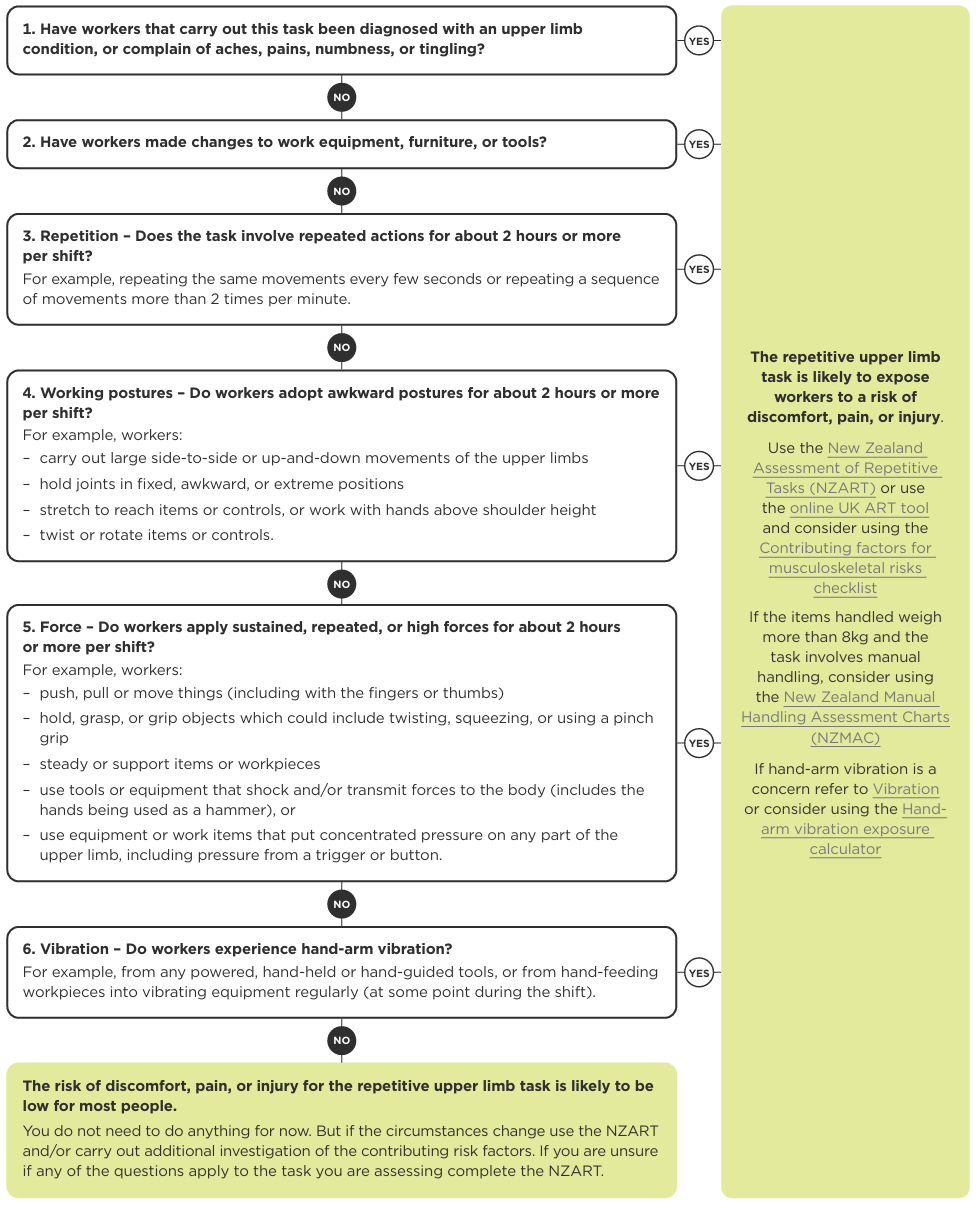
Flowchart 1 shows six sequential questions for screening a repetitive upper limb task, where a "yes" answer at any question leads to the risk outcome and a "no" answer continues to the next question:
- Have workers that carry out this task been diagnosed with an upper limb condition, or complain of aches, pains, numbness, or tingling?
- Have workers made changes to work equipment, furniture, or tools?
- Repetition – Does the task involve repeated actions for about 2 hours or more per shift? For example, repeating the same movements every few seconds or repeating a sequence of movements more than 2 times per minute.
- Working postures – Do workers adopt awkward postures for about 2 hours or more per shift? For example, workers: carry out large side-to-side or up-and-down movements of the upper limbs; hold joints in fixed, awkward, or extreme positions; stretch to reach items or controls, or work with hands above shoulder height; twist or rotate items or controls.
- Force – Do workers apply sustained, repeated, or high forces for about 2 hours or more per shift? For example, workers: push, pull or move things (including with the fingers or thumbs); hold, grasp, or grip objects which could include twisting, squeezing, or using a pinch grip; steady or support items or workpieces; use tools or equipment that shock and/or transmit forces to the body (includes the hands being used as a hammer), or use equipment or work items that put concentrated pressure on any part of the upper limb, including pressure from a trigger or button.
- Vibration – Do workers experience hand-arm vibration? For example, from any powered, hand-held or hand-guided tools, or from hand-feeding workpieces into vibrating equipment regularly (at some point during the shift).
A "yes" answer at any question leads to: "The repetitive upper limb task is likely to expose workers to a risk of discomfort, pain, or injury. Use the New Zealand Assessment of Repetitive Tasks (NZART) or use the online UK ART tool and consider using the Contributing factors for musculoskeletal risks checklist. If the items handled weigh more than 8kg and the task involves manual handling, consider using the New Zealand Manual Handling Assessment Charts (NZMAC). If hand-arm vibration is a concern refer to Vibration or consider using the Hand-arm vibration exposure calculator(external link)."
A "no" answer all the way through leads to: "The risk of discomfort, pain, or injury for the repetitive upper limb task is likely to be low for most people. You do not need to do anything for now. But if the circumstances change use the NZART and/or carry out additional investigation of the contributing risk factors. If you are unsure if any of the questions apply to the task you are assessing complete the NZART."
End of text alternative.
Last updated