This screening tool can help you identify when a lifting or lowering task is low risk or if you need to complete a more detailed risk assessment.
How do you use this screening tool?
Step 1: Consider if you have any vulnerable workers
Some vulnerable workers may be at greater risk of injury. Go straight to the New Zealand Manual Handling Assessment Charts (NZMAC) and/or complete additional investigation of the contributing risk factors if you have workers who:
- are new mothers, or pregnant
- are young workers
- are older workers
- are new to the job or workforce
- have a disability, significant health condition, injury, or are recovering from an injury.
Step 2: Using the lifting screening tool (Flowchart 1)
- Watch workers carrying out the lifting or lowering activity.
- Use Figure 1 as a guide to check which zone or zones the workers' hands pass through when lifting or lowering the load.
- Look at the range of weights that are being lifted/lowered for the task that you are assessing, and select the maximum weight handled.
- Use the maximum weight and compare it to the loads, also called screening values, in the different lifting/lowering zones when the worker is in a stable body position. A stable body position is one where the feet are on the ground and provide a good base of support to perform the lift.
- Once you have the screening value, answer the questions in Flowchart 1 to see what, if any, action you need to take.
Remember
The screening values are not ‘safe load limits’ or acceptable ‘weight limits’. If handling occurs above the screening values, it simply means that you should complete a more detailed risk assessment to understand the risk factors in greater detail.
When handling these loads (or less) in these zones, the risk of injury is low for most people and no further action should be needed.
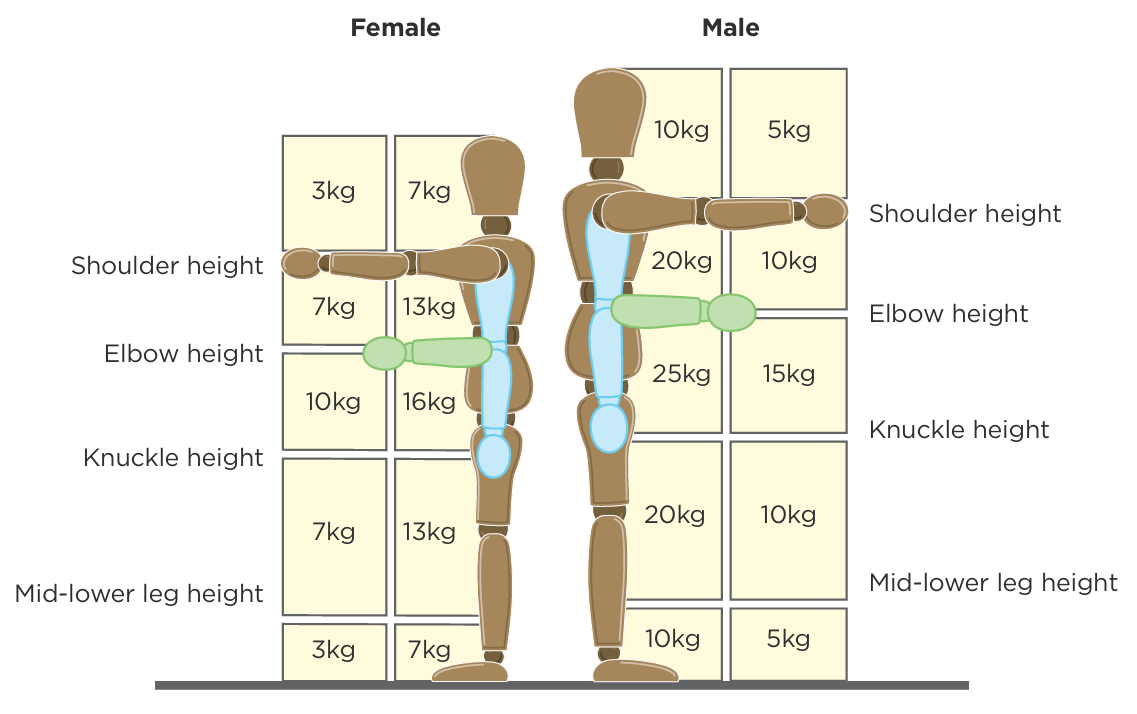
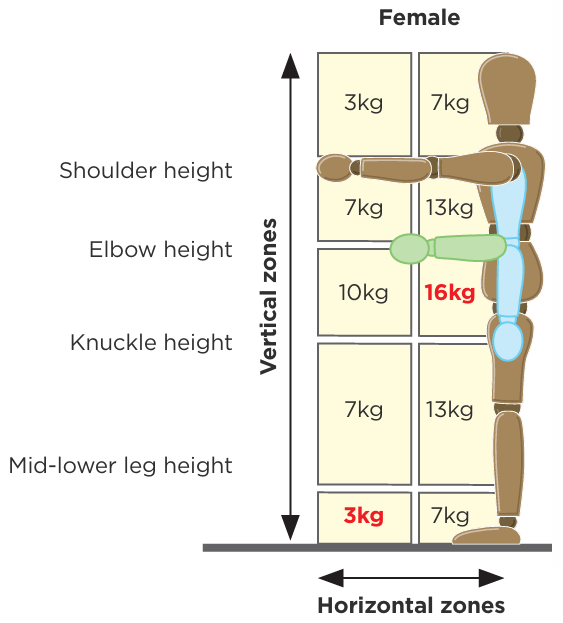
Diagram of a female figure and a male figure, flanked by two columns of screening weight values in kilograms, for the "close to body" and "away from body" positions, across zones marked by shoulder height, elbow height, knuckle height (with arms down), and mid-lower leg height lines.
Female values (close to body / away from body): above shoulder 7kg / 3kg; shoulder to elbow 13kg / 7kg; elbow to knuckle 16kg / 10kg; knuckle to mid-lower leg 13kg / 7kg; below mid-lower leg 7kg / 3kg.
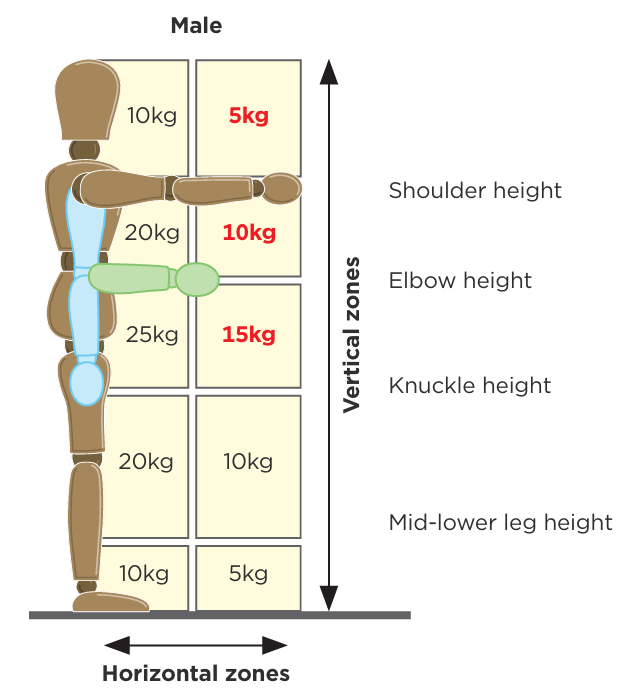
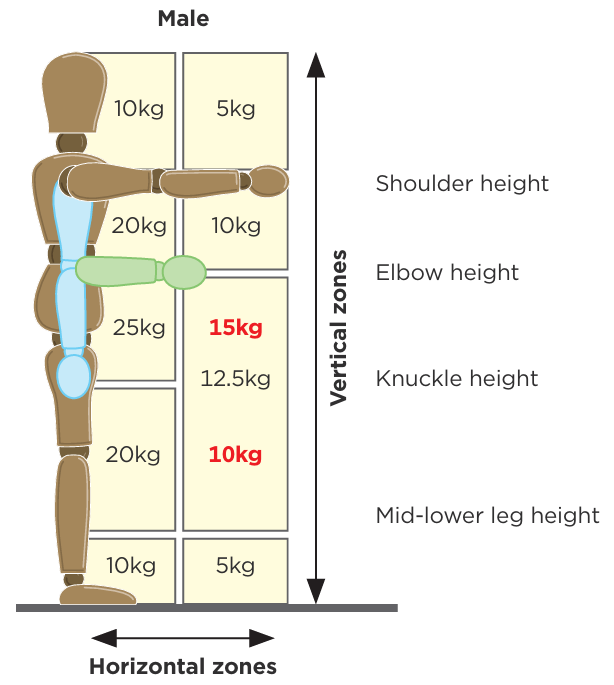
Male values (close to body / away from body): above shoulder 10kg / 5kg; shoulder to elbow 20kg / 10kg; elbow to knuckle 25kg / 15kg; knuckle to mid-lower leg 20kg / 10kg; below mid-lower leg 10kg / 5kg.
If you need some help to use Figure 1, look at the examples provided after the flowchart.
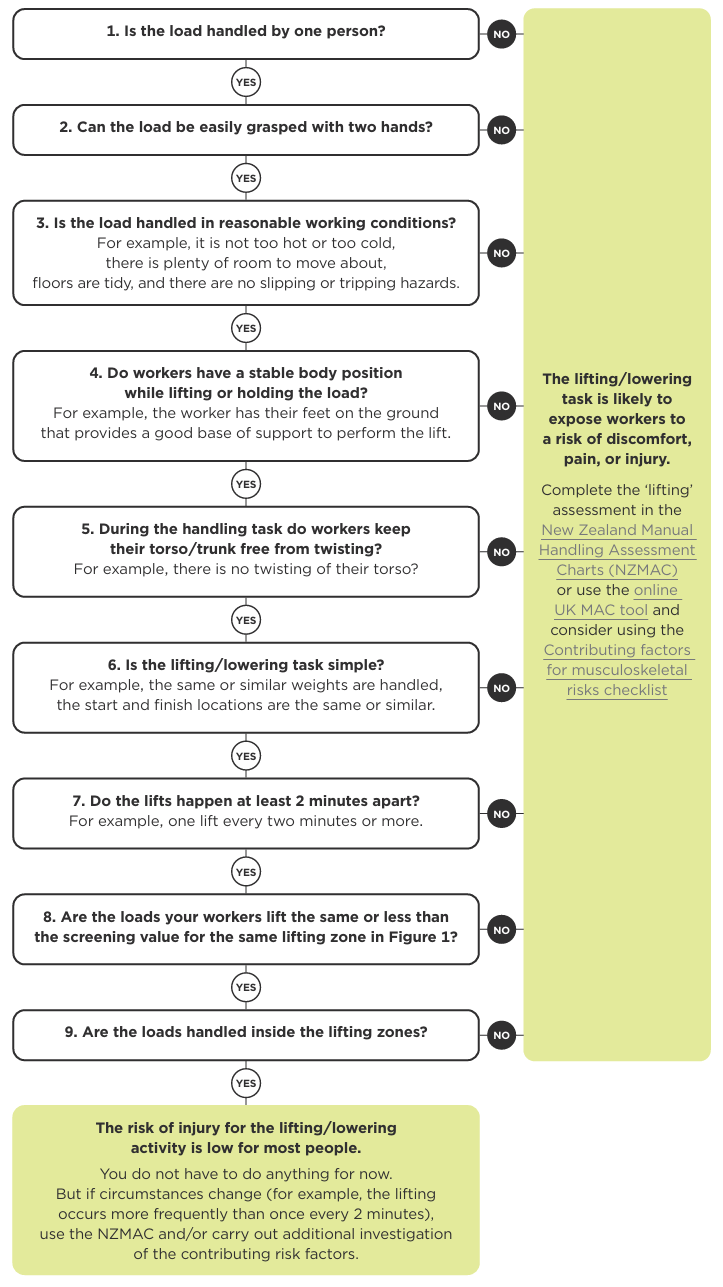
Flowchart 1 has nine sequential yes/no questions:
- Is the load handled by one person?
- Can the load be easily grasped with two hands?
- Is the load handled in reasonable working conditions? (for example, it is not too hot or too cold, there is plenty of room to move about, floors are tidy, and there are no slipping or tripping hazards).
- Do workers have a stable body position while lifting or holding the load? (for example, the worker has their feet on the ground that provides a good base of support to perform the lift).
- During the handling task do workers keep their torso/trunk free from twisting? (for example, there is no twisting of their torso?).
- Is the lifting/lowering task simple? (for example, the same or similar weights are handled, the start and finish locations are the same or similar)
- Do the lifts happen at least 2 minutes apart? (for example, one lift every two minutes or more).
- Are the loads your workers lift the same or less than the screening value for the same lifting zone in Figure 1?
- Are the loads handled inside the lifting zones?
A "no" answer at any question leads to: "The lifting/lowering task is likely to expose workers to a risk of discomfort, pain, or injury. Complete the 'lifting' assessment in the New Zealand Manual Handling Assessment Charts (NZMAC) or use the online UK MAC tool(external link) and consider using the Contributing factors for musculoskeletal risks checklist."
A "yes" answer all the way through leads to: "The risk of injury for the lifting/lowering activity is low for most people. You do not have to do anything for now. But if circumstances change (for example, the lifting occurs more frequently than once every 2 minutes), use the NZMAC and/or carry out additional investigation of the contributing risk factors."
End of text alternative.
If you are unsure if the screening values are being exceeded or loads are handled outside the lifting zones complete the ‘lifting’ assessment in the NZMAC.
Some examples to help you use the screening tool
Look at the following examples to help you understand how to use the tool in different situations.
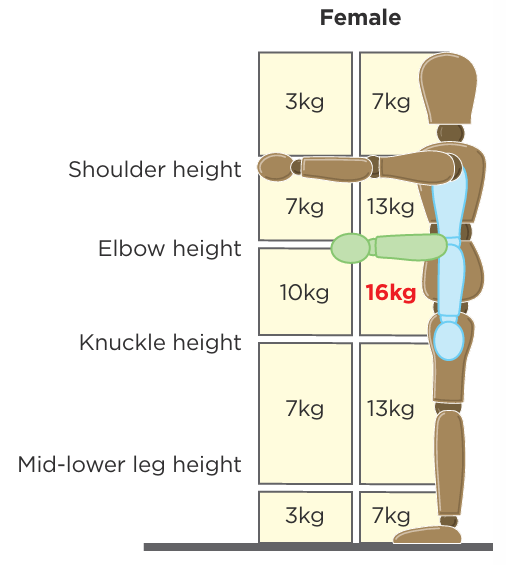
Example 1: Deciding on the screening value
You have a female worker lifting and lowering a load from just above knuckle height to below elbow height (around waist height) with their elbows held close to the body.
Using the tool, you see that most females should be OK to lift/lower a 16kg or less load when it is held close to the body.
But if your female workers are lifting loads greater than 16kg in this posture they may be at increased risk of injury, so you should complete a more detailed risk assessment.
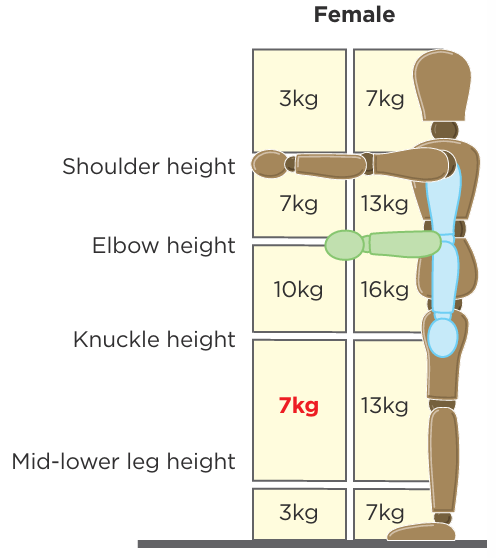
Example 2: The load weight reduces as it is held away from the body with arms outstretched or, at high or low levels
This is because there is a greater risk of developing discomfort, pain, or injury when lifting or lowering in these postures.
You have a female worker who is lifting and lowering loads at around knee height with their arms outstretched away from their body.
The screening value for this task is 7kg.
Using the tool, you see that most females should be OK to lift/lower 7kg or less.
But if your female workers are lifting loads greater than 7kg in this posture they may be at increased risk of injury, so you should complete a more detailed risk assessment.
Example 3: The load is being moved through different zones
You have a female worker who lifts a load off a workbench where the load is held close to their body. The screening value in this zone is 16kg.
But they lower the load onto the ground with their arms outstretched away from their body. The screening value in this zone is 3kg.
The lifting screening value is 16kg but is only 3kg for the lowering task. You need to select the lowest screening value (3kg).
Using the tool, you see that most females should be OK when lifting/lowering a 3kg or less load to ground level with the arms held away from the body.
If your female workers are lifting loads greater than 3kg in this posture they may be at increased risk of injury, so you should complete a more detailed risk assessment.
Example 4: The load is being moved through different zones
Use the smallest screening value if the workers hands pass through more than one lifting zone.
You have a male worker lifting a load from just above knuckle height to nose height with the arms extended away from the body.
Using the tool, you see that there are different screening values from moving the load between:
- knuckles to elbow (15kg)
- elbow to shoulder (10kg)
- shoulder to top of head (5kg).
As 5kg is the lowest value, this is the screening value you should use. This means that most males should be OK to lift loads of 5kg or less from knuckle to nose height with the arms extended away from their body.
If your male workers are lifting loads greater than 5kg in this posture they may be at increased risk of injury, so you should complete a more detailed risk assessment.
Example 5: If the workers hands are close to a boundary between zones use an in-between weight
If the load is being moved to or from the boundaries between either the vertical or horizontal zones, you should work out the middle (average) value and use that as the screening value.
You have a male worker that lifts a load from elbow (waist) to knuckle (thigh) height with their arms outstretched.
Using the tool, you see that most males should be OK to lift 15kg loads. But you notice that the lifting ends at the knuckle height boundary, so you also need to consider the screening value for that zone (10kg).
The value between 10kg and 15kg is 12.5kg. This means that most males should be OK to lift 12.5.kg or less loads.
If your male workers are lifting loads greater than 12.5kg in this posture they may be at increased risk of injury, so you should complete a more detailed risk assessment.
Last updated