This tool can help you to identify when a simple carrying task performed by one person is low risk, or, if you need to complete a more detailed risk assessment.
How do you use the screening tool?
Step 1: Consider if you have any vulnerable workers
Some vulnerable workers may be at greater risk of injury. Go straight to the New Zealand Manual Handling Assessment Charts (NZMAC) and/or complete additional investigation of the contributing risk factors if you have workers who:
- are new mothers, or pregnant
- are young workers
- are older workers
- are new to the job or workforce
- have a disability, significant health condition, injury, or are recovering from an injury.
Step 2: Using the carrying screening tool (Flowchart 1)
Watch workers undertaking the carrying activity and answer the questions to see what, if any, action you need to take.
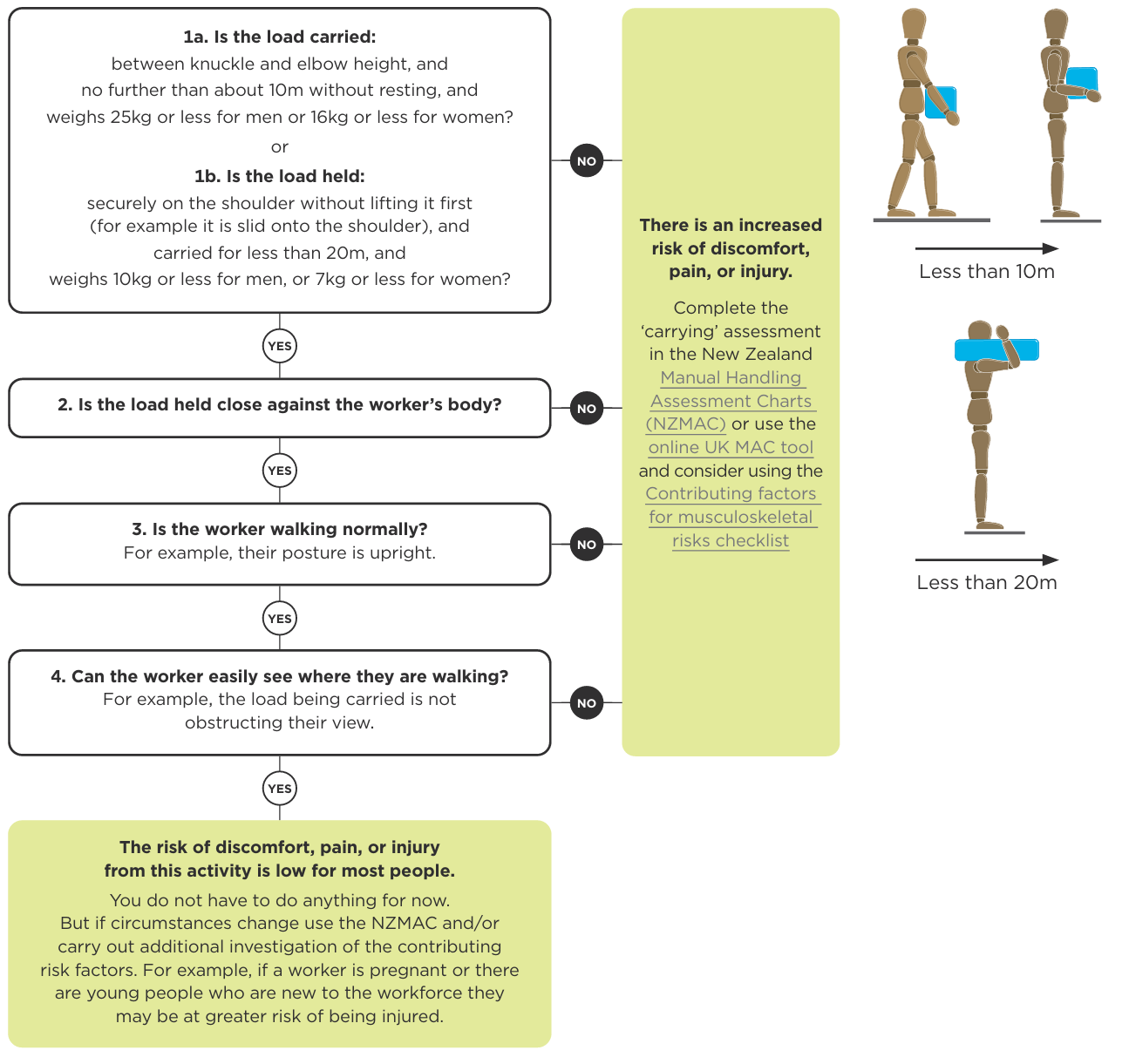
Flowchart 1 shows four sequential yes/no questions for screening a carrying task:
- a: Is the load carried: between knuckle and elbow height, and no further than about 10m without resting, and weighs 25kg or less for men or 16kg or less for women? Or b: Is the load held: securely on the shoulder without lifting it first (for example it is slid onto the shoulder), and carried for less than 20m, and weighs 10kg or less for men, or 7kg or less for women?
- Is the load held close against the worker's body?
- Is the worker walking normally? For example, their posture is upright.
- Can the worker easily see where they are walking? For example, the load being carried is not obstructing their view.
A "no" answer at any question leads to: "There is an increased risk of discomfort, pain, or injury. Complete the 'carrying' assessment in the New Zealand Manual Handling Assessment Charts (NZMAC) or use the online UK MAC tool(external link) and consider using the Contributing factors for musculoskeletal risks checklist."
A "yes" answer all the way through leads to: "The risk of discomfort, pain, or injury from this activity is low for most people. You do not have to do anything for now. But if circumstances change use the NZMAC and/or carry out additional investigation of the contributing risk factors. For example, if a worker is pregnant or there are young people who are new to the workforce they may be at greater risk of being injured."
Alongside the flowchart are two illustrations of a figure carrying a load close to the body while walking, labelled "Less than 10m," and a third illustration of a figure carrying a load on the shoulder while walking, labelled "Less than 20m."
End of text alternative.
If you are unsure if any of the questions apply to the task you are assessing complete the ‘carrying’ assessment in the NZMAC tool.
Last updated