Only use this tool for tasks where workers are seated, and loads are handled using two hands. It will help you to identify if the task is low risk or if you need to complete a more detailed risk assessment.
How do you use the screening tool?
Step 1: Consider if you have any vulnerable workers
Some vulnerable workers may be at greater risk of injury. Go straight to the Contributing factors for musculoskeletal risks checklist and/or use other assessment methods to complete additional investigation if you have workers who:
- are new mothers, or pregnant
- are young workers
- are older workers
- are new to the job or workforce
- have a disability, significant health condition, injury, or are recovering from an injury.
Step 2: Using the manual handling-while-seated screening tool (Flowchart 1)
- Only use this screening tool if workers are handling loads while seated.
- Watch the worker carrying out the handling activity and compare it with the image in the flowchart. Answer the questions to see what, if any, action you need to take.
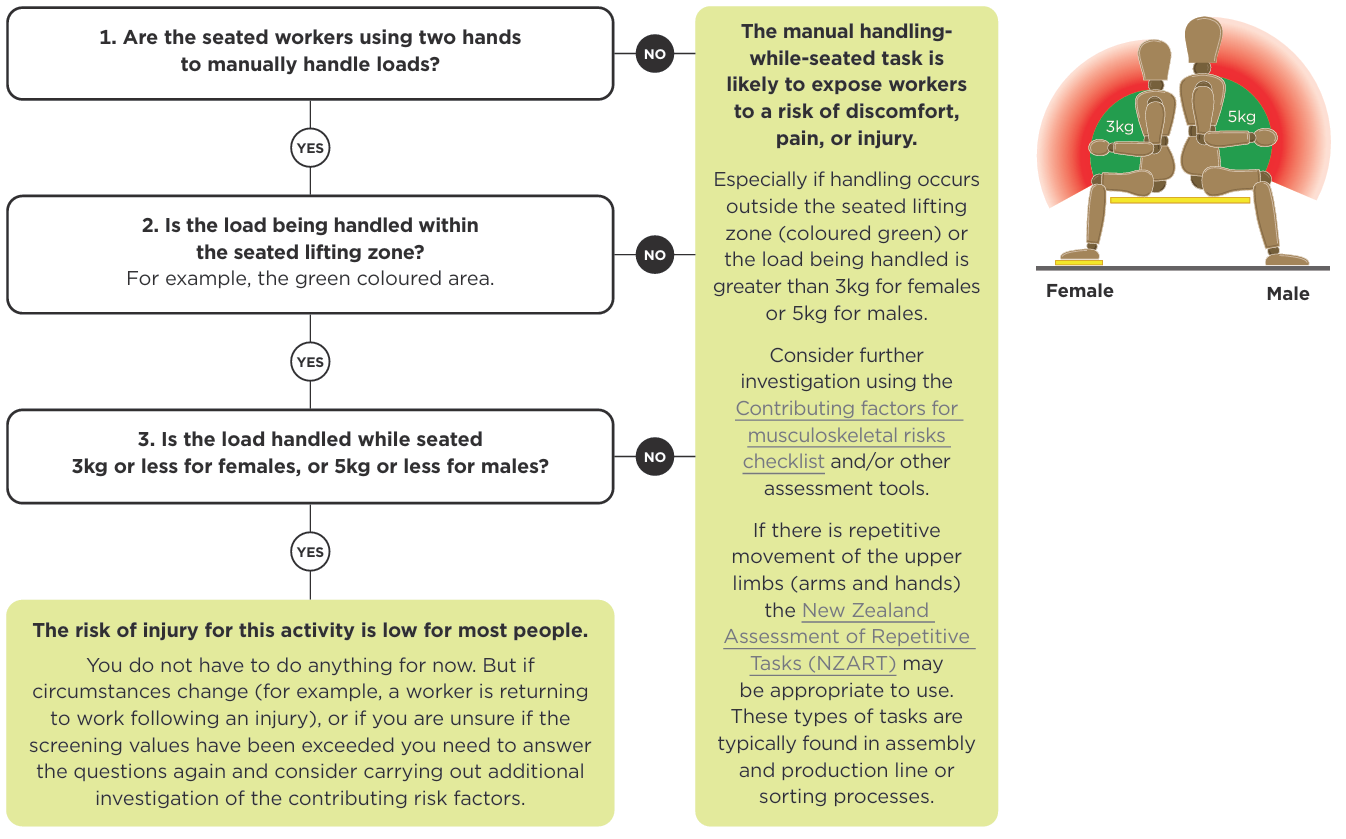
Flowchart 1 shows three sequential yes/no questions for screening a manual handling-while-seated task.
- Are the seated workers using two hands to manually handle loads?
- Is the load being handled within the seated lifting zone? For example, the green coloured area.
- Is the load handled while seated 3kg or less for females, or 5kg or less for males?
A "no" answer at any question leads to: "The manual handling-while-seated task is likely to expose workers to a risk of discomfort, pain, or injury. Especially if handling occurs outside the seated lifting zone (coloured green) or the load being handled is greater than 3kg for females or 5kg for males. Consider further investigation using the Contributing factors for musculoskeletal risks checklist and/or other assessment tools. If there is repetitive movement of the upper limbs (arms and hands) the New Zealand Assessment of Repetitive Tasks (NZART) may be appropriate to use. These types of tasks are typically found in assembly and production line or sorting processes."
A "yes" answer all the way through leads to: "The risk of injury for this activity is low for most people. You do not have to do anything for now. But if circumstances change (for example, a worker is returning to work following an injury), or if you are unsure if the screening values have been exceeded you need to answer the questions again and consider carrying out additional investigation of the contributing risk factors."
Alongside the flowchart are two seated figures, female and male, each shows a green seated lifting zone (above the lap within reach while elbows are tucked) labelled 3kg for the female figure and 5kg for the male figure. Beyond each green zone is a red glow extending out to arms-straight reach.
End of text alternative.
If you are unsure if any of the questions apply to the task you are assessing complete additional investigation of the contributing risk factors.
Remember
The screening values (in Question 3) are not ‘safe load limits’ or acceptable ‘weight limits’. If handling occurs above the screening values, it simply means that you should complete a more detailed risk assessment to understand the risk factors in greater detail.
When handling these loads (or less) in these zones, the risk of injury is low for most people and no further action should be needed.
Last updated