This tool can help you to identify when pushing or pulling activities are low risk, or if you need to complete a more detailed risk assessment.
Pushing or pulling tasks include moving loads on wheeled equipment or moving loads that are slid, rolled, or dragged.
How do you use the screening tool?
Step 1: Consider if you have any vulnerable workers
Some vulnerable workers may be at greater risk of injury. Go straight to the New Zealand Assessment of Pushing and Pulling (NZRAPP) and/or complete additional investigation of the contributing risk factors if you have workers who:
- are new mothers, or pregnant
- are young workers
- are older workers
- are new to the job or workforce
- have a disability, significant health condition, injury, or are recovering from an injury.
Step 2: Using the pushing and pulling screening tool (Flowchart 1)
- Watch the worker carrying out the pushing or pulling activity and compare their postures to the images shown in Flowchart 1.
- Answer the questions to see what, if any, action you need to take.
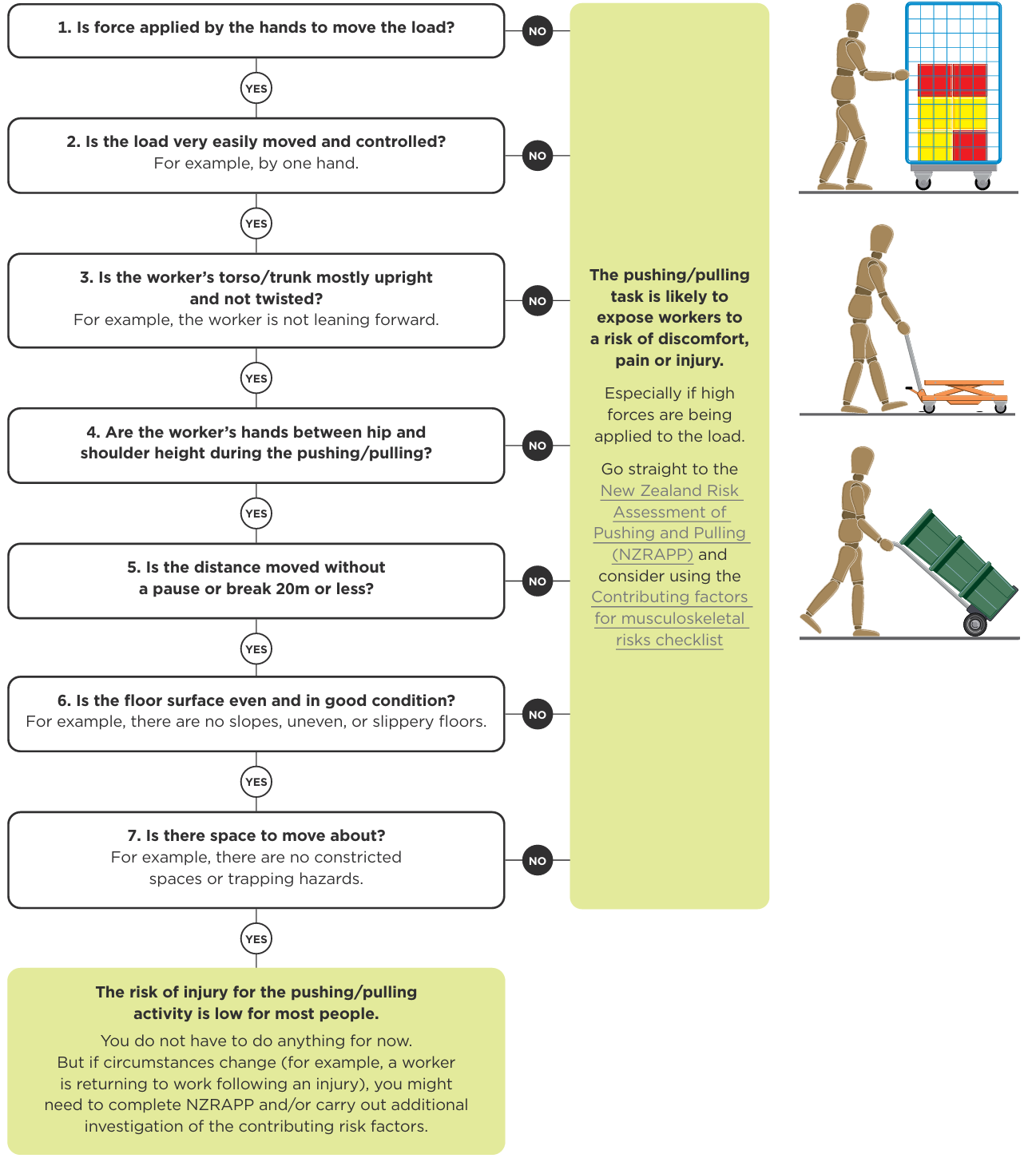
Flowchart 1 shows seven sequential yes/no questions for screening a pushing or pulling task:
- Is force applied by the hands to move the load?
- Is the load very easily moved and controlled? For example, by one hand.
- Is the worker's torso/trunk mostly upright and not twisted? For example, the worker is not leaning forward.
- Are the worker's hands between hip and shoulder height during the pushing/pulling?
- Is the distance moved without a pause or break 20m or less?
- Is the floor surface even and in good condition? For example, there are no slopes, uneven, or slippery floors.
- Is there space to move about? For example, there are no constricted spaces or trapping hazards.
A "no" answer at any question leads to: "The pushing/pulling task is likely to expose workers to a risk of discomfort, pain or injury. Especially if high forces are being applied to the load. Go straight to the New Zealand Risk Assessment of Pushing and Pulling (NZRAPP) and consider using the Contributing factors for musculoskeletal risks checklist."
A "yes" answer all the way through leads to: "The risk of injury for the pushing/pulling activity is low for most people. You do not have to do anything for now. But if circumstances change (for example, a worker is returning to work following an injury), you might need to complete NZRAPP and/or carry out additional investigation of the contributing risk factors."
Alongside the flowchart are three illustrations: a figure pushing a wheeled cage trolley loaded with crates; a figure pulling a wheeled hydraulic lifting trolley by a handle; and a figure pulling a wheeled hand trolley loaded with bins.
End of text alternative.
If you are unsure if any of the questions apply to the task you are assessing complete NZRAPP.
Last updated