Screening tools to help businesses to manage risks from lifting, lowering, carrying, pushing, pulling, and handling loads while seated.
Businesses must eliminate or minimise risks from the work they do.
This includes risks from hazardous manual tasks such as lifting and lowering, pushing and pulling, carrying, and manual handling loads while seated.
It is important to remember that the law does not set specific weight limits for lifting, carrying, pushing, pulling and seated handling tasks.
It is estimated that work-related musculoskeletal disorders, such as sprains and strains, make up over 30% of all workplace harm. So, it is important that businesses can identify the risks from these types of tasks.
The screening tools
Screening tools help you to quickly identify low-risk tasks and to decide when you should complete a more detailed risk assessment. There are four different screening tools. Select the tool or tools that match the work activity:
- lifting and lowering
- carrying
- pushing and pulling
- manual handling-while-seated.
Remember that the weights shown in these tools are not specific weight limits and should not be considered as 'safe load limits'. The tools tell you when workers could be harmed and when you should carry out a detailed risk assessment.
What to know about these tools
The screening tools have been adapted from the United Kingdom where they are called Simple manual handling risk filters.1,2 Before using the tools, you should note that they are based on some broad assumptions:
- They are based on population data which show there are differences between males and females' lifting capacity. But some workers may have higher or lower capacity.
- The risk of injury is considered low for most workers when the loads handled fall within or below the screening values or conditions.
- Work above the screening values or conditions exposes workers to risk of discomfort, pain, or injury, and a more detailed assessment should be completed.
- Some vulnerable workers may be at greater risk of injury. Go straight to either the New Zealand Manual Handling Assessment Charts (NZMAC) or Risk Assessment of Pushing and Pulling (RAPP) and/or complete additional investigation of the contributing risk factors if you have workers who:
- are new mothers, or pregnant
- are young workers
- are older workers
- are new to the job or workforce
- have a disability, significant health condition, injury, or are recovering from an injury.
If you are unsure that the task is low risk (meets the screening criteria) go straight to the New Zealand Manual Handling Assessment Charts (NZMAC) or for pushing and pulling tasks go to the Risk Assessment of Pushing and Pulling (RAPP) tool. You may also need to complete additional investigation of the contributing risk factors.
Depending on how complex the job or task you are looking at is, you may need help from a specialist such as an ergonomist/human factors professional. To find someone qualified you can use the HASANZ Register(external link)
They should be able to help you with the assessment process and to identify controls. There are many other risk assessment methods that may also be used.
1 Health and Safety Executive, (2016). Manual handling operations regulations 1992. L23 (fourth edition). www.hse.gov.uk/pubns/books/l23.htm(external link)
2 Health and Safety Executive, Simple manual handling risk filters. www.hse.gov.uk/msd/manual-handling-risk-filters.htm(external link)
Deciding which tool to use
Flowchart 1 will help you decide which screening or risk assessment tools you can use when assessing different tasks.
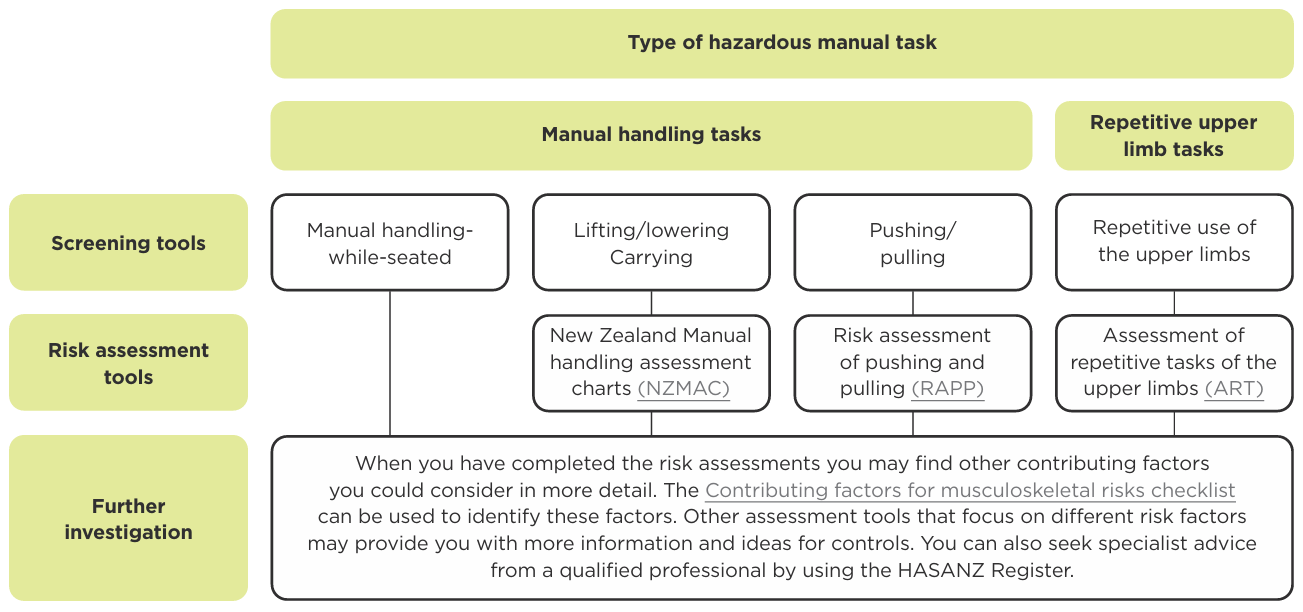
Flowchart 1 shows types of hazardous manual task, grouped into manual handling tasks and repetitive upper limb tasks. The first row shows five screening tools, which each (apart from the first one) flow down to a risk assessment tool:
- Manual handling-while-seated (no risk assessment tool)
- Lifting/lowering, carrying: New Zealand Manual handling assessment charts (NZMAC)
- Pushing/pulling: Risk assessment of pushing and pulling (RAPP)
- Repetitive use of the upper limbs: Assessment of repetitive tasks of the upper limbs (ART)
Each of these flow down to information about further investigation: when you have completed the risk assessments you may find other contributing factors you could consider in more detail. The Contributing factors for musculoskeletal risks checklist can be used to identify these factors. Other assessment tools that focus on different risk factors may provide you with more information and ideas for controls. You can also seek specialist advice from a qualified professional by using the HASANZ Register.
End of text alternative.
Last updated