Message from Sharon Thompson, Chief Executive, WorkSafe New Zealand
At WorkSafe, we’re committed to leading the way in creating an inclusive workplace where everyone feels valued, respected, and safe. We want to build a positive and inclusive workplace culture because how people feel at work shapes how they show up every day. As New Zealand’s health and safety regulator, we take that responsibility seriously.
In this next phase of our diversity, equity, inclusion, and belonging (DEIB) work, we’re making a clear commitment to accessibility and inclusion for disabled and neurodivergent people. This means embedding accessibility into everything we do and ensuring our workplaces are physically and psychologically safe for all.
DEIB is work we all contribute to. Every one of us has a part to play, now and into the future. Together we will strengthen WorkSafe as an organisation where everyone can thrive.
Ngā mihi nui,
Sharon Thompson
Chief Executive, WorkSafe New Zealand
Download document
Our vision
Everyone who goes to work comes home healthy and safe. Achieving this requires a workplace culture where we value diverse perspectives and work to create an environment where everyone feels they belong.
When people feel they belong, they’re more likely to speak up about safety concerns, share diverse perspectives on risk and feel accountable for looking after each other to create safer communities across Aotearoa.
We are guided by our mātāpono (values)
Whakakotahi
We’re united in a strong purpose
Tiakina mai
We’re entrusted with a duty of care
Kōrero mai
We engage meaningfully
Our approach
WorkSafe’s diversity, equity, inclusion and belonging approach 2026–2029
Accessibility and inclusion is the foundation of our refreshed approach. We’re committed to creating environments where everyone can fully participate, by removing barriers and embedding accommodations as a normal part of everyday practice.
We’re focusing on the areas that matter most to our people and our communities. These focus areas reflect what we’ve learned from our journey so far, and the voices of our kaimahi. They’re practical steps to make diversity, equity, and inclusion part of everyday work, so everyone feels valued, supported, and able to thrive.
This is an on-going journey, and together, small actions we take today will influence how we shape our future.
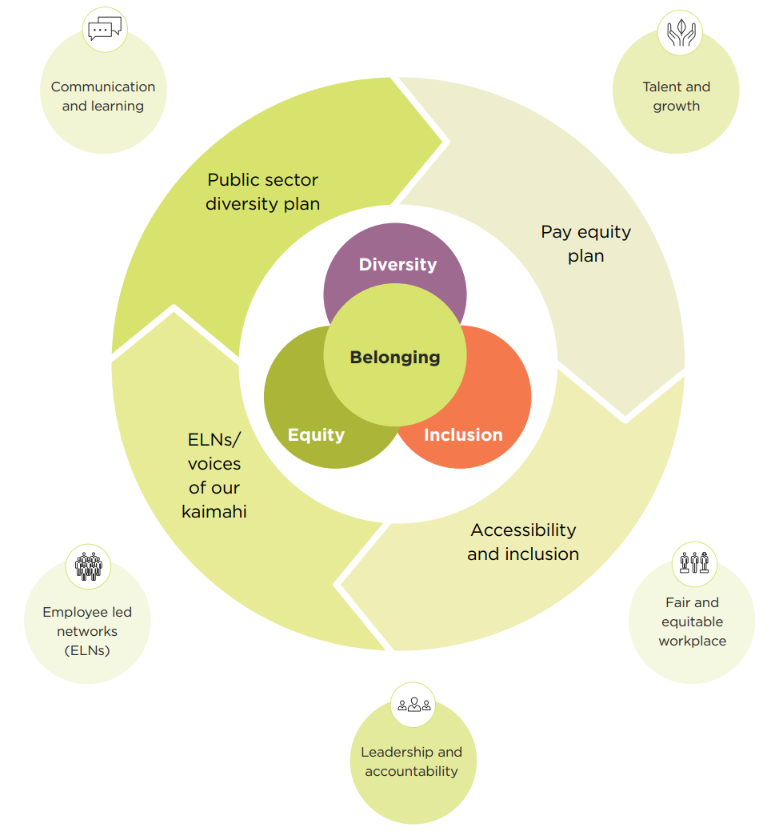
The image shows our approach to diversity, equity, inclusion, and belonging – we have placed belonging at the heart of what we do:
- Public sector diversity plan
- Pay equity plan
- Accessibility and inclusion
- Employee-led networks (ELNs) / voices of our kaimahi
These form part of our focus areas:
- communication and learning
- talent and growth
- a fair and equitable workplace
- leadership and accountability
- employee-led networks.
End of text alternative.
Our action plan
Our focus area – fair and equitable workplaces
| 2026 | 2027 | 2028 |
|---|---|---|
| Conduct regular pay gap analysis and address any disparities ensuring fair and equitable outcomes | Promote tools and resources so people feel confident to speak up and share concerns early, fostering a culture of trust and psychological safety | Complete full Accessibility Tick assessment for certification to demonstrate our commitment to creating an accessible and inclusive workplace for all |
| Implement Pay Equity Action Plan and ensure we are tracking against our actions | ||
| Implement Accessibility Tick recommendations to create a workplace that is accessible and inclusive |
Our focus area – inclusive leadership and accountability
| 2026 | 2027 | 2028 |
|---|---|---|
| Implement a DEIB measurement and reporting framework to track progress, inform decisions and drive lasting culture change | Include DEIB objectives into kaimahi and people leaders’ individual performance plans to embed inclusion into everyday practice | Ensure DEIB progress is tracked and reported regularly to inform decisions and create lasting cultural change |
| Include DEIB discussion points to ELT meetings and forums to ensure leadership accountability | ||
| Senior leaders (levels 2 –3) to support our ELNs by becoming a sponsor of their network to strengthen visibility, influence and inclusion across WorkSafe |
Our focus area – supporting employee led networks (ELNs)
| 2026 | 2027 | 2028 |
|---|---|---|
| Continue to support the establishment and growth of ELNs to become self-sustainable | Position the DEIB Rōpū (ELN leads) as trusted advisors for organisational decisions, ensuring their expertise shapes inclusive policies and practices | Ensure ELNs are sustainable and that inclusion and collaboration with ELNs becomes standard practice |
| Implement Accessibility Tick recommendations to create a workplace that is accessible and inclusive | ||
| Foster collaboration opportunities across ELNs to deliver more intersectional initiatives organisationally and across the sector |
Our focus area – talent and growth
| 2026 | 2027 | 2028 |
|---|---|---|
| Implement Accessibility Tick recommendations to create a workplace that is accessible and inclusive | Pilot anonymous shortlisting and structured interviews to ensure the interview and selection process is fair, transparent, and provides equal opportunity for all candidates | Track and celebrate participation of coaching, mentoring and tuakana-teina (two-way learning) |
| Identify secondment opportunities and encourage people to consider development opportunities outside their current role | Show clear leadership pathways through our talent and succession practices and improve representation of underrepresented groups in leadership roles | |
| Gather feedback from underrepresented groups and use it to improve what we offer as an employer and our engagement score |
Our focus area – inclusion through communications and learning
| 2026 | 2027 | 2028 |
|---|---|---|
| Increase visibility of our DEIB efforts and initiatives internally and externally to demonstrate our commitment | Ensure our comms, marketing and learning reflects our DEIB commitment to demonstrate inclusion and build trust. | Ensure plain, inclusive and accessible language checks are part of BAU |
| Review current DEIB learning and agree what our essential learning offerings are | Develop quick reference guides for all things DEIB to give all kaimahi and people leaders easy access to inclusive practices and support everyday decision-making | |
| Make unconscious bias / inclusive recruitment training mandatory for hiring managers to ensure fair, transparent, and equitable hiring practices |
Last updated