To clarify requirements for managing ethanol water dilutions.
Ethanol-water dilutions intended for drinking (EWD) are either a class 3.1B or 3.1C depending on the concentration of ethanol. This means that sites where these are manufactured and stored may be covered by the Health and Safety at Work (Hazardous Substances) Regulations 2017 (the HS Regulations).
Full compliance with the HS Regulations is required unless the EWD:
- is covered by the exclusion in regulation 1.9(1), or
- meets the requirements for alternative compliance in regulation 1.9(3).
What is considered an EWD?
For the purposes of applying regulation 1.9:
- ethanol dilutions that are being processed to make alcoholic beverages as well as the final alcoholic beverage are considered as EWDs.
- ethanol that is purchased (typically as a 96% solution) and before being processed or diluted is not an EWD.*
*Ethanol that is not considered an EWD does not need to be at a hazardous substance location and does not require certification if it is stored for 24 hours or less.
Exclusion
Regulation 1.9(1) provides that the HS Regulations do not apply to EWD that meets either of the following requirements:
- the EWD is in containers with a capacity of 5 L or less, or
- the EWD has an ethanol concentration of not more than 15% by volume.
Alternative requirements
Regulation 1.9(3) provides alternative requirements for EWD if the EWD is contained and stored as follows:
- the substance is stored in containers at premises used for storing or handling (including processing) EWD, and
- the containers are constructed in accordance with sections F4.1-F4.5 and F4.7 of Appendix F of AS 1940:2017, and
- the areas at the premises where the EWD is stored or handled (including processing):
- complies with section F8 of Appendix F of AS 1940:2017, and
- is equipped with vapour detectors.
If the above criteria are met, the following parts of the HS Regulations do not apply to the EWD:
- HS regulation 8.1 (requirement for a location compliance certificate)
- HS regulation 8.3 (restriction for carriage on public transport)
- Part 10 of the HS Regulations (controls for class 2, 3 and 4 substances)
- Part 11 of the HS Regulations (controls relating to adverse effects of unintended ignition for class 2 and 3.1 substances)
- Part 17 of the HS Regulations (stationary container systems).
Further to the above
Regulations 22 and 23 of the Health and Safety (General Risk and Workplace Management) Regulations 2016 (the GRWM Regulations) requires the management of risks associated with an atmosphere with potential for fire or explosion, and the risks associated with ignition sources. Such risks must be managed in accordance with regulations 5 to 8 of the GRWM Regulations. Examples of effective control measures could include:
- the area can be managed by designating hazardous areas with appropriate protected plant and equipment installed in the zoned areas to prevent unintended ignition. The New Zealand standard for establishing hazardous areas is AS/NZS 60079.10.1:2022 and/or
- managing vapour concentration in the atmosphere by providing adequate ventilation.
Ethanol water dilutions that do not meet regulation 1.9
If regulation 1.9 does not apply to the EWD, depending on the quantity held, the relevant requirements of the HS Regulations must be complied with. For example:
- Part 2 labelling, signage packaging
- Part 3 Inventory and risk management
- Part 4 Training and supervision
- Part 5 Fire extinguishers and emergency response plans
- securing substances from unauthorised access
- segregation of class 3 substances from class 2, 4 and 5 substances
- designation of hazardous areas, installation and maintenance of appropriate protected equipment
- providing secondary containment
- Part 17 of the HS Regulations when stored in a stationary tank or process container and certification where relevant
- establishing a hazardous substance location and obtaining a location compliance certificate
- separation distances for tanks, and stores
- requirements for flammable liquid stores and cabinets
- workroom requirements for open packages or containers, or when the EWD is being used.
For small quantities of class 3.1 substances that are used in a building at any one time (no more than 60 L of class 3.1A and 3.1B substances in aggregate, or 250 L of class 3.1C substances) the provisions of regulations 11.17(5) or 11.37(5) may apply and a workroom would not be required.
HS regulation 1.9 – Ethanol-water dilutions
(regulatory applicability flowchart)
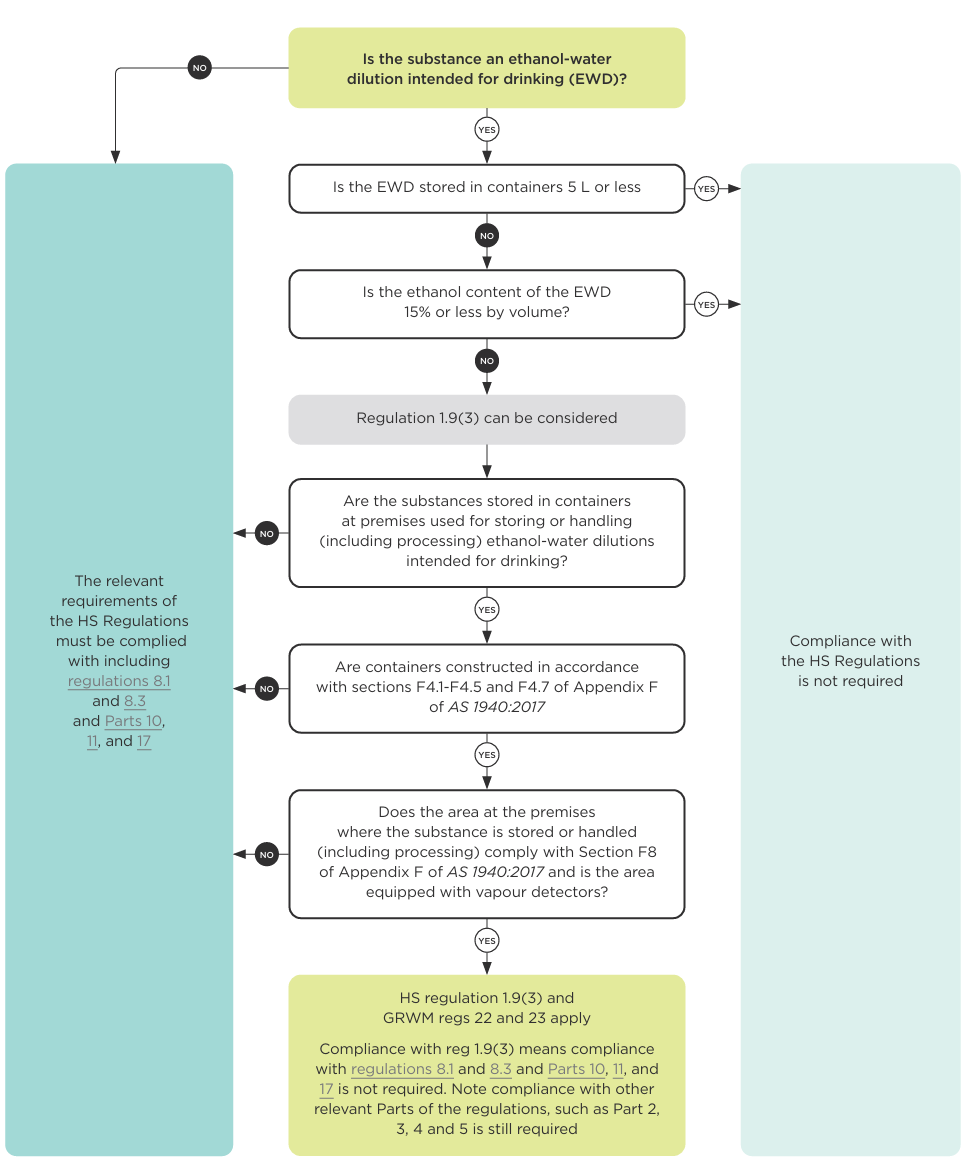
Is the substance an ethanol-water dilution intended for drinking (EWD)?
- If no: The relevant requirements of the HS Regulations must be complied with including regulations 8.1(external link) and 8.3(external link) and Parts 10(external link), 11(external link), and 17(external link)
- If yes: go to next question.
Is the EWD stored in containers 5 L or less?
- If yes: Compliance with the HS Regulations is not required.
- If no: Go to next question
Is the ethanol content of the EWD 15% or less by volume?
- If yes: Compliance with the HS Regulations is not required.
- If no: Regulation 1.9(3) can be considered. Go to next question.
Are the substances stored in containers at premises used for storing or handling (including processing) ethanol-water dilutions intended for drinking?
- If no: The relevant requirements of the HS Regulations must be complied with including regulations 8.1(external link) and 8.3(external link) and Parts 10(external link), 11(external link), and 17(external link)
- If yes: Go to next question.
Are containers constructed in accordance with sections F4.1-F4.5 and F4.7 of Appendix F of AS 1940:2017?
- If no: The relevant requirements of the HS Regulations must be complied with including regulations 8.1(external link) and 8.3(external link) and Parts 10(external link), 11(external link), and 17(external link)
- If yes: Go to next question.
Does the area at the premises where the substance is stored or handled (including processing) comply with Section F8 of Appendix F of AS 1940:2017 and is the area equipped with vapour detectors?
- If no: The relevant requirements of the HS Regulations must be complied with including regulations 8.1(external link) and 8.3(external link) and Parts 10(external link), 11(external link), and 17(external link)
- If yes: HS regulation 1.9(3) and GRWM regs 22 and 23 apply.
Compliance with reg 1.9(3) means compliance with regulations 8.1(external link) and 8.3(external link) and Parts 10(external link), 11(external link), and 17(external link) is not required. Note compliance with other relevant Parts of the regulations, such as Part 2, 3, 4 and 5 is still required.
Last updated