This guidance helps businesses and organisations understand their obligations and good practice when using tertiary containment systems to contain pooling substances.
Download:
Key points
- You must manage the risks of hazardous substances in your workplace.
- Based on your assessed risks, a tertiary containment system can contribute to managing risks of pooling substances at your workplace if secondary containment fails.
- If a tertiary containment system is installed, the risks to the health and safety of people from any plant or structure must be eliminated or minimised.
- Through a whole-of-workplace approach, tertiary containment systems can make a meaningful difference to emergency management.
Note to readers
Words that show what is law and what is good practice
This guidance uses different words to show you what is required by law, and what is good practice.
| Term | Definition |
|---|---|
| Must |
This shows a legal requirement that you must meet. Example: You must manage the risks of hazardous substances in your workplace. |
| Should, could, can, and may |
These words indicate an approach that is good practice. Example: If your secondary containment system is at risk of being overwhelmed, you can install a tertiary containment system. |
| You |
‘You’ refers to the person conducting a business or undertaking (PCBU). In some regulations, this is called a relevant PCBU or, for major hazard facilities, the operator. We use the regulatory term where it appears in the regulations. |
Key terms
The glossary at the back of this guidance lists the technical words and terms used, and explains what they mean.
Lists
Lists of examples are not exhaustive. They show some options, but not all.
Images
Images are a guide only. They are not technical specifications.
Audience
WorkSafe New Zealand recognises that a wide range of people will use this guidance. The language and content communicate good practice to a broad audience. More specialised content is managed through communications such as technical bulletins.
Contact
If you have technical questions or suggestions for improvements to this guidance, call us on 0800 030 040.
1.0 Purpose
The Health and Safety at Work Act 2015(external link) (HSWA) provides a balanced framework for managing health and safety risks in workplaces.
For more information on HSWA, see WorkSafe’s guidance Introduction to the Health and Safety at Work Act 2015 – special guide
HSWA sets duties. Regulations made under HSWA specify minimum enforceable requirements.
This guidance provides information about the risks of hazardous substances in the workplace. It focuses on:
- hazardous substances that can pool or flow
- tertiary containment systems that can be used to contain these hazardous substances if they escape from a secondary containment system.
This guidance also provides information on the risk management of contaminated firefighting run-off under emergency management conditions.
This guidance is for:
- PCBUs who store, or intend to store, class 3, 4, 5.1.1, 5.2, 6 and 8 hazardous substances in above ground stationary tanks
- PCBUs who store, or intend to store, class 9.1A, 9.1B, 9.1C or 9.1D hazardous substances in above ground stationary tanks
- operators of major hazard facilities (MHFs) who store, or intend to store, those substances in above ground stationary tanks
- operators of onshore petroleum and oil storage facilities who store, or intend to store, those substances in above ground stationary tanks may find this guidance useful – however, those operators should refer to the Health and Safety at Work (Petroleum Exploration and Extraction) Regulations 2016(external link) in the first instance
- compliance certifiers
- PCBUs who design, construct, install, upgrade, operate, maintain or test secondary containment systems for above ground stationary tanks.
This guidance is not a substitute for the Health and Safety at Work Act 2015 or its regulations. It should not be read as creating new legal obligations. You must meet your duties under HSWA and comply with the applicable regulations.
This guidance should be read alongside the following WorkSafe guidance:
2.0 Out of scope
This guidance does not cover:
Laboratories
- These facilities may have other regulations and generally use smaller amounts of hazardous substances.
- For more information, see Laboratories
New Zealand Defence Force (NZDF)
- NZDF may find this guidance useful.
- Refer to NZDF guidance in the first instance.
Containment systems within a building
- These have different risks and controls.
Containment systems for surface containers
- That are above ground containers and not covered by part 17, subpart 18, of the Health and Safety at Work (Hazardous Substances) Regulations 2017(external link)
Retail service stations
- Retail service station operators may find this guidance useful where pooling substances are stored in above ground stationary tanks.
- For more information, see Service stations
Farms
- Farm operators may find this guidance useful.
- For more information, see Above ground fuel storage on farms
Not all hazardous substances require secondary containment systems. This guidance explains when they are required.
3.0 Introduction
You must manage the risks of hazardous substances in your workplace. Tertiary containment systems manage certain risks by retaining pooling substances.
For example, a tertiary containment system can help prevent issues when:
- a pooling substance leaks or overflows from the secondary containment system
- the secondary containment system is at risk of being overwhelmed in an emergency.
The Health and Safety at Work (Hazardous Substances) Regulations 2017 (Hazardous Substances Regulations) have no minimum requirements for tertiary containment systems. These systems are installed where your risk assessment shows that a tertiary containment system is a suitable control measure.
3.1 The legislative framework
Act and regulations
This guidance provides information about duties under the Health and Safety at Work Act 2015(external link) (HSWA). HSWA provides a balanced framework to secure the health and safety of workers and workplaces. For more information on HSWA, see Introduction to the Health and Safety at Work Act 2015 – special guide
HSWA sets out health and safety duties, while regulations made under HSWA set specific requirements to support those duties. The regulations include the Hazardous Substances Regulations.
Additional duties may apply for designated major hazard facilities (MHFs) under the Health and Safety at Work (Major Hazard Facilities) Regulations 2016(external link) (MHF Regulations). MHFs should read this information alongside the requirements of those regulations, including:
- requirements for notification and designation
- identification and control of major incident hazards
- documented safety assessments
- a major accident prevention policy or safety case
- enhanced emergency planning, for example MHFs must meet Schedule 3(external link) content requirements in regulation 31(external link)
- strengthened worker engagement and participation.
Other instruments
Environmental Protection Authority
Hazardous substances are defined in regulation 4(external link) of the Hazardous Substances Regulations.
The Environmental Protection Authority (EPA) assesses hazardous substances under the Hazardous Substances and New Organisms Act 1996(external link) (HSNO) and is responsible for issuing approvals.
As a part of this approval process, controls are put in place to make sure the risks of using the substance are appropriately managed. These controls are listed on the approval document or in a group standard. For more information about how the EPA carries out risk assessments and grants approvals, see the EPA website Hazardous substances(external link)
The EPA has also published the EPA Notices. These provide a set of standard rules that must be followed when importing, manufacturing and using all hazardous substances. The most relevant notice for these guidelines is the Hazardous Substances (Hazardous Property Controls) Notice 2017 (the HPC Notice). However, the other Notices must also be complied with. The HPC Notices can be downloaded from EPA notices for hazardous substances(external link)
An individual approval or group standard can vary the controls provided for in the EPA Notices. When looking at using a substance, check all the rules that apply to ensure you meet all relevant obligations.
For more information about ecotoxic substances, see EPA’s guidance Ecotoxic substances guidance for business(external link)
Building and resource consents
Tertiary containment systems include compounds that are built structures and intended to be permanent. You may also have legal obligations under other legislation. Your local territorial authority can provide information about other legal obligations.
3.2 What is a pooling substance?
A pooling substance is defined in regulation 3(1)(external link) of the Hazardous Substances Regulations as any hazardous substance that is:
- a liquid, or
- likely to liquefy in a fire.
If you store or use class 3, 4, 5.1.1, 5.2, 6 and/or 8 hazardous substances in your workplace, you should check to see if the substance meets the definition of a pooling substance. You should do this even if the substances are solid, gel, emulsion or gas in their normal state.
If a hazardous substance meets the definition of a pooling substance, you must assess that substance for any secondary containment requirements under part 17 subpart 18(external link) of the Hazardous Substances Regulations.
A note on class 9 substances
Certain class 9 substances are subject to secondary containment when in workplaces. If you have class 9.1A, 9.1B, 9.1C and/or 9.1D substances in your workplace, you should check to see if the substance meets the definition of a pooling substance.
The substance must meet the requirements of part 17 subpart 18(external link) of the Hazardous Substance Regulations if it is:
- a pooling substance, and
- meets the threshold in table 9(external link) of the Hazardous Substances Regulations.
3.3 What if my hazardous substance can pool with no fire present?
Some hazardous substances can change their state, liquify, and pool when they are not ‘in a fire’. They may do this when subjected to:
- elevated process or operating temperatures
- loss or failure of cooling systems
- radiant heat from nearby plant, equipment or operations
- abnormal but foreseeable operating or emergency conditions
- decomposition or exothermic reactions that generate heat.
Under regulation 3.2(external link) of the Hazardous Substances Regulations, you must manage the risks of these substances. Control measures may include the installation of a secondary containment system for the substance.
For major hazard facilities, part 4(external link) of the Major Hazard Facilities Regulations manages substances that may liquify and pool when they are not in a fire. Upper tier and lower tier facilities have separate requirements.
3.4 What is a tertiary containment system?
A tertiary containment system is a system of engineering control measures. In relation to health and safety, a control measure means a measure to eliminate or minimise a risk.
An engineering control measure is physical, and it includes mechanical devices or processes.
A tertiary containment system can contain either:
- pooling substances, or
- firefighting run-off from the secondary containment system.
A tertiary containment system may be needed if the secondary containment system:
- is damaged – for example, in an earthquake, by a collision, or during foundation settlement
- supports multiple tanks and could be overwhelmed by a multi-tank failure
- is involved in a fire emergency and could be overwhelmed by contaminated firefighting run-off
- is overwhelmed by stormwater in an extreme weather event.
If activated early, a tertiary containment system may prevent the secondary containment system being overwhelmed.
A tertiary containment system may include a mixture of engineering control measures, such as:
- compounds
- storage tanks
- pipework
- drains
- interceptors
- pumps
- hard-paved areas
- judder bars
- nib walls.
These engineering control measures can work together to contain pooling substances or run-off.
The Hazardous Substances Regulations do not contain prescribed minimum requirements for tertiary containment systems. The design and installation of the system is based on your assessed risks.
3.5 What tertiary containment systems do
Containment systems manage pooling substances as three lines of defence (Figure 1). Tertiary containment is a third line of defence. It is additional to secondary containment capacity. Tertiary containment is not used to demonstrate compliance with mandatory secondary containment capacity.
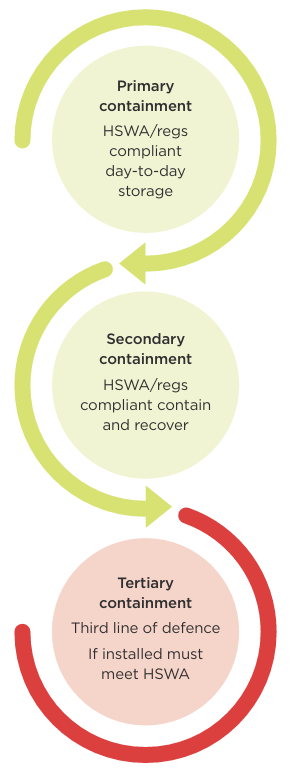
Primary containers
Above ground stationary tanks are:
- fixed to or resting on the ground, or
- fixed or attached to a structure that is fixed to or resting on the ground.
Above ground stationary tanks must meet the minimum requirements of the Hazardous Substances Regulations, including the specified design standards in part 17(external link)
A secondary containment system may have more than one above ground stationary tank.
You must install a secondary containment system for your above ground stationary tanks where required by the Hazardous Substances Regulations.
Secondary containment systems
In relation to a workplace, secondary containment system is a system:
- in which pooling substances will be contained if they escape from their primary container, and
- from which a pooling substance can (unless waste is unavoidable) be recovered.
Where waste is unavoidable, disposal of the unrecoverable material must comply with the Hazardous Substances (Disposal) Notice 2017(external link)
The Hazardous Substances Regulations have minimum requirements for secondary containment systems when certain thresholds are met. Thresholds and minimum requirements are in part 17 subpart 18(external link) of the regulations.
The class specific regulations include:
- regulation 10.30(external link) – applies to class 3 and class 4 pooling substances
- regulation 12.13(external link) – applies to class 5.1.1 pooling substances
- regulation 12.38(external link) – applies to class 5.2 pooling substances
- regulation 13.30(external link) – applies to class 6 and 8 pooling substances.
If it is reasonably foreseeable that your secondary containment system could be overwhelmed or fail, a tertiary containment system may help you to manage that risk.
Whole-of-workplace approach
Together primary, secondary and tertiary containment can give you whole-of-workplace approach to risk management of pooling substances (Figure 2).
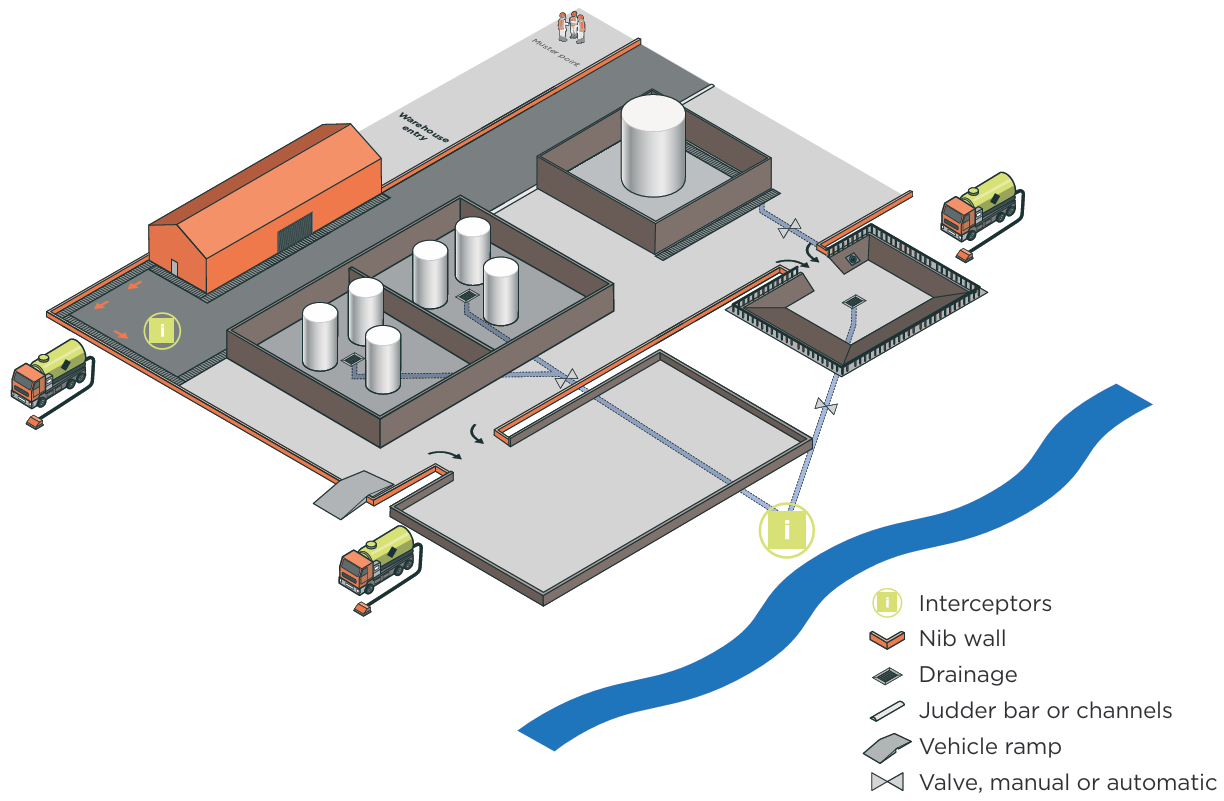
If multiple tanks fail, other impacts such as surge, heave, volumes of firefighting water and foam, as well as debris can overwhelm even the most robust secondary containment system.
Through careful risk assessment and a whole-of-workplace approach, tertiary containment systems can make a meaningful difference to:
- emergency management (see Section 9.0)
- risk minimisation
- the health and safety of workers
- the community
- the environment.
For more information on a whole-of-workplace approach to containment of hazardous substances, see Appendix 1: Containment – Whole-of-workplace approach
3.6 How worker is defined
Section 19 of HSWA defines a worker as an individual who carries out work for you, in any capacity.
This includes:
- employees, contractors, subcontractors, or labour hire companies and their employees, when they are carrying out work for you
- outworkers (including homeworkers), apprentices, trainees and interns, and volunteer workers (working, but unpaid)
- individuals who are in a trial period of work, on secondment, or are with you to gain work experience
- any other person specifically included and referred to in health and safety regulations (other prescribed persons).
If an individual is doing work for you in any capacity, paid or unpaid, they are a worker under HSWA.
3.7 Capable persons
This guidance uses the term ‘capable person’. This term is not defined in the Hazardous Substances Regulations. Its use here does not replace the term ‘competent person’, which has a specific and narrower meaning in the regulations.
For this guidance, the term ‘capable person’ is someone (including a PCBU) who is:
- trained so they fully understand the risks of the pooling substance being managed
- adequately trained for the role they are carrying out.
For example, if you are doing a five-yearly structural integrity inspection of a concrete compound within your secondary containment system, you might hire a capable person with training in civil engineering and experience in the containment of your pooling substance. You must then provide that person with supervision and protect them from risks to their health and safety.
3.8 Keeping records
Whatever the type or types of tertiary containment you include in your system, you should keep accurate records along with:
- drawings
- specifications and materials
- a copy of your original risk assessment.
You should also enter your tertiary containment compounds on your asset register. This is discussed further in Section 11.0 as a part of your maintenance programme.
If you decide to upgrade or extend your tertiary containment system in the future, this information will give future designers and builders a guide to follow. It will also support you to design and put in place a good maintenance programme.
Keeping full and accurate records will help you in the event of any incident and investigation. Where needed, the records are evidence that you have taken steps to meet your duties under HSWA and its regulations, and of your commitment to good practice.
4.0 Why tertiary containment matters
You can manage the risks of hazardous substances and gain additional benefits by taking a broad approach to the design of your tertiary containment system.
4.1 Emergency management
If secondary containment has a reasonably foreseeable risk of failure, tertiary containment systems can be designed to support in various ways.
Tertiary containment systems can:
- reduce the effects of loss of secondary containment and the scale of an emergency through early activation (for more information on early activation of tertiary containment see subsection 8.2)
- help with the recovery of a pooling substance where it is safe to do so
- increase the safety of workers and emergency responders (the system can take the flow of pooling substance and run-off away from safe escape routes and protect safe areas)
- direct the flow of pooling substances and run-off away from other hazards
- direct the flow of pooling substances to a designated catchment (safe holding) area
- manage the effects of hydraulic forces such as surge (flow of the substance) and heave (upward movement of substances and structures) of pooling substances coming from the secondary containment system
- give more time (through extra storage and flow control) to evacuate your site and deploy more containment measures
- manage large volumes of firefighting run-off (which is likely to be contaminated) in an emergency
- protect the public and the environment by restricting or stopping pooling substances or run-off from escaping the workplace, entering waterways, or leaching into ground water.
For steps to minimise environmental harm from any run-off from a firefighting emergency, read the EPA publication Fire Fighting Chemicals Group Standard 2021(external link)
For more information on emergency management, see Section 9.0 of this guidance.
4.2 Waste management
Hazardous waste is defined in regulation 3(1)(external link) of the Hazardous Substances Regulations. Tertiary containment systems can be designed to more efficiently, effectively and safely treat and dispose of waste that results from an emergency.
At your workplace, you must manage the risks to health and safety associated with using, handling, manufacturing or storing a hazardous substance, or group of hazardous substances. This includes any waste that contains a hazardous substance or substances.
You must make sure that you:
- keep waste streams that may contain incompatible substances separate
- manage any pooling substance or run-off as hazardous waste until it has been tested and is shown not to be hazardous
- do not dispose of untreated hazardous waste until it has been treated and tested
- consult with your territorial authority and, where appropriate, the EPA (make sure all required permits are in place prior to releasing any waste into waterways).
For more information, see Hazardous waste
4.3 Buncefield – summary case study
This summary case study shows the importance of tertiary containment systems and their design and maintenance. It also shows how tertiary containment systems can improve the safety of businesses, workers, communities and the environment. Information for this case study was sourced from the Health and Safety Executive, UK.
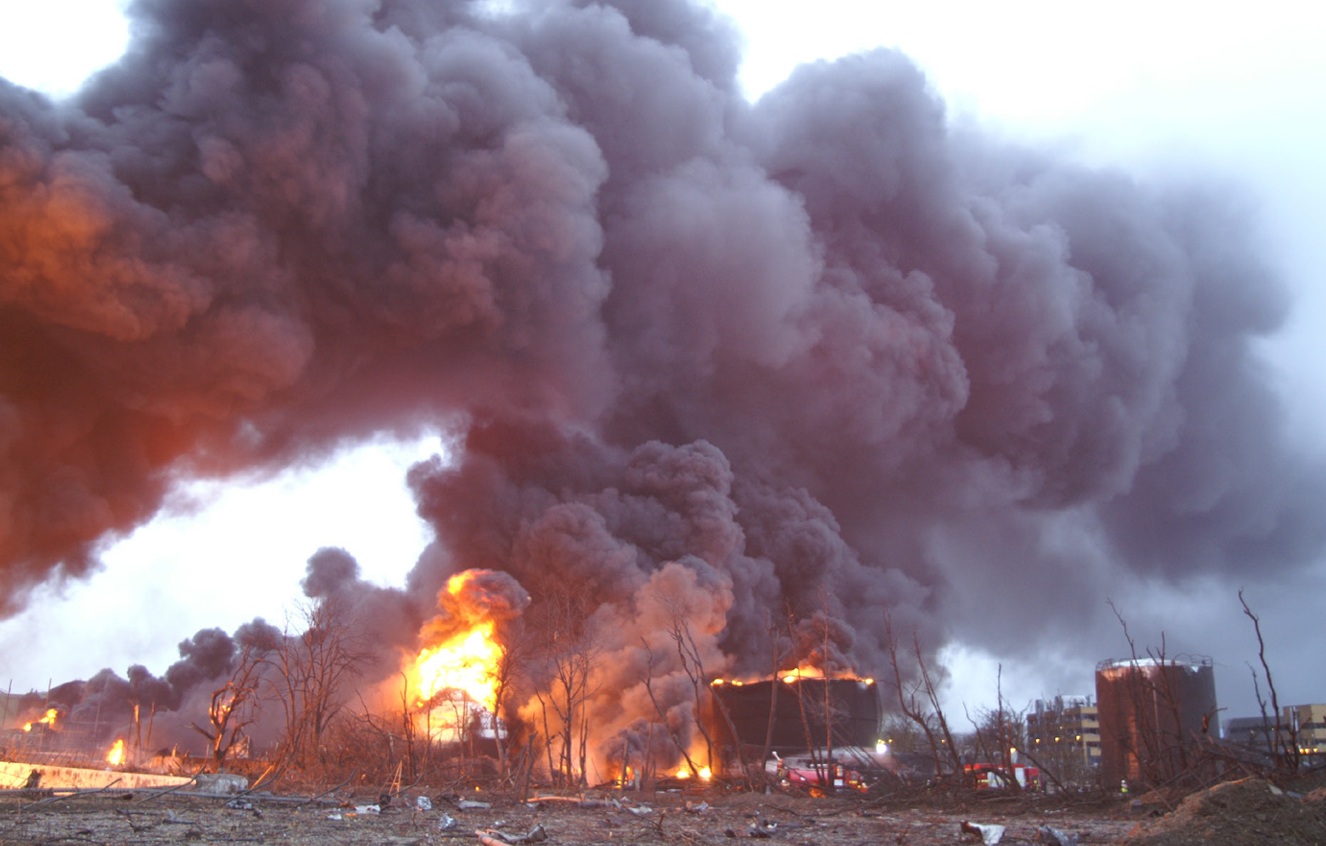
On a Saturday evening in December 2005, a gauge failed at Buncefield oil storage and transfer depot in the United Kingdom. This was the gauge that allowed workers to monitor the filling of Tank 912. The independent-high-level-switch (IHLS), installed to stop Tank 912 overfilling, was inoperable. Tank 912 overflowed, and a vapour cloud formed and ignited.
The Buncefield fire burned for five days. The site was destroyed. Many people were injured, and whole communities were evacuated. Environmental impacts were severe.
4.4 Lessons from Buncefield: Tertiary containment
Tertiary containment was limited at Buncefield. The site was heavily reliant on secondary containment with little support available should that system fail.
Secondary containment failed.
Tertiary containment included site drainage systems. These were designed for the management of rainwater and minor spills or leaks by flowing those liquids into interceptors and the site’s effluent treatment plant. Flammable liquids and firefighting run-off surged across the site, overwhelming the system. The tertiary containment system at Buncefield could have been improved by a whole-of-workplace approach.
The incident at Buncefield demonstrates the importance of:
- designing for early activation of the tertiary containment system
- carefully estimating the capacity of the entire tertiary containment system, including volume of loss from secondary containment, firefighting water, foam and debris, and the effects of surge and heave on the system
- using nib walls, boundary walls, or earth mounds to contain the leaked substance (and any firefighting water and foam) on site
- being clear about the role of each part of the tertiary containment system when directing the flow of any run-off, including keeping water storage and run-off containment separate
- designing tertiary containment systems to manage the flow of liquid into the correct tertiary containment compounds and areas, and keeping run-off away from incompatible substances and other ignition risks on the site
- designing and maintaining the system to minimise penetrations in compounds that might allow flammable liquid to leak out (all parts of the engineered system should be impervious to the pooling substance)
- improving fire resistance throughout the system, including at penetrations in compound walls or floors
- using impervious liners strong enough to resist damage from falling debris
- installing a combination of active methods (such as pumps) and passive methods (such as gravity fed drains) to transfer pooling substances into, and out of compounds
- using appropriately rated pumps and other equipment, and setting these up to shut down remotely wherever possible
- designing any drains, channels, and nib walls as fit for use for flammable liquids in an emergency (impervious, fire resistant), and with sufficient capacity to control flow.
A lagoon had been installed at Buncefield to capture and store water to use as firewater in an emergency. Flammable liquid surged across the site and filled the firewater lagoon. The firewater lagoon and its pump house were rendered unserviceable.
The tertiary containment system at Buncefield relied on pumps that did not have enough pumping capacity. When the power to the site was shut down, the pumps also stopped.
Areas of the Buncefield site were natural land, which was unprotected from the spilled liquids and run-off. Soakways were used (subsurface drains) to manage surface water run-off, allowing it to slowly percolate in the ground instead of pooling in a containment structure.
Natural features can support effective tertiary containment on large scale sites (such as MHFs) where making a larger surface area impervious may not be practicable. However, the use of natural features must be considered carefully, and expert advice should be sought. Remediation can also be costly. See subsection 5.2 for more information on use of natural features.
5.0 Types of tertiary containment
Tertiary containment systems manage the flow of a pooling substance or run-off to one or more containment points.
5.1 Engineering control measures
Engineering control measures are physical. They include a mechanical device or process. You can use a mix of engineering control measures (see Figure 2) that are:
- proportionate to the assessed risks
- proportionate to your site
- compatible with your pooling substance.
These control measures could include:
- site drainage such as pipework, channels, drains, sumps, and (where appropriate) valves and drain covers
- nib walls, judder bars, and hard paved areas (contoured) to control flow
- appropriately rated pumps
- vacuum trucks
- containment compounds.
For more information on containment compounds, see Compounds: For containing pooling substances
Tertiary containment systems may be fixed in place, or they may be temporary and put in place as needed (such as vacuum trucks). The use of vacuum trucks must be planned as a part of your emergency response plan, and the site must be designed so access is easy and safe. When relying on vacuum trucks, consult with your supplier to make sure they have enough on hand, and that they are appropriately rated for your hazardous substance.
The mix of types of tertiary containment you use will depend on the pooling substance, the assessed risks, and your site. Natural features may help with tertiary containment on large sites. However, even where natural features are used, some engineering of the feature is likely to be required. See subsection 5.2 for more information on use of natural features.
5.2 Use of natural features
You should consult with your territorial authority and the EPA if you are planning to use natural features for hazardous substance control in an emergency. Engaging with engineering experts will help you to understand the risks of using natural features, and how these risks can be mitigated.
It is important to:
- understand the permeability of natural areas
- understand the stability and durability of any natural areas.
- know how the permeability of soil (and your site, more generally) is affected by weather and time
- map the proximity to groundwater, and find out how to mitigate risks through, for example, the use of groundwater suppression wells which lower the water table, causing groundwater to flow into the site (rather than out to the wider water table) and allow for the recovery of hydrocarbon over time
- map the infrastructure over and under the land, such as utilities that may be affected by, or have effects on, the pooling substance (these might include power, data infrastructure, wastewater, stormwater, and drinking water pipes).
You should get an expert assessment (such as surveying and geotechnical assessment) to confirm sufficient capacity exists to contain the worst-case spill (including run-off) using both engineered control measures and natural features.
It is important to take a controlled approach to any release of a hazardous substance into the environment, and to make sure workers and other people are safe.
Relying on natural features means that, in the event of a spill, extensive environmental remediation will be required. The process, cost, and effectiveness of any remediation should be carefully considered before deciding to use natural features.
6.0 Risk assessment and tertiary containment
To manage the risks of pooling substances in your workplace, you need to know what the risks are.
A comprehensive and systematic investigation and analysis of all risks will support you to identify the risks you must manage.
You must engage with your workers as you assess the risks of hazardous substances at your workplace that workers will work with or could be affected by. You must also engage with your workers on how you will manage those risks.
For more information on worker engagement, see Worker engagement, participation, and representation
6.1 Risk assessment for tertiary containment
You must manage the risks to the health and safety of workers and other people no matter where a pooling substance is in your workplace.
If there is a risk that your secondary containment system might fail, a tertiary containment system may be the right control measure or measures. A tertiary containment system may be able to manage the assessed risks by:
- eliminating risks to health and safety so far as is reasonably practicable, or
- minimising risks so far as is reasonably practicable.
If there is a reasonably foreseeable risk that your secondary containment system might fail, that failure is also a reasonably foreseeable emergency, and it must be described in your emergency response plan. You should consider designing and installing a tertiary containment system to help you manage that emergency.
A tertiary containment system will make sure effects are:
- restricted to the area initially affected
- reduced in severity as soon as practicable
- eliminated, if reasonably possible.
Through a whole-of-workplace approach (Appendix 1), tertiary containment systems can make a meaningful difference to emergency management (see Section 9.0).
Appendix 2: Risk assessment – tertiary containment systems can be used as a ‘go to’ to help you identify if secondary containment system failure is a risk at your workplace. The same model can be used to assess risks that arise from the structure and operations of the tertiary containment system.
Figure 4 is a sample risk assessment model. It includes examples and uses a hierarchy of control measures to support a decision to design and install a tertiary containment system to manage risks so far as is reasonably practicable.
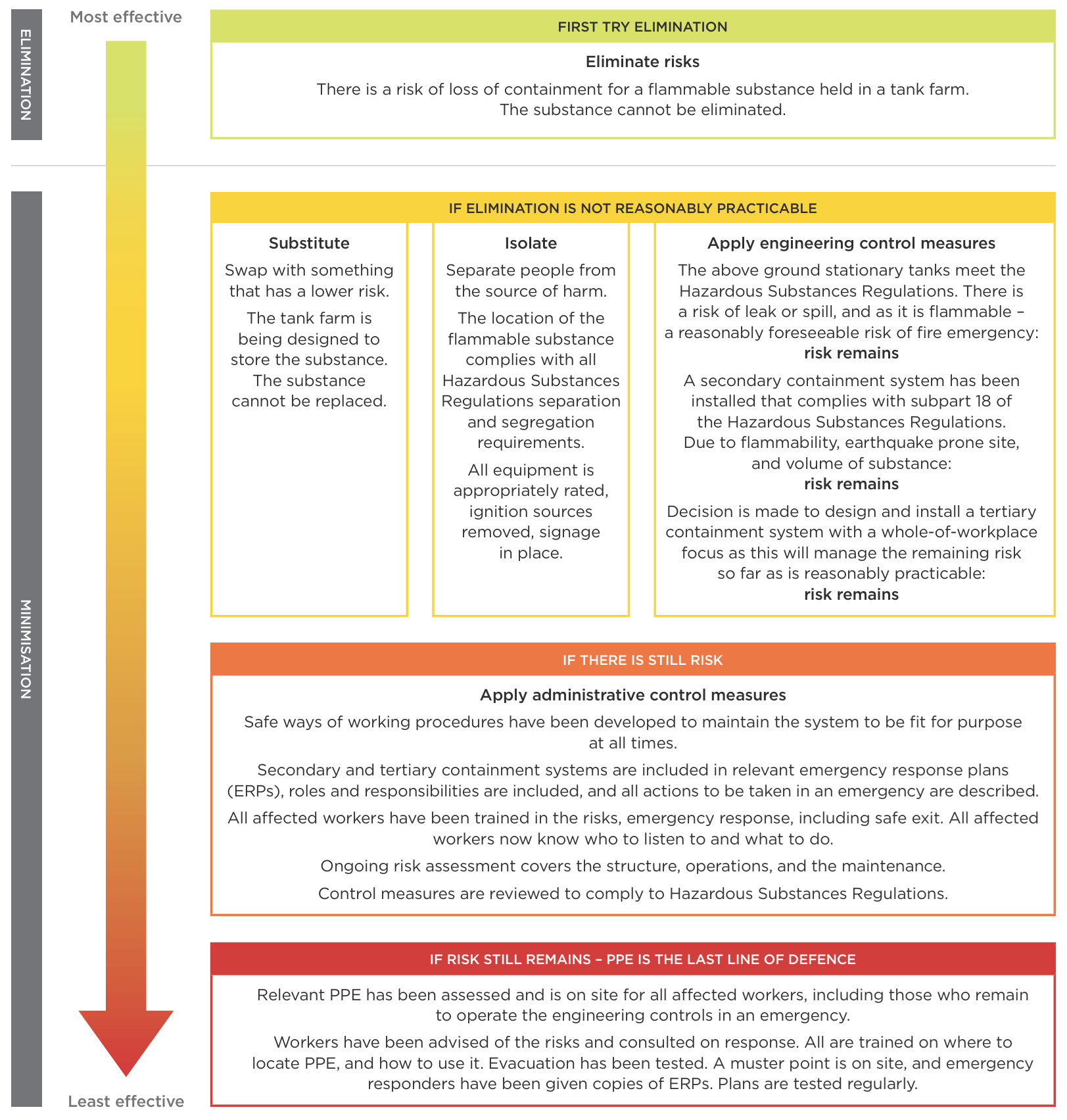
Figure 4 is a flowchart showing the hierarchy of control measures, from most effective to least effective, with a worked example for a flammable substance held in a tank farm.
First try elimination: eliminate risks – there is a risk of loss of containment for a flammable substance held in a tank farm; the substance cannot be eliminated.
If elimination is not reasonably practicable, three options are shown side by side: Substitute – swap with something that has a lower risk; the tank farm is being designed to store the substance, the substance cannot be replaced. Isolate – separate people from the source of harm; the location of the flammable substance complies with all Hazardous Substances Regulations separation and segregation requirements, all equipment is appropriately rated, ignition sources removed, signage in place. Apply engineering control measures – the above ground stationary tanks meet the Hazardous Substances Regulations, there is a risk of leak or spill and, as it is flammable, a reasonably foreseeable risk of fire emergency: risk remains; a secondary containment system has been installed that complies with subpart 18 of the Hazardous Substances Regulations, but due to flammability, earthquake prone site, and volume of substance: risk remains; a decision is made to design and install a tertiary containment system with a whole-of-workplace focus as this will manage the remaining risk so far as is reasonably practicable: risk remains.
If there is still risk, apply administrative control measures: safe ways of working procedures have been developed to maintain the system to be fit for purpose at all times; secondary and tertiary containment systems are included in relevant emergency response plans (ERPs), with roles, responsibilities and actions described; all affected workers have been trained in the risks and emergency response including safe exit; ongoing risk assessment covers the structure, operations, and maintenance; control measures are reviewed to comply with the Hazardous Substances Regulations.
If risk still remains, PPE is the last line of defence: relevant PPE has been assessed and is on site for all affected workers, including those who remain to operate the engineering controls in an emergency; workers have been advised of the risks and consulted on response, trained on locating and using PPE; evacuation has been tested; a muster point is on site; emergency responders have copies of the ERPs; plans are tested regularly.
End of text alternative
6.2 Risk assessment of the tertiary containment structure
You must make sure you provide and maintain safe plant and structures. This includes any tertiary containment system installed, and any component of that system.
For example, you can:
- use guard rails where practicable to stop workers falling into compounds in the system
- cover drains and place pipes underground to reduce trips and sprains (uncovered drains and pipes may cause injury on a normal working day, but they may also make workers more vulnerable to serious harm in an emergency)
- make sure the system flows pooling substance and run-off away from workers, and does not stop them exiting safely
- make sure the system flows pooling substance and run-off away from hazardous areas, hazardous substance locations, and any incompatible substance (including water) or material
- make sure the system flows pooling substance away from ignition risks, especially if the substance forms a flammable vapour.
Carry out the risk assessment of the structures and components within a tertiary containment system as a whole system. For example, don’t do a separate risk assessment for the compounds. Consider how points of failure will affect the whole system.
For example, consider how:
- transfer into and out of compounds might fail
- incompatible substances could enter or mix in transfer systems before reaching compounds
- plant such as pumps and interceptors could fail or cause pooling substance to ‘back up’, creating what are sometimes called waterstops.
As you assess the risks of your tertiary containment system, consider what ‘real time’ information your response team might need as an emergency happens. You may be able to install devices that warn of an issue about to happen.
These devices might include:
- fluid level sensors
- pH-meters
- detectors that find flammable gas (lower explosive limit/LEL meters)
- temperature sensors.
Devices, such as cameras, make issues more visible remotely to decision makers. These devices can be installed well away from the tertiary containment system.
7.0 Safe ways of working
You must engage with your workers as you develop safe ways of working.
7.1 Procedures and training
Safe ways of working should be written into procedures. These must be easily understandable to the workers who will do the work.
Workers (including supervisors) must be adequately trained. For example, they must be trained in:
- safe ways of working with hazardous substances
- the use of all plant, objects and equipment they will use
- the use of personal protective equipment (PPE) required for their work.
For more information on PPE, see Personal protective equipment
You must give workers who are working with and around tertiary containment systems suitable and adequate supervision and training. This includes constructing, upgrading, maintaining (including cleaning), operating or inspecting the tertiary containment system.
Training must include:
- the tasks the workers have to do
- the risks of that work
- the control measures that help to manage those risks.
An emergency plan must be prepared for the workplace, and this plan must include the testing of emergency procedures. Scenario training (sometimes called drills or practice runs) should be carried out.
Make sure workers know how to raise the alarm and safely exit. You must also make sure they are aware of hazards around compounds and the transfer systems that feed into (and sometimes from) them.
For example, tell your workers about:
- toxicity, fire, acids, slipping, tripping, fumes and vapours
- surge (flow of the substance)
- heave (upward movement of the substances and structures under pressure).
You must tell your workers their legal obligations under the Hazardous Substances Regulations, such as:
- what tasks they must do and all the safety requirements they must follow
- what actions you need them to take in any emergency.
You must also:
- tell your workers about their legal obligations under section 45(external link) of HSWA
- keep records of all training given to each worker
- make sure records of training given to workers are available for inspection by a WorkSafe inspector or a compliance certifier.
7.2 What to include in procedures
Workers must have access to:
- information on any hazardous substance they use at work, and any health hazards associated with it
- safe use procedures for the use, handling, manufacture, storage and disposal of the hazardous substance
- procedures for safe use of any associated plant and equipment
- their obligations under the Hazardous Substances Regulations
- information about actions they should take in an emergency involving the hazardous substance.
Workers should also be told:
- who is supervising them in any emergency
- what the role of emergency services is in an emergency (for example, what it means when Fire and Emergency New Zealand ‘take control’ of a site).
Workers who are constructing, upgrading, or doing significant maintenance need to know their roles, risks and responsibilities. You also need to make sure workers understand their day-to-day responsibilities in relation to the compound.
For example, you need to make sure workers understand:
- any minor maintenance they are expected to do, including cleaning or clearing of debris from, in, or around the compound
- any light inspections they should do (such as looking for staining and other signs of leakage)
- any reporting they should do, for example, how they report maintenance issues or safety concerns and to who
- any precautions they should take, such as leaving mobile phones, music devices, vaping equipment, or other ignition sources in a locker away from the tertiary containment system and the hazardous substance it will contain.
You also need to include in procedures details of the appropriate PPE, its location, and how to use it.
8.0 Some factors to consider when designing a tertiary containment system
There are a range of factors to consider when designing a tertiary containment system.
Tertiary containment is separate from, and additional to, the secondary containment system.
Tertiary containment systems give more emergency management options and additional capacity to manage risks if secondary containment fails or is at risk of being overwhelmed.
8.1 Using national or international standards
You may identify national or international standards that can be applied to your tertiary containment system’s design, construction, installation, operation or maintenance.
Any standards you use should take into account the need to be:
- reasonably practicable, and
- consistent with accepted engineering principles and practices.
Standards can be useful in providing good practice information, and in managing the risks of a hazardous substance so far as is reasonably practicable. When applying any standard to the design, construction, installation, operation, or maintenance of a tertiary containment system, it must be appropriate for New Zealand. You must comply with all New Zealand laws, including all requirements for the management of the pooling substance.
8.2 Activating tertiary containment
Tertiary containment systems can be passive. For example, they may begin with gravity fed drains. However, these systems can also be active. That means, you will activate the system at some point by opening valves or starting pumps or using another method.
By activating a tertiary containment system early, you may avoid secondary containment being overwhelmed.
Select an activation method that works best for your workplace and the risks you are managing. Activation methods can be manual or automatic depending on the system design.
Manual activation can be any action where a worker needs to do something to start the system. For example, a worker may need to:
- operate a valve by turning a handle (such as a quarter turn)
- press a button near the system (or in a control room) that starts a pump.
Automatic activation can be based on measurable data points that are continuously monitored by sensors. Monitoring may be based on a mix of data points.
Sensors might be placed in:
- a primary containment tank to warn of overfilling and to monitor change in the level of liquid in the tank
- a secondary containment compound to warn of filling at an overflow warning level, or at a stage in filling where you have planned for the activation of the tertiary containment system.
Continuous monitoring of the measurable data points allows the system to detect problems early. This can allow early warning and automatic activation of the system. Make sure any activation method is fit for purpose and responsibilities are clear.
To achieve a fit-for-purpose activation method:
- have an alarm system that notifies workers of any activation so they begin their emergency response and remain safe
- make sure any sensors in an automatic activation scenario are operational and calibrated
- assign trained and capable people the role of activating the tertiary containment system
- be clear about the timing of activation and the indicators that the tertiary containment system should be engaged
- if your activation method is manual and close to the system, ensure appropriate PPE is available to any worker whose role it is to activate the system, and that the worker knows how to use that PPE.
On your emergency response plan, you must include any activation method and the related responsibilities. If it is on your emergency response plan, any activation system must be maintained and tested regularly to make sure it remains fit for purpose.
8.3 Tertiary containment system capacity
Tertiary containment systems are separate to secondary containment systems. This means tertiary containment systems do not reduce the need for capacity in the secondary containment system.
You can feed multiple secondary containment systems into one tertiary containment system if the substances and all materials are compatible.
You should:
- consider the impacts of multiple points of failure on the transfer systems and the tertiary containment capacity
- design to avoid incompatible substances or materials making contact in any part of the tertiary containment system (see subsection 8.4).
You should estimate your tertiary containment system capacity based on the reasonably foreseeable risks you have identified.
You should:
- assess the amount of pooling substance or run-off likely to flow from the secondary containment system
- consider the effects of firefighting, including:
- substances that are incompatible with water (see subsection 8.4)
- substances that may increase in volume in contact with water (see subsection 8.5)
- consider the need for and practicality of applying foam suppression to the containment structures
- minimise the amount of time contaminated run-off is in tertiary containment
- design for the safe and efficient treatment and disposal of waste
- allow for access by vacuum trucks for off-site disposal.
Managing firefighting run-off
It is difficult to estimate the impact of firefighting run-off. Taking an early and active approach to spill management is good practice.
Avoid spill over and surge effects by acting quickly and staying ahead of the firefighting water or foam application.
Have active controls to support early management of the hazardous substance or any firefighting run-off in an emergency. For example, you could have appropriately rated portable pumps on site. Where it is safe to do so, you can also expand your tertiary containment capacity quickly using appropriately rated vacuum trucks. Discuss this with your vacuum truck supplier in advance, and consider including them in any emergency drills.
If your vacuum truck suppliers do participate in emergency drills:
- take note of the time they take to respond
- discuss with them anything that slowed their response, such as traffic issues and availability of trained drivers
- note the number of appropriately rated trucks they had available on the day of the emergency drill.
Firefighting run-off can overwhelm transfer systems (such as drains and pipes) that take the run-off from secondary containment and flow it into tertiary containment.
You should:
- consider the likely rate of release from secondary containment (how much and how fast it may spill and travel)
- consider any surge (flow of the substance), and heave (upward movement of substances and structures), and design for as smooth as possible a flow of run-off into the tertiary containment system
- check for points along the transfer system that may fail, become blocked, or slow down the transfer (for example, bends, T junctions, or joins in pipes).
Under emergency conditions, the drains and pipes of transfer systems can become blocked by debris. They can also backwash due to volume. Where practical, plan for this when designing the system.
For example:
- make sure pipes and drains have extra capacity
- install bypass systems and methods to reroute substance to small compounds (sumps) while blockages are cleared
- have appropriately rated equipment on site to unblock the system
- train relevant workers about the risks of blockages, what to do if they happen, and how to act quickly but safely
- make sure workers have the correct PPE and know how to use it.
A whole-of-workplace approach (Appendix 1) can make a significant and positive difference in an emergency by managing the flow of run-off so far as is reasonably practicable.
Dilution is never a solution on its own (contamination risks must be managed). Large volumes of contaminated run-off will travel by the most available route.
Site contour can both help (directing flow) and hinder (by increasing surge and spread of the substance). Consider how contour can be used, or engineered, across the whole workplace to manage flow of run-off.
Design the tertiary containment system to suit the assessed risks, the substance, and the site.
A large amount of run-off at shallow depth (for example, in a multiuse compound such as a carpark with nib wall) can be difficult to recover, even as waste. You should consider how recovery will be managed, and design your tertiary containment system to make this easier, safer, and more effective.
For example, you could:
- install a small recovery sump (sometimes called a scavenger sump) at a low point in each compound
- make the recovery sump area accessible to vacuum trucks with enough reach to recover product from the sump.
You should allow for firefighting foam blankets as a fire suppressant. These may be applied to parts of the tertiary containment system. Consulting with Fire and Emergency New Zealand will help you to understand where this is likely to be needed.
A note on transfer systems
Transfer systems for tertiary containment are often gravity-based systems of drains and pipes. While gravity transfer is good practice, it often uses below-ground pipework. Make sure this pipework is large enough to manage the likely volume of pooling substance and rate of release (more capacity is better than too little).
The condition and integrity of below-ground pipework can be hard to monitor. You should:
- check the condition of your transfer system regularly
- make sure the system is clear of debris including any organic matter, which can react with hazardous substances
- check for leaks in the system and fix them
- flush the system regularly.
The whole transfer system should be made of compatible, impermeable materials. So far as is reasonably practicable, use incombustible materials and design methods that protect liners.
8.4 Incompatibility issues
Incompatible substances and materials
Some hazardous substances react with each other. This reaction may cause intense heat, fire, explosion, flammable vapours, toxic vapours, corrosion, or oxidation. You need to keep incompatible hazardous substances away from each other.
Your tertiary containment system’s components and materials may be incompatible with pooling substances and react with them. Some substances can dissolve certain materials, weaken the structural integrity of the system, and create flammable or toxic gases.
For example:
- some flammable liquids react with certain plastic materials
- metal corrosives affect metal objects by breaking them down
- some corrosives affect metal and give off flammable gas
- some corrosives react with toxic products releasing acutely toxic gas.
The risks of incompatible hazardous substances and materials must be managed.
A separate tertiary containment system is needed for tanks (and their secondary containment systems) that hold incompatible pooling substances.
All materials a tertiary containment system is made from need to be compatible with, or protected from contact by, incompatible pooling substances. This includes all pipes, drains, and parts (such as pumps and valves) that a pooling substance might flow to, or through.
Dense gases (heavier than air) can travel to and accumulate in tertiary containment compounds, as these are often below ground level. If you store dense gases on your site, you should install low-level gas detection sensors in the tertiary containment compound. This is particularly important if the dense gases you store are incompatible with the pooling substance or run-off the tertiary containment system will contain.
You must:
- make sure that substances incompatible with water do not mix with water in any part of the tertiary containment system, including rainwater (see subsection 8.6)
- have administrative control measures, such as safe ways of working procedures (see Section 7.0) that give workers clear instructions on how to manage any incompatible pooling substances you have on site
- include information on incompatible pooling substances in your emergency response plans
- provide for the retention of any liquid or liquefied oxidising substance or organic peroxide you store on site to stop them contacting incompatible substances.
Substances incompatible with water
Some hazardous substances (both solid and liquid) can spontaneously ignite or emit dangerous quantities of flammable gases when in contact with water.1
Water, being a primary firefighting medium, is applied as water jets, fog sprays, sprinklers, and deluge systems. Water is also a primary suspension medium for firefighting foams including low, medium, and high expansion types.
You should conduct a risk assessment that is specific to the pooling substance (including any flammable liquid) you are managing. You should identify:
- water sources under, over, and around the site that could contact the pooling substance in a spill event and in a fire emergency
- appropriate mediums for firefighting.
The risks associated with incompatible hazardous substances and materials must be managed. This includes hazardous substances that are incompatible with water. You need to consider how you will isolate these incompatible hazardous substances from water and water-based solutions (mixtures).
Make sure that spray or run-off from water sprinklers cannot reach incompatible substances. Have sensors to identify rainwater build-up in the tertiary containment system and a plan to activate drainage (see subsection 10.2).
Think carefully about the health and safety of emergency responders. You need to:
- install signage clearly stating there is a substance that is incompatible with water, and that water and water-based foams are not to be used for fire suppression in that area
- show the location of any hazardous substance that is incompatible with water on your workplace emergency plan
- show the location of all points in the secondary containment system and tertiary containment system that the pooling substance will reach on the relevant emergency response plan
- consult Fire and Emergency New Zealand on the substances your workplace contains that are incompatible with water, and provide them with a copy of your emergency response plan for review.
If Fire and Emergency New Zealand make a written recommendation to you about your emergency response plan you must, so far as is reasonably practicable, amend the emergency response plan to give effect to their recommendations.
The classifications and criteria for the hazardous substances that are incompatible with water are shown in Table 1.
| Classification | Criteria |
|---|---|
| Substance or mixture which, in contact with water, emits flammable gas Category 1 | Reacts vigorously with water at ambient temperatures and demonstrates a tendency for the gas produced to ignite spontaneously, or which reacts with water at ambient temperatures such that the rate of evolution of flammable gas is ≥ 10 L per kg of substance over any one minute. |
| Substance or mixture which, in contact with water, emits flammable gas Category 2 | Reacts readily with water at ambient temperatures such that the maximum rate of evolution of flammable gas is ≥ 20 L per kg of substance per hour, and which does not meet the criteria for Category 1. |
| Substance or mixture which, in contact with water, emits flammable gas Category 3 | Reacts slowly with water at ambient temperatures such that the maximum rate of evolution of flammable gas is > 1 L per kg of substance per hour, and which does not meet the criteria for categories 1 and 2. |
Table 1: Substances and mixtures which, in contact with water, emit flammable gases. Source: EPA’s Guide to classifying hazardous substances – version 1.0(external link)
In April 2021, the EPA updated the classification system for hazardous substances in New Zealand to one based on the seventh edition of the Globally Harmonised System of classification and labelling of hazardous substances (GHS 7). This replaced the previous HSNO classification system. Table 2 shows a HSNO:GHS 7 correlation table.
| Substances and mixtures which, in contact with water, emit flammable gases | |
|---|---|
| Pre 30 April 2021 HSNO classification | Post 30 April 2021 HSNO classification |
| 4.3A | Substances and mixtures which, in contact with water, emit flammable gases Category 1 |
| 4.3B | Substances and mixtures which, in contact with water, emit flammable gases Category 2 |
| 4.3C | Substances and mixtures which, in contact with water, emit flammable gases Category 3 |
Table 2: HSNO:GHS 7 correlation table. Source: EPA’s HSNO:GHS 7 correlation tables(external link)
1 Environmental Protection Authority (22 October 2021) Guide to classifying hazardous substances in New Zealand – version 1.0(external link)
8.5 Immiscibility/miscibility issues
Substances immiscible with water
Polar substances have an uneven distribution of electron density (for example, water). Nonpolar substances have electron density that is relatively even (for example, oil). These substances are immiscible (will not mix) unless certain other conditions occur.
Where substances are immiscible (like water and oil), they do not readily mix in secondary containment or tertiary containment compounds. Instead, they will separate based on their density. When this happens, there is a risk that a burning pooling substance will accumulate on top of the water (Figure 5).
If the burning pooling substance overtops the compound, so will the fire.
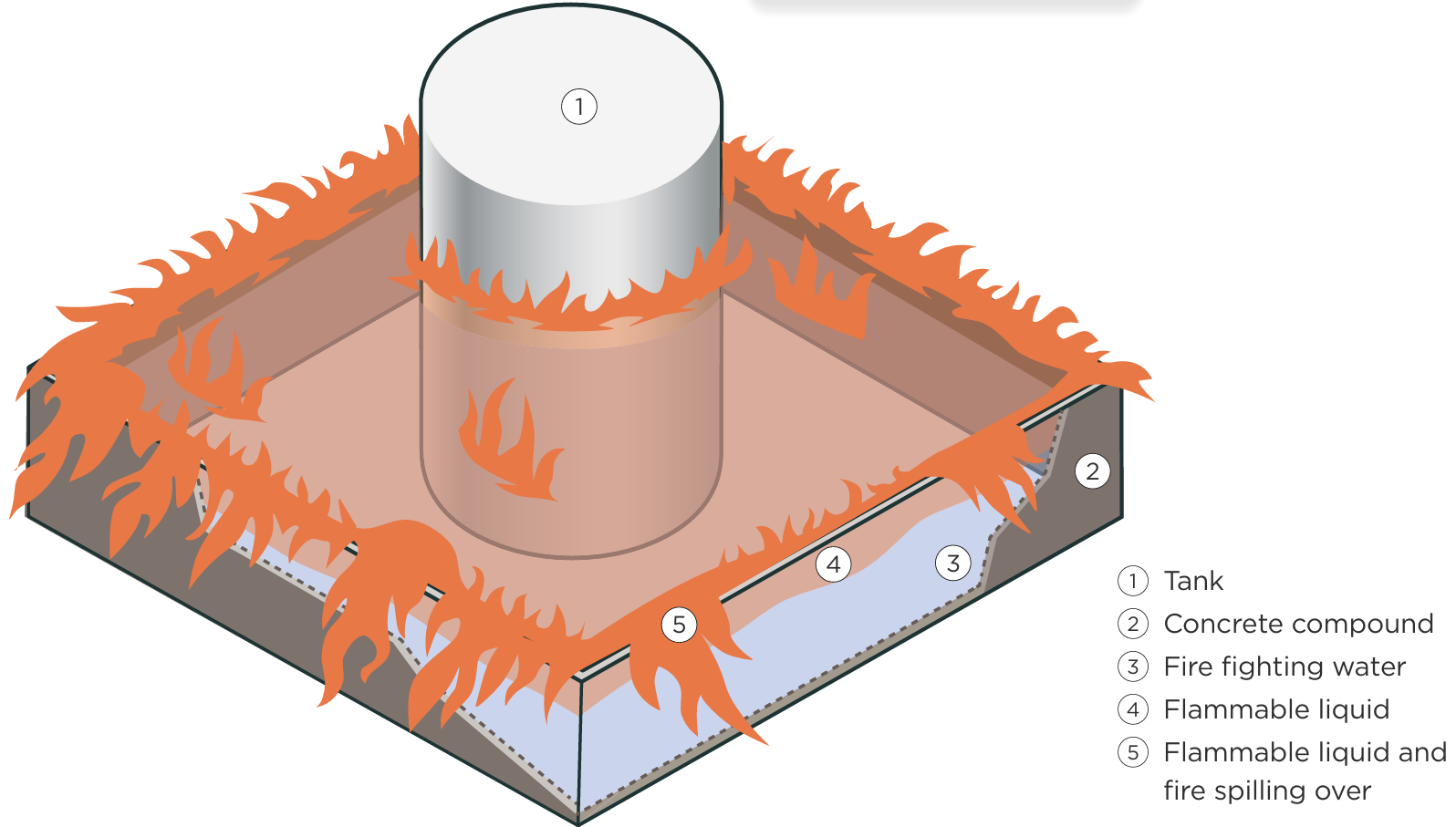
You can put control measures in place on the compound located in your secondary containment system to prevent the burning substance from reaching your tertiary containment system.
You can use engineering control measures to remove water from below the flammable liquid and transfer it to tertiary containment early. This is covered in more depth Compounds: For containing pooling substances
You should conduct a risk assessment specific to the pooling substance (including any flammable liquid) you are managing. The risks associated with immiscible hazardous substances and materials must be managed.
A system to remove water from under the burning liquid will help to manage overtopping. It is good practice to activate the system early and transfer firefighting water to tertiary containment.
Substances miscible with water
Polar substances have an uneven distribution of electron density (for example, water and certain flammable liquids, such as methanol and ethanol). These substances are miscible (readily mix). The results of mixing water and flammable liquids can be catastrophic.
When an alcohol of this nature ignites or is at risk of doing so, it needs a non-polar firefighting medium, such as an alcohol resistant foam. If polar firefighting mediums are applied (for example, water or polar foams), the miscibility properties will present a serious problem for containment.
Miscibility issues may result in:
- significant increase in volume of run-off
- potential secondary containment overtopping
- pressure on transfer systems
- potential tertiary containment overflow.
Ignited alcohol will continue to burn no matter how much water is applied. Burning will continue until the water/flammable polar solvent ratio exceeds about 0.95:1 depending on real-time conditions. This can result in almost doubling the volume of burning liquid volume if firefighting is not correctly planned for and managed.
Careful and well-informed consideration of an appropriate firefighting medium is critical in the design of a containment system, emergency response planning, and emergency management. The risks of miscible hazardous substances and materials must be managed.
You need to consider:
- water sources under, over, and around the site (including rainwater build-up) that could contact the pooling substance in a spill event and in a fire emergency
- water sprinkler installations nearby (these are often overlooked)
- the miscibility of your pooling substance with water and its likely effects
- impacts on capacity of the containment system
- appropriate mediums for firefighting.
If the fire is fuelled by a clean alcohol fuel, it will burn with a near-invisible flame adding to difficulties in managing it.
Applying water to a polar solvent will consume the firefighting medium, but fail to suppress the fire.
8.6 Rainwater
Where an outdoor compound is used for tertiary containment, it is good practice to rainproof to reduce rainwater in the system. For example, a simple carport-style roof can be used to rainproof smaller compounds.
Rainproofing has many benefits, such as:
- reducing the risk to worker safety from accidental slips and falls into the system
- leaving the full capacity of the system available in an emergency
- reducing the need to drain the system
- reducing the cost and effort to maintain the system.
However, if you place a walled enclosure over a tertiary containment system, you might create a confined space or hazardous area by allowing hazardous fumes to increase and become dangerous. Any rainproofing should allow for ventilation to make sure that any toxic, flammable, or otherwise hazardous fumes are dispersed and cannot accumulate.
Rainproofing may be a requirement in some sensitive areas. You should contact your territorial authority to check on local regulations.
Consider using valves in your tertiary containment system (in particular, in compounds) that remain closed to contain rainwater. Rainwater build-up can be monitored using sensors, and valves can be opened remotely. The baseline for the operation of valves (normally open or normally closed) should be based on the assessed risks and decisions made by a capable person.
If there is a risk of heavy weather filling the tertiary containment system, and rainwater build-up has previously been tested and shown to be clear of contamination, the benefits of releasing the rainwater may outweigh the benefits of keeping the valve closed.
If the pooling substance you are containing is compatible with water, active and early control of rainwater build-up is critical.
Assess the risks of the valves, and record their baseline position in procedures and emergency response plans. Other control measures (such as sumps and interceptors) can give more support based on those assessed risks.
If rainwater pools in the tertiary containment system, it should be disposed of in a way:
- that meets the needs of your consents
- does not negatively affect the site or the wider environment.
9.0 Emergency management
You must include information on any tertiary containment system you install in the relevant emergency response plan.
9.1 Emergency plans (MHF Regulations)
Major hazard facilities (MHFs) are likely to install tertiary containment systems to support emergency management (see Appendix 3: Major Hazard Facilities for more information on these facilities).
Specified emergency planning requirements apply to the operators of designated major hazard facilities. These emergency planning requirements are outlined in regulation 31 of the MHF Regulations.
The MHF Regulations focus on three levels of incident or event:
- a notifiable incident, as defined in regulation 4(1) declared under regulation 33 and required to be notified under regulation 34
- a major incident, as defined in regulation 9(1)
- an uncontrolled event, as defined in regulation 9(2).
If you are an operator of a designated major hazard facility, you must test your emergency plan according to the testing and review provisions of the emergency plan.
The operator of the major hazard facility must:
- document (keep records) each time a test of the emergency plan is carried out
- keep that documentation for at least two years.
Major Hazard Facilities: Emergency planning gives operators of major hazard facilities more information on emergency planning that meets the requirements of the MHF Regulations.
If you have installed a tertiary containment system to manage a reasonably foreseeable emergency, you must include that tertiary containment system on the list of on-site emergency resources and equipment.
9.2 Emergency response plans (Hazardous Substances Regulations)
Tertiary containment systems are put in place where there is an assessed risk that secondary containment might fail, and you have decided that this is the best way to manage that risk. So tertiary containment systems have an important role in the management of a reasonably foreseeable emergency.
You must ensure your workplace has prepared an emergency response plan. The emergency response plan must describe and apply to all reasonably foreseeable emergencies that may arise, including a secondary containment failure.
The requirements for an emergency response plan are detailed in regulation 5.7 of the Hazardous Substances Regulations.
For more information, see:
- Emergency plans
- Fire and Emergency New Zealand’s guidance Emergency response plans(external link)
Pooling substances hazardous to the aquatic environment
Regulations 5.6 to 5.12 of the Hazardous Substances Regulations relate to Emergency Response Plans.
If you are storing substances that are hazardous to the aquatic environment (as outlined in Schedule 5 of the Hazardous Substances Regulations (class 9.1A, 9.1B, 9.1C and 9.1D)) you should also comply with the Consolidated Hazardous Substances (Hazardous Property Controls) Notice 2017 (HPC Notice).
The EPA is responsible for the HPC Notice. For more information, see EPA’s guidance Ecotoxic substances guidance for business(external link)
9.3 What to include in your emergency response plan
If any tertiary containment system is entered into an emergency response plan, its purpose and location must be described in the plan.
Your emergency response plan must meet all the requirements of regulation 5.7 of the Hazardous Substances Regulations. These requirements include:
- descriptions of any actions to be taken to activate and manage a tertiary containment system during an emergency, and the sequence of those actions
- details of the people who will manage the system in an emergency, their role, responsibilities, and contact details (including those of emergency responders)
- information on the hazardous properties of, and means of controlling, the substances that are going to be contained by the tertiary containment system
- details of all emergency management equipment, including the type and location of fire extinguishers (see subsection 9.4).
You should explain how the tertiary containment system works, what might go wrong, and what to do if it does (for example, if it blocks during use).
During a fire emergency, electricity may be cut off and pumps may fail. Having a back-up plan will help you to work through simple mechanical failures that can become big problems. Back up plans might include appropriately rated mobile pumps and vacuum trucks on stand-by.
Wherever a vacuum truck is relied on to contain and transport run-off, make sure that there is safe access, mobility within the site, and safe exit for the vacuum trucks.
Make sure vacuum trucks have sufficient reach to access any compound. Vacuum truck drivers must be trained and provided with the correct PPE.
You should also describe how the tertiary containment system is safely returned to full operating condition following any emergency.
You should be aware in advance of the needs of any workers with disabilities, and plan to keep them safe.
9.4 Fire extinguishers
You have a duty to provide fire extinguishers as specified in part 5 subpart 1(external link) of the Hazardous Substances Regulations.
For this guidance, you should check for class 3, class 4, and class 5 pooling substances (see schedule 4(external link)) that may need fire extinguishers.
Specified fire extinguishers must have a classification and rating of at least 30B under AS/NZS 1850:2009 Portable fire extinguishers, classification, rating, and performance testing.
You should assess the risk of potential reignition in your tertiary containment system after the main fire has been suppressed, and make the correct fire extinguishers available.
Your risk assessment should also include:
- any substance nearby at risk of combustion when exposed to heat or fire
- the location of incompatible fire extinguishers nearby.
For example, the Hazardous Substances Regulations require in certain cases (LPG, propane, butane, or isobutane, where it is present in a quantity of 50 kg or more), that you have a hydrant system or hose reel long enough to be directed to the places these are present. These substances and their fire suppression methods may have additional risks if placed within reach of a tertiary containment system (including if temporarily stored in or near multiuse compounds).
Flammable gas cylinders (of any size) should not be located close to your tertiary containment system if that system will contain run-off that is combustible or flammable, or where the gas cylinders may be an additional risk in a fire emergency.
Incompatible fire extinguishers, hydrants, or hose reels (and their water-based run-off) should not be within reach of your tertiary containment system if that system will contain run-off that is incompatible with water (see subsections 8.4 and 8.5 on incompatibility with water).
The type and location of fire extinguishers, hydrants, and hose reels must be shown on your emergency response plan.
Regularly check and maintain fire extinguishers, hydrants, and hose reels so they are always fit for purpose. Obsolete fire extinguishers, hydrants, and hose reels should be decommissioned, removed from the site, and removed from emergency response plans.
Fire extinguishers must be easily seen and accessible. Workers who will access them (and any hydrant or hose) must be trained in their use, aware of any risks, and aware of their own obligations to the health and safety of others.
9.5 Reignition in tertiary containment
Your emergency response plan must include a process for the safe management of firefighting run-off when it reaches tertiary containment. In many cases, the contaminated run-off that fills a tertiary containment compound can produce a flammable atmosphere.
The flammable atmosphere may form above the compound and downwind of the compound. Remove ignition sources from places likely to be within these zones. Ensure muster points are located at a safe distance.
Consider situations where a compatible foam blanket will be needed. Maintaining the integrity of the foam blanket can be difficult (for example, when exposed to wind). The nature of the site will contribute to this risk.
For flammable substances, when the tertiary containment system reaches capacity, run-off may escape from beneath the foam blanket. Plan to manage flammable run-off. The tertiary containment system should be monitored. You should have advance warning of overflow and time to respond.
If you are storing substances that react violently on contact with water, you must ensure your tertiary containment system is regularly checked and drained. Consider:
- using sensors to automatically monitor rainwater build-up
- having an active system that can drain the system of rainwater build-up quickly and completely.
9.6 Test your emergency response plan
You must be able to implement the emergency response plan in the event of an emergency. Emergency response plans must be tested and revised to ensure they are workable and effective.
Aligning the testing of your emergency response plan to any hydrostatic testing of your secondary containment system provides a good opportunity for scenario training.
You need to make sure that risks arising from the test environment (such as volumes of water, hydraulic force, and the risk of loss of containment) are assessed and managed so they do not threaten the health and safety of workers and other people.
If practicable, firefighters and paramedics should attend scenario training and provide feedback.
9.7 Fire and Emergency New Zealand
Fire and Emergency New Zealand may review your emergency response plans to check whether they can do what is required and meet their own policies. They may make recommendations to improve the emergency response plan, although they do not have to.
You must, so far as is reasonably practicable, change your emergency response plan to meet Fire and Emergency New Zealand’s recommendations. You should record all contact with Fire and Emergency New Zealand, and each time you try to contact them. You should also keep a copy of any report or recommendations they give you.
10.0 After a leak, spill or fire emergency
Put control measures back in place after any emergency to meet the needs of your emergency response plan.
10.1 Site management
You must have safe ways of working in place to make sure the processes of tertiary containment, recovery, or disposal of run-off do not start another emergency (see Section 7.0).
Safe ways of working should include:
- how to test and recover any pooling substance safely
- processes for the relevant and safe treatment, management, and disposal of run-off and waste.
Plan for the safe removal of firefighting run-off from below the layer of foam. This might flow to a treatment station and another part of the tertiary containment system where it can be removed by vacuum trucks. Plan for the safe clean-up of all deployed equipment, the site, and any firefighting run-off, including any hazardous waste.
After an emergency, you must put control measures back in place to meet the requirements of your emergency response plan. This includes the testing and (where necessary) replacement of PPE and any agents such as neutralisers or absorbents.
Check your tertiary containment system and make sure it continues to be fit for purpose. Check all compounds, scavenger sumps, interceptors, drains and such for residual run-off, debris, and sediments that may be contaminated with the pooling substance. Make sure they are clean. Do not wash contaminated water down drains or into waterways (see Section 10.2).
The process to re-establish control measures must be included in your emergency response plan.
You can use the records of the event to improve your emergency response plans. These records could include:
- any investigation reports and recommendations
- engagement with your workers
- discussions with emergency responders.
10.2 Draining tertiary containment
You must make sure the tertiary containment system can be safely drained. You should drain the system once Fire and Emergency New Zealand notify you that the emergency is over, and when they give back control of the site.
You can use other engineering control measures to support proper use and operation of drain valves. For example, you can:
- place a sign at each drain position stating that drainage valve/s must be closed unless under supervision (be clear about who supervises)
- install lockable valves with checks and approvals before opening – this can significantly reduce accidental spills
- maintain and regularly check the last boundary/isolation valve to make sure it does not leak – this is critical to safety
- make sure all valves give an effective seal under the assessed emergency conditions (many sluice valves need a pressure head to seal fully and at low flows may not give full containment).
You must have safe ways of working (see Section 7.0) to cover any treatment and disposal processes for contaminated run-off and waste. For example, in any workplace storing hydrocarbons, drainage water from the tertiary containment system should be passed through an interceptor or separator to make sure the hydrocarbons are trapped.
Remember that firefighting foam inhibits gravity separation of hydrocarbons.
Firefighting foam and other factors (such as heat) may create a situation where substances that do not normally mix (like oil and water) are drawn along together. They can become more soluble, and may flow through an interceptor.
Your drainage system should have a means to close the outfall at the site boundary or point of discharge. If you intend to release run-off, you must have any required consenting in place.
If you accidentally release run-off that is contaminated with a pooling substance, you should contact your territorial authority immediately.
11.0 Maintenance and testing
Your workplace must continue to meet the requirements of HSWA for the health and safety of workers and other people.
If you decide to install a tertiary containment system, and it is entered in your emergency response plan, you must also ensure it remains fit for purpose so you can activate the emergency response plan in the event of an emergency.
11.1 Establishing a maintenance programme
You need to put in place a regular, scheduled inspection, testing, and maintenance programme (Figure 6).
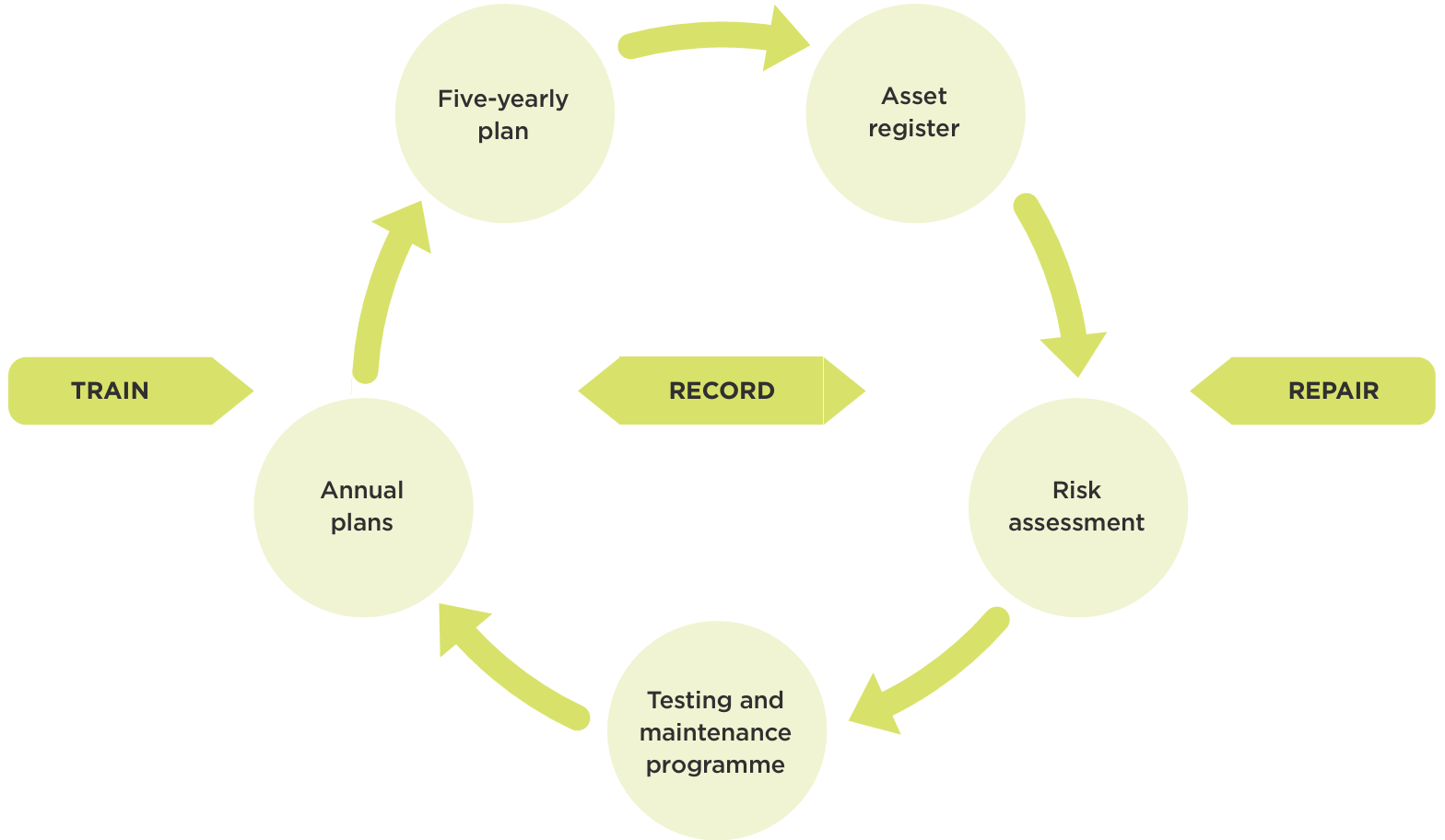
For your regular, scheduled inspection, testing, and maintenance programme you should:
- Create an asset register
Your asset register should be for your entire tertiary containment system, and it should list each section of the system, its age, where it is located, what it is for (which substance, and its role in the system), and its specifications. This is the starting point for your maintenance programme.
- Do a risk assessment
Your risk assessment should focus on maintenance. Consider where the system could be stressed or under pressure. Taking a risk-based approach will help you to prioritise inspection, testing, and maintenance of the system.
Ask yourself these questions.
- What are the risks of the substance? How will you ensure that the system contains the substance and remains fire resistant?
- What is the age and condition of the system?
- What will wear out and when? Who’s responsibility is it to check it, and who will fix it?
- Are there penetrations in the compound walls? Are these appropriately detailed? When will they need maintenance or an upgrade?
- Is leak detection sufficient?
- Are there overflow valves? When should they be inspected and tested?
- Are there sensors? When should they be inspected, calibrated and tested?
- When and how should the tertiary containment system be tested?
- Who should test it?
- Who signs off all inspection and testing?
- Create a maintenance programme
Your maintenance programme should include a schedule. You should also make sure responsibilities are clearly shown. A two-stage responsibility is better than assigning two people to one action. That means one person has the responsibility to take the action (for example, a maintenance engineer), and one person has the responsibility to check that the action has been taken and is sufficient (for example, the maintenance manager).
Write an annual plan. This should be drawn from your maintenance programme. Regularly check your system for maintenance issues, carry out any annual tests, and do any repairs immediately. An annual plan should include tasks for:
- Operators – they should check the system at least weekly and tell their manager of any maintenance issues they notice on a day-by-day basis
- Maintenance Engineers – they should have a schedule of regular maintenance checks, with those checks and maintenance happening at least six monthly
- Maintenance Managers – they should check all records at least annually and do spot checks to make sure maintenance is being carried out and to the standard needed
- Health and Safety Leads
- they should talk to operators and engineers at least annually to find out what safe ways of working are in place, whether they are working well, and whether any other administrative control measures are needed
- they should check and, where required, update any safe work procedures and PPE in consultation with workers.
- Write a five-yearly plan for major maintenance and upgrades
Your five-yearly plan could coincide with your review of control measures. It should include tasks for:
- Engineers (structural, civil, and mechanical as needed) – they should schedule system-wide structural integrity inspections to occur at no more than five-yearly intervals, and following an earthquake (or other natural event) of enough force to damage the system
- Health and Safety Managers – they should work with operators and engineers to review all administrative control measures and PPE every five years. They should also upgrade these alongside any major maintenance or system upgrades. This does not stop continuous improvement on a case-by-case basis but gives a system-wide review point.
- Train your people
You must make sure that any person who has responsibility for an inspection, test, or repair is fully trained and able to complete their role.
- Do any repairs and maintenance immediately
If any scheduled activity, repairs, or maintenance are deferred this should only be on approval by a capable person (such as the engineering manager) and must be recorded and a new date built into the plan.
- Keep accurate records
You need to keep accurate records of all inspection, testing and maintenance.
11.2 Maintaining a fit-for-purpose system
A maintenance schedule is a living system that improves continuously. To achieve continuous improvement, you could:
- schedule regular maintenance check ins with workers to get their input on maintenance issues
- communicate with emergency services to discuss the current state of all control measures, and seek their advice on improvement
- use any incident as an opportunity to improve the system
- use any recurring maintenance issue (such as a valve that continually breaks) as an opportunity to improve the system.
You can minimise the risk of significant system failure through simple inspection routines, on a day-to-day or weekly basis.
Operators could carry out the checks in Table 3.
| Oil trays and drip trays | Valves on/off/locked |
| Levels in primary containment, signs of filling in secondary containment | Any evidence of surface damage (including rust or chemical staining) |
| The area is clear of rubbish and combustibles | PPE is accessible |
| All signage is visible | Entry and exits are clear |
| Unusual noises during operations | The area is clear of ignition sources |
Table 3: Examples of simple inspection routines for operators
Regular, scheduled maintenance means the system is in usable condition when you need it.
Maintenance managers or engineers could carry out the checks in Table 4.
| For cracks in concrete | Signs of leaking, corrosion, and oxidation (including any staining) |
| Signs of leaking, corrosion, and oxidation (including any staining) | Signs of damage (animals burrowing, impact damage, punctures) |
| Check for equipment requiring calibration and ensure this is done regularly | Subsidence, contour, and flow – check the system, where does clean water run to? |
| For ignition sources – including testing electrical equipment | Combustibles and general storage – keep the containment systems clear |
| Pumps – test for operation | Drains – clear and accessible to liquids |
| Containers – no leaks, contaminants, or rainwater | All valves, leak detectors, and overflow detection systems are in working order |
Table 4: Examples of simple inspection routines for maintenance managers or engineers
By maintaining your tertiary containment system, you can protect your workplace and get the best lifecycle for your investment.
11.3 Testing
The Hazardous Substances Regulations have no minimum requirements for when to test tertiary containment systems, or the processes you need to follow when testing.
You should align the functional testing of your tertiary containment system with that of your secondary containment system. So whenever the secondary containment system is in hydrostatic testing, the test water should be released into the tertiary containment system. You should then monitor the flow to check that the system is behaving as expected and is controlling and containing the test water.
This is a good time to also test emergency response scenario training. However, make sure risks arising from the test environment (such as volumes of water, hydraulic force, and the risk of loss of containment) are also assessed and managed so they do not affect the health and safety of workers and other people.
Tertiary containment systems can have many parts and vary in their design. The approach to the development of test processes for each part of the system should be specified by a capable person.
That person should assess:
- where wear and tear are likely to affect the ability of the system to contain a substance or run-off, due to the nature of the substance or the site
- the best way to align tests to scheduled and unscheduled maintenance activities (the right test, at the right time)
- the appropriate test methods which may include, wherever practicable, non-destructive testing of parts of the system.
For more information on the testing of secondary containment systems and non-destructive testing techniques, see Secondary containment: For pooling substances in above ground stationary tanks
You may also find it useful to refer to Compounds: For containing pooling substances
Appendices
Appendix 1: Containment – whole-of-workplace approach
This image shows how containment systems can take a whole-of-workplace approach. It is not an actual plan, but it shows different containment options you might use. Note the position of the muster point, uphill from the substance flow and away from the engineering control measures.
The image does not cover all containment types. Any tertiary containment system should be designed to suit your site layout and the risks you have identified.
Key
- Warehouse with packages, drums and IBCs containing hazardous substances (including pooling substances).
- The warehouse is segregated from the above ground stationary tanks by a sloped, hard paved area designed to keep potential spills (from hazardous substances stored in the warehouse) contained.
- A grated drain runs around the warehouse and along a nib wall to carry spills away and keep rainwater clear of the warehouse. The drain is gravity fed.
- An interceptor (interceptor 4) facilitates the treatment of any spill. The interceptor should be designed to suit the pooling substance you are managing. Both rainwater and spills should be managed. Design the system in consultation with your territorial authority. Vacuum trucks (also called sucker trucks, see item 20) can be useful if it is safer to remove waste and dispose of it off site.
- A group of above ground stationary tanks2 hold compatible substances. The group of tanks is in the compound of a secondary containment system (compound 5).3
- The concrete walls of compound 5 are designed to effectively retain any pooling substance that escapes from the tank.4 The compound must have safe entry and exit for workers, for example, non-slip (up-and-over) stairs made of compatible materials.
- Each group of tanks is 25,000,000 L and is in an intermediate secondary containment system, created by an intermediate wall. The intermediate wall is 0.25 m below the outer compound 5 wall. If a pooling substance escapes from the tank, it should spill into the other side of the secondary containment system and not over the outer compound wall. This supports a staged approach to spill management. The intermediate wall should be of the same construction as the outer compound wall.
- On both sides of the intermediate wall there are drains that feed into a gravity-fed, underground pipe system. This pipe system runs under the outer compound 5 wall and down to a large interceptor (Interceptor 9).
- A large interceptor (interceptor 9) facilitates the treatment of any spill. The interceptor should be designed to suit the pooling substance you are managing. Rainwater and the disposal of any spill should be managed. Design the system in consultation with your territorial authority.
- Once the spill and any run-off diluting it is treated, and with any required consents in place, it may be discharged into the waterway. This is a last resort in the containment system and is still a controlled release point. Consult with your local territorial authority and the Environmental Protection Authority in advance of any emergency event and at the time of any release. By making compounds and larger interceptors accessible to vacuum trucks, this may be avoided.
- If the gravity-fed, underground pipe system is overwhelmed and compound 5 overflows, there is a contingency in place, and another tertiary containment system takes over. The spill travels over hard-paved surfaces where nib walls and gradient are used to encourage the spill toward the next pooling point.
- The next pooling point is a multiuse, concrete compound (compound 12). Other uses for such a compound may include car parking, or delivery (pick up/set down) areas that are cleared daily, or tanker turning bays.
These multiuse areas are usually already available on the site and are modified to support the tertiary containment function. Any multiuse area should be carefully risk assessed. For example, make sure that materials and equipment that may be present (including petroleum, electric, and diesel vehicles) do not create new hazards due to incompatibility with the pooling substance.
Vacuum trucks (item 20) can remove pooled substance from this multiuse compound and manage waste away from the workplace from that point. This can decrease stress on the containment system during a significant event and ensure the compound does not get overwhelmed. Consider installing a scavenger pump at an accessible, low point to help with removal of the substance. - A large above ground stationary tank holds a pooling substance. The tank is on solid foundations to support its weight and size.
- The tank sits in a secondary containment system. Secondary containment includes a concrete compound (compound 14).
- The compound wall is made of reinforced concrete. The compound must have safe exit for workers, for example, non-slip (up-and-over) stairs made of compatible materials.
- Should the secondary containment in compound 14 be overwhelmed, a gravity-fed grated drain provides tertiary containment. This transfers into an underground pipe which feeds a tertiary containment compound (compound 18).
- Should the grated drain block or fail, an alternative flow-route across a hard-paved area with nib walls encourages the spill into compound 18.
- Compound 18 is a deep, open concrete compound built into the ground. It is impervious and fire-resistant, and surrounded by a low guard rail to stop people falling into the compound. A ladder (or stairs) can be installed into compound 18 for easy exit but must be made of material compatible with any pooling substance the compound will contain.
- A gravity-fed underground pipe system takes the spill and any run-off diluting it from compound 18 to interceptor 9 where (with appropriate consents in place) it is treated before release into the waterway (10). To create an active system, include an appropriately rated pump.
- Another contingency for compound 18 (and for all compounds, with careful planning) is the use of vacuum trucks. These are deployable tertiary containment that provide overflow protection and safe, transportable containment around your workplace and off site.
Vacuum trucks need to be appropriately rated for the pooling substance they are intended to hold. Wherever a vacuum truck is relied on to contain and transport spill, make sure there is safe access, mobility within the site, and safe exit for the vacuum trucks.
Make sure there is sufficient reach on the vacuum trucks to access any compound. Vacuum truck drivers must be trained and need to be provided with the correct personal protective equipment (PPE). Vacuum trucks are generally not suitable for class 3.1A–C flammable substances unless they are specifically designed, certified, and operated for flammable liquid service, and the risks of ignition and explosion are effectively controlled.
2 All above ground stationary tanks that store hazardous substances must comply with part 17 of the Hazardous Substances Regulations.
3 Any secondary containment system required by regulation 17.99 of the Hazardous Substances Regulations must comply with part 17, subpart 18.
4 All secondary containment compounds must meet the requirement to effectively retain a hazardous substance as required by regulation 3(1).
Perimeter drainage systems
Perimeter drainage systems include a network of channels and drainage that go around the boundaries of a containment system. You could use this type of system to stop contamination leaving your site. The system should include leak detection. You must not allow incompatible substances or materials to make contact in any part of the system.
The width of the perimeter drain should be able to take the amount of pooling substance that is likely to be needed. While these drains are often open, consider placing a grate system over the drain that allows easier access to and movement around the site especially in areas such as the main muster point (as shown on the drawing below).
Any sediment traps and sumps should have sufficient containment capacity.
All drain inlets in and around a pooling substance containment area (such as gullies and utility holes) should be sealed to prevent contaminants seeping into them. All seals and drain mats used must be fit for purpose and compatible with the substance you are containing.
The following drawing is an example only. A capable person must design perimeter drainage systems using site-specific analysis.
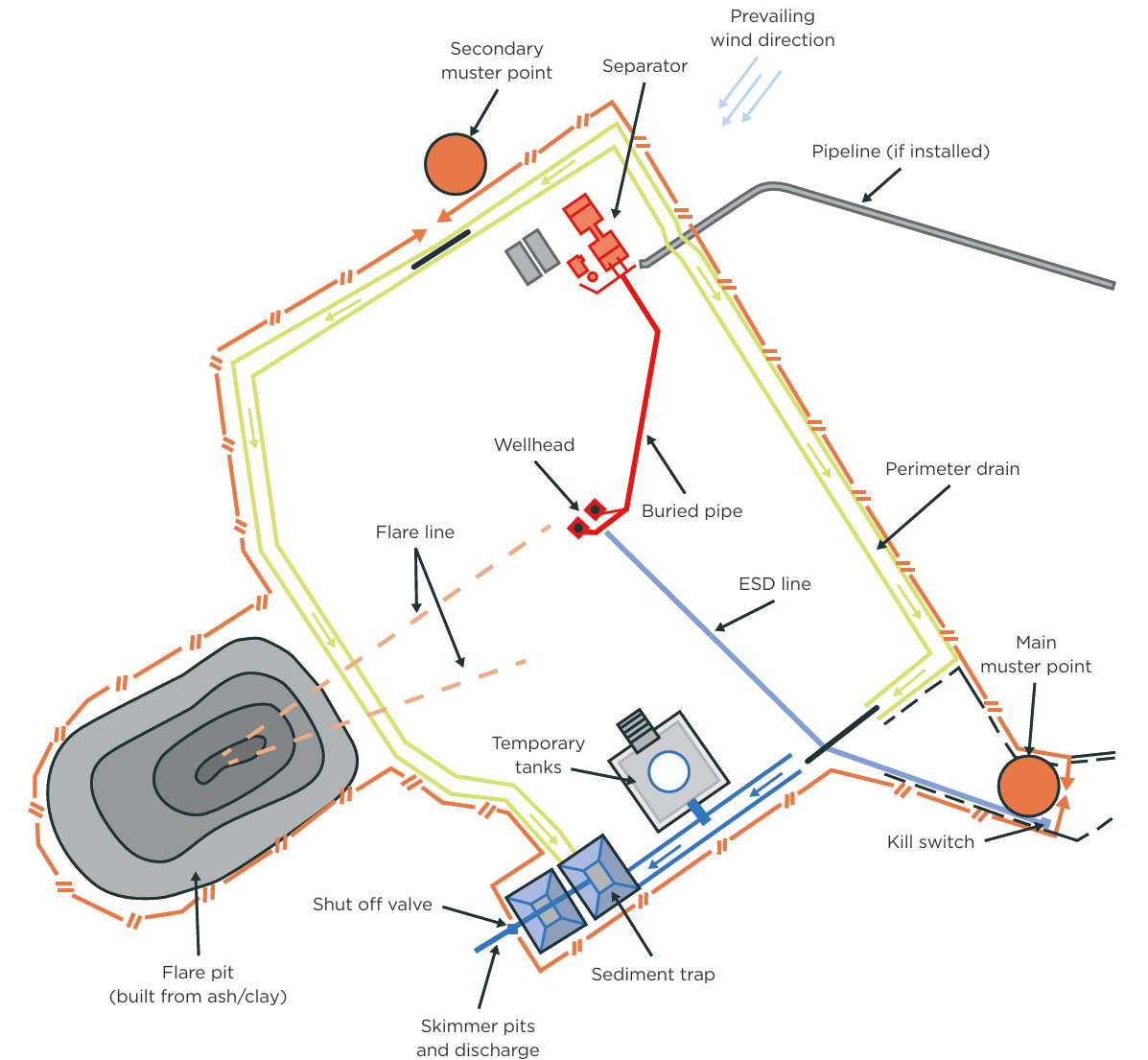
Any whole-of-site design should be site specific. This appendix is offered to help you to think about risk assessment and a whole-of-workplace approach to tertiary containment systems.
Appendix 2: Risk assessment – tertiary containment systems
Risk assessment supports you to understand your risks so you can minimise them.
A tertiary containment system may be a good control measure for risk management. You must assess any risks arising from the design, construction, installation, operation, and maintenance of that system.
A model for risk assessment
Risk assessment is both a practical starting point, identifying risks so that you can minimise them, and a continuous improvement pathway. Whether your workplace is new or established, proactive and ongoing risk assessment will help you to design, construct, install, operate, maintain, and eventually upgrade your tertiary containment system.
Hierarchy of control measures
A model based on a hierarchy of control measures can be used to assess:
- whether you need a tertiary containment system
- the risks of the pooling substance it will contain
- the health and safety risks that may arise from the design, construction, installation, operation, and maintenance of that system.
You need to make informed decisions about risks. You can use:
- safety data sheets
- EPA databases for approved substances and other information on hazardous substances published on their website
- workplace data (including discussions with workers and emergency responders, and information from recorded incidents and investigations)
- national data from Fire and Emergency New Zealand, Statistics New Zealand, Accident Compensation Corporation (ACC), and WorkSafe
- industry organisations and membership bodies
- regional information from your territorial authority and local infrastructure providers
- international data (such as the Buncefield summary case study in subsection 4.4 of this guidance).
You need to think about how likely each risk is so that you can prioritise and select appropriate control measures. The following model can provide you with a structured approach for risk assessment.
Hierarchy of control measures
![[image] graphic showing the hierarchy of control measures from most to least effective](/assets/Uploads/image-hierarchy-of-control-measures.jpg)
Risks of secondary containment failure – assessing the need for tertiary containment
If you are storing a flammable substance in an above ground stationary tank, a fire in that system is a reasonably foreseeable emergency.
If there is a risk that your secondary containment system may fail, a tertiary containment system may be the right control measure to manage the assessed risks.
As discussed in subsection 6.1 (Figure 4) of this guidance, you can use the hierarchy of control measures model to support a decision to design and install a tertiary containment system. You can also use it to manage the risks so far as is reasonably practicable.
Risks specific to the pooling substance
Using the hierarchy of control measures model, you should consider:
- the risks that are specific to the pooling substance
- how those risks might impact the design, construction, installation, operation, and maintenance of your tertiary containment system.
Consider effects that may be caused by the pooling substance, such as:
- vapour clouds that can catch fire or explode
- release of asphyxiant
- release of toxic fumes.
Manage these risks through careful design.
Think about effects such as oxidation and corrosion. Design your system so these issues can be minimised then monitored and managed through your maintenance programme.
A pooling substance might continue to create fumes over a period. In the event of a spill, you may need enough space to mark out a zone that excludes non-essential or non-emergency workers, and you may need to increase the size of that zone during an emergency. Give your system space if you can.
Plan where you will store the correct personal protective equipment (PPE, including any breathing apparatus) for your workers or any responder. Design so that PPE is accessible in the right place and at the right time. Leave space for workers to put on the gear quickly (make sure spaces are not overcrowded or blocked in any way).
Consider incompatibility with other hazardous substances, and incompatibility with water.
Tertiary containment systems should maintain separation distances from protected and public places, and should not create hazardous areas or endanger hazardous substance locations.
Safety data sheets provide comprehensive information about the properties of a hazardous substance, how it affects health and safety in the workplace, and how to manage these risks.
Risks specific to the structures
Using the hierarchy of control measures model, you should consider the risks that are specific to the construction, installation, operation, and maintenance of your tertiary containment system.
For example, consider:
- possible operational failures, such as failure of plant, or human error by operators
- effects of shortfalls in design, such as lack of alarms and fail-safe devices, unsafe embankments, inadequate ventilation, or incompatible materials
- structural failures, such as materials or components corroding or being exposed to heat and flame
- unapproved changes of use or other misuse
- impacts from refuelling vehicles.
- human acts beyond your control, such as vandalism or sabotage
- natural events beyond your control such as flood, fire, earthquake, or tsunami (tidal wave)
- geological, geographical or hydrogeological factors, such as subsidence or liquefaction
- effects of weather conditions
- ageing or deteriorating assets and sub-components.
Consider the risks that are specific to the structures (the compounds, any above ground pipework or ground level transfer systems such as drains, or any deployed equipment), and how that might impact your design, construction, operation and maintenance.
For example, consider workers and other people might slip and fall into any part if the tertiary containment system (for example, into compounds). To keep workers safe, often a guard rail is the best option, and good signage is always appropriate.
If a fall happens while the tertiary containment structure is empty, there is a risk of fall-related injury. If the fall happens while the structure is filled with a pooling substance or firefighting run-off, there is a risk of direct contamination if a worker falls in.
Compounds might also fill with rainwater during a significant weather event and create the risk of harm through drowning. Rainwater build-up is dangerous when you are containing substances incompatible with water. In uncovered compounds, consider a once in 50-year rainfall event (subject to resource consent conditions).
Above ground pipework can create a tripping hazard (this can cause minor injury on a day-to-day basis but may lead to more serious harm by slowing safe exit in an emergency). By making sure it is clearly marked and, so far as is reasonably practicable, away from foot traffic, you can minimise this risk.
Ground level drains can result in sprains and falls. Using grated covers that fit well will help minimise this risk and still leave the drain sufficiently open so workers can observe its condition and operation.
You must ensure that workers can safely enter and exit compounds for maintenance and other day-to-day work. You could install non-slip stairs made from compatible materials well away from the inflow areas.
You should always know how many workers are near the structure, give them a safe muster point, and consider the needs of workers affected by disabilities.
General steps to risk assessment
You must first try to eliminate a risk if this is reasonably practicable. If it is not reasonably practicable to eliminate the risk, it must be minimised so far as is reasonably practicable.
You must engage with workers and their representatives:
- when identifying and assessing risks
- when making decisions about how to eliminate or minimise the risks using appropriate control measures.
Follow the steps below to identify, assess, and manage work health and safety risks.
Step 1: Identify hazards that could create work risks
With your workers, identify what could harm the health or endanger the safety of one or more workers or others (such as visitors, or bystanders).
Step 2: Assess work risks
With your workers, identify and assess the risks arising from each work hazard.
Ask the following questions.
- Who might be exposed to the hazard?
- What could happen?
- How severe could the resulting injuries be?
- How could people’s health be affected?
- How likely are these effects?
Decide which risks to deal with immediately. For example, you could prioritise risks with potentially significant effects such as serious injury or death, chronic ill-health, or those with a high likelihood of occurring.
Step 3: Decide how to manage each risk
With your workers, decide how to manage work risks.
Multiple control measures may be needed to deal with a given risk. Give preference to control measures that protect many workers at the same time (for example, safety barriers, safety nets).
You should use the following hierarchy of control measures to work out the most effective control measures to use.
First try to eliminate
First try to eliminate the risk if this is reasonably practicable. This can be done by removing the source or cause of harm (such as faulty equipment, a noisy machine, or a trip hazard).
Then try to minimise
If it is not reasonably practicable to eliminate the risk, the risk must be minimised so far as is reasonably practicable.
Minimise the risk using one or more of the following actions.
- Substitute/swap with something that has a lower risk.
- Isolate the hazard by separating people from the source of harm.
- Apply engineering control measures (where physical components of the plant, structure or work area are changed to reduce or eliminate exposure to hazards).
If the risk still remains after taking one or more of the actions above, try to minimise the risk with administrative control measures (such as safe methods of work, procedures, or processes).
If risk still remains, use personal protective equipment (PPE) to minimise the risk. PPE is the least effective control measure and should only be used when other control measures alone cannot adequately manage the risk.
Step 4: Put control measures in place
As soon as possible after a decision is made about the control measures, a PCBU should:
- put the control measures in place
- instruct and train workers (including new workers) about the control measures, including why it is important to use them and how to apply them.
Step 5: Review and improve control measures
Control measures should remain effective, be fit for purpose, be suitable for the nature and duration of the work and be used correctly. With your workers, regularly monitor control measures to confirm that the measures are effective.
You must review control measures:
- when a new risk is identified
- when there is a change at the workplace or to the work
- when workers or their health and safety representative ask for a review
- when there is evidence that control measures may not be working effectively to manage the risk (for example, when you receive monitoring results or a report following an incident investigation).
Use guidance from WorkSafe or others (for example, industry associations) to help to identify, assess, and manage risks, and review control measures. If you need help, WorkSafe recommends getting advice from a suitably qualified and experienced health and safety professional.
For more information, see Identifying, assessing and managing work risks
Appendix 3: Major Hazard Facilities
Major Hazard Facilities (MHFs) are PCBUs that store large quantities of hazardous substances. These facilities have the potential to generate catastrophic events that could cause harm to workers, communities, the environment, and the wider economy. Tertiary containment systems are used by MHFs to manage the risk of secondary containment failure.
MHFs are designated by WorkSafe based on specified hazardous substances being present, or likely to be present, in:
- quantity that is equal to or exceeds specified thresholds outlined in Schedule 2(external link) of the Health and Safety at Work (Major Hazard Facilities) Regulations 2016(external link) (MHF Regulations)
- a site where more than one specified hazardous substance is present and the calculation of threshold quantities of the substances has been done according to regulation 28(external link) and is greater than or equal to 1.
If the quantity of a specified hazardous substance at a facility meets the threshold for a MHF, then the operator must tell WorkSafe and be assessed for designation as an MHF. For more information, see WorkSafe’s MHF guidance Notifications and designation
You can use the Major Hazard Facility Calculator to help you to work out the quantities of specified hazardous substances and show whether your facility is an MHF. If so, it is either:
- an Upper Tier MHF, which must have a safety case that has been formally accepted by WorkSafe and must provide general information to the local community about their operation – see WorkSafe’s MHF guidance Safety cases
- a Lower Tier MHF, which must have a Major Accident Prevention Policy in place – see WorkSafe’s MHF guidance Major accident prevention policy and safety management systems
Both lower tier and upper tier MHFs must meet all requirements for emergency planning specified in regulation 31(external link) of the MHF Regulations. For more information see WorkSafe’s webpage Major Hazard Facilities
Appendix 4: Glossary
This glossary of terms and legal definitions may be useful to you.
Administrative control
- Means a control measure that is a method of work, process, or procedure designed to minimise risk; but
- Does not include:
- an engineering control; or
- the wearing of personal protective equipment (PPE).
GRWM Regulations – reg 3(1)(external link)
Asphyxiant
An asphyxiant is a gas or vapour that causes a person to become unconscious (sleepy, asleep, or unaware of their surroundings). An asphyxiant can cause death by taking away oxygen and causing the person to suffocate. It may cause serious injury or death by preventing the person from escaping.
Compound
A basin, pit, excavation, hollow or enclosure that is resistant to fire and:
- Is constructed of concrete, brick, clay, earth, or similar incombustible material; and
- will effectively retain a hazardous substance that is a liquid if the hazardous substance leaks or flows out of its container.
Hazardous Substances Regulations – reg 3(external link)
Control measure
In relation to a risk to health and safety, means a measure to eliminate or minimise the risk.
GRWM Regulations – reg 3(1)(external link)
Crest locus limit
Crest locus limit refers to a specific distance, typically measured from the crest (top edge) of an above ground stationary tank to the top inside wall of a secondary containment compound. For more information, see the section on crest locus limit in Compounds: for containing pooling substances
Emergency Response Plan (ERP)
Means a plan prepared in accordance with regulation 5.7(external link) of the Hazardous Substances Regulations. Sometimes referred to as an Incident Response Plan.
Engineering control
- Means a control measure that is physical in nature; and
- Includes a mechanical device or process.
GRWM Regulations – reg 3(1)(external link)
Explosive
Capable of sudden expansion owing to a release of internal energy; and includes the capability to generate:
- deflagration; or
- pyrotechnic effects.
Explosion has a corresponding meaning.
Firefighting
Means taking any action to control, restrict, suppress, or extinguish a fire.
Fire and Emergency New Zealand Act 2017 – s 6(external link)
Hazardous substance
Means, unless the context otherwise requires, hazardous substance:
- has the same meaning as in section 2(1)(external link) of the HSNO Act, as that meaning is modified by subclause (2); but
- does not include food, but includes a food additive; and
- does not include medicine, but includes new medicine that is treated as hazardous under the HSNO Act; and
- does not include a psychoactive substance that is treated as not hazardous under the HSNO Act.
- The meaning of hazardous substance is modified for the purposes of these regulations by omitting paragraph (a)(vi) (ecotoxicity) of the definition of hazardous substance in section 2(1)(external link) of the HSNO Act.
- Subclause (1)(a) applies despite the definition of hazardous substance in section 16(external link) of the Act.
Hazardous Substances Regulations – reg 4(external link)
Hazardous waste
Means waste that is:
- generated by a manufacturing or other industrial process; and
- reasonably likely to be or contain a substance that meets one or more of the classification criteria for substances with explosive, flammable, oxidising, toxic, or corrosive properties under the Hazardous Substances (Classification) Notice 2017.
Hazardous Substances Regulations – reg 3(external link)
Nib wall
A low wall (6 cm to 30 cm) that prevents, controls, or contains a pooling substance. Exceptionally low nib walls can look like judder bars. Some may have sections made of materials that will compress so that vehicles can drive over them.
Person conducting a business or undertaking (PCBU)
Means person conducting a business or undertaking. In most cases a PCBU will be a business entity, such as a company. However, an individual carrying out business as a sole trader or self-employed person is also a PCBU. A PCBU does not include workers or officers of a PCBU, volunteer associations with no employees, or home occupiers that employ or engage a tradesperson to carry out residential work.
Protected place
- includes:
- a dwelling, residential building, place of worship, public building, school or college, hospital, childcare facility, or theatre, or any building or open area in which persons are accustomed to assemble in large numbers, whether within or outside the property boundary of a place where a hazardous substance location is situated:
- any factory, workshop, office, store, warehouse, shop, or building where persons are regularly employed, whether within or outside the property boundary of a place where a hazardous substance location is situated:
- a ship lying at permanent berthing facilities:
- a public railway; but
- does not include:
a small office or other small building associated with a place where storage, handling, use, manufacture, or disposal of a class 2, 3, 4, 5, 6, or 8 substance is a major function.
Hazardous Substances Regulations – reg 3(external link)
Public place
- means a place (other than private property or a protected place) that is open to, and frequented by, the public; and
- includes a public road.
Hazardous Substances Regulations – reg 3(external link)
Run-off
The term ‘run-off’ is used in this document to describe any pooling substance, fire water, foam, debris, sediments, and other contaminants that flow during a spill, leak, or firefighting emergency.
Substance
Means:
- any element, defined mixture of elements, compounds, or defined mixture of compounds, either naturally occurring or produced synthetically, or any mixtures thereof:
- any isotope, allotrope, isomer, congener, radical, or iron of an element or compound which has been declared by the Environmental Protection Authority, by notice in the Gazette, to be a different substance from that element or compound:
- any mixtures or combinations of the above:
- any manufactured article containing, incorporating, or including any hazardous substance with explosive properties.
Workplace
Means any place where a worker goes or is likely to be while at work, or where work is being carried out or is customarily carried out. Certain locations will only classed as workplaces while work is being carried out in those locations.
Acknowledgements
WorkSafe New Zealand would like to acknowledge and thank the stakeholders who have contributed to the development of this guidance.
Last updated