Use the New Zealand risk assessment of pushing and pulling (NZRAPP) to help identify high-risk pushing and pulling tasks.
Download:
It will help you assess the most common risk factors for:
- moving loads on wheels, such as hand trolleys, pump trucks, carts, wheelbarrows, or
- moving loads without wheels, such as when objects are dragged/slid, rolled, or involve a combination of pivoting and rolling known as churning.
Originally developed by the Health and Safety Executive (HSE) in the United Kingdom, WorkSafe New Zealand has adapted the tool for use in Aotearoa New Zealand. To reflect these changes and to differentiate from the original HSE version, we have called our document The New Zealand risk assessment of pushing and pulling (NZRAPP). The risk factor categories, descriptions, and scoring system remain largely unchanged from the original tool.
The NZRAPP is currently only available in PDF format.
Alternatively, you could use the HSE’s online UK RAPP tool(external link)
Development of the NZRAPP
For more information on how the manual handling screening tools were developed, read Development of the New Zealand risk assessment of pushing and pulling (NZRAPP)
1.0 Introduction
Work-related musculoskeletal disorders (WRMSDs) including injuries or conditions from pushing and pulling tasks, can cause a significant amount of work-related harm in Aotearoa New Zealand.
1.1 Pushing and pulling – a type of manual handling task
Manual handling is the transporting or supporting of a load by hand or bodily force. It includes lifting, lowering, pushing, pulling, moving, or carrying a load. A load is any type of moveable object such as a box, container, person, animal, or trolley.
Manual handling may be considered a hazardous manual task. Hazardous manual tasks have one or more of the following characteristics:
- high, sudden, repetitive, or sustained forces
- repetitive movements
- sustained or awkward postures or
- exposure to vibration.
1.2 How to manage the risk of WRMSDs?
Under the Health and Safety at Work Act 2015 (HSWA), a person conducting a business or undertaking (PCBU) must ensure, so far as is reasonably practicable, the health and safety of its workers and others.
This means PCBUs (businesses) must, so far as reasonably practicable, manage health and safety risks associated with WRMSDs (Ref 2 and 3).
1.3 RAPP and NZRAPP
The Risk Assessment of Pushing and Pulling (RAPP) (Ref 1) was developed in the United Kingdom (UK) by the Health and Safety Executive (HSE). It is designed to help businesses assess the key risks in manual pushing and pulling tasks that involve whole-body effort. For example, moving loaded trolleys or roll cages, dragging, hauling, sliding, or rolling loads.
The RAPP has been adapted by WorkSafe New Zealand to reflect New Zealand legislation. This version is known as the New Zealand Risk Assessment of Pushing and Pulling (NZRAPP).
The NZRAPP can help you to:
- identify high-risk pushing and pulling tasks
- prioritise which tasks should be considered first
- check the effectiveness of control measures to eliminate or minimise the risk of discomfort, pain, and injury.
For more information about WRMSDs and risk factors, see our quick guide Work-related musculoskeletal disorders and risk factors (Ref 2).
For information about identifying, assessing and managing work risks, see our quick guide Identifying, assessing and managing work risks (Ref 4).
1.4 When to use NZRAPP?
Use NZRAPP to assess pushing or pulling tasks where loads are moved:
- on non-powered wheeled equipment. For example, loads are moved on hand trolleys, pump trucks, carts, or wheelbarrows (Section 2)
- without wheels. For example, loads are dragged, slid, rolled, or pivoted and rolled along the base edges by a churning action (churned) (Section 3).
1.5 What does NZRAPP involve?
The NZRAPP is made up of:
- an assessment guide – provides detailed information to help you determine the level of risk for each risk factor
- a flowchart – provides an overview of the risk factors and assessment process
- a score sheet – provides a place to record information about the task and the assessment findings.
The NZRAPP uses a traffic light system to indicate the risk level for each risk factor:
| Risk level | Colour | Description |
|---|---|---|
| Low level of risk | Green (G) | Although the risk is low, consider the exposure levels for vulnerable groups such as workers who are new mothers, or pregnant, young workers, older workers, new to the job or workforce, or those that have a disability, significant health condition, injury, or are recovering from an injury. |
| Medium level of risk | Amber (A) | Examine tasks closely. |
| High level of risk | Red (R) | Prompt action needed. This may expose a significant proportion of the working population to risk of injury. |
| Unacceptable level of risk | Purple (P) | Such tasks may present a serious risk of injury and should be improved urgently. |
1.6 Who can use NZRAPP?
The NZRAPP is aimed at those responsible for health and safety in workplaces to identify, assess, and manage musculoskeletal health risks. It can be used by:
- PCBUs (businesses), (the 'you' in this tool)
- health and safety generalists such as advisors and managers
- health and safety specialists (for example, human factors/ergonomics professionals, occupational health nurses, occupational health physiotherapists, vocational occupational therapists)
- workers and their representatives
- health and safety inspectors.
If you need help to use NZRAPP, you could use a qualified health and safety specialist with the right training, skills, and expertise. You could use the HASANZ Register(external link) to find one.
Be aware that some professional groups will have more knowledge and expertise than others in the use of these assessment methods and the interventions and controls that reduce musculoskeletal health risks.
1.7 Using NZRAPP
1. Identify the tasks to assess
Choose pushing or pulling tasks that involve whole-body effort.
2. Check that the NZRAPP is the best tool to use
Look at the table below and decide if the NZRAPP is the right assessment tool.
| Use NZRAPP for pushing or pulling tasks | Do not use NZRAPP for pushing or pulling tasks |
|---|---|
Carry on to Step 3 below. |
That only use the upper limbs That only use the lower limbs Where powered handing equipment is used |
3. Engage with workers (Ref 7)
The key to effective risk assessment is making sure you talk to workers. To best understand the risks, you should complete NZRAPP with your workers.
- Ask workers (and their representatives) about the pushing and pulling tasks they perform and if they have any ideas on how to manage the musculoskeletal risks.
- Aim to gain insight into the demands of the job from the perspectives of all workers (or a representative sample) carrying out the task.
4. Observe the task carefully
- Make sure that you look at how the task is being carried out by workers, not how you assume it is done. Workers may complete tasks in differing ways, so 'normal practice' may vary.
- Videoing the task may help, but make sure to follow the privacy principles outlined in the Privacy Act 2020.
5. Select the type of assessment to carry out
Decide if the task involves pushing or pulling loads on non-powered wheeled equipment (Section 2) or if the loads are moved without wheels (Section 3).
6. Follow the assessment guides and flowcharts to complete the assessment
Work through the appropriate assessment guide in Section 2 or 3 to determine the level of risk for each risk factor. Always assess the worst-case scenario.
7. Fill in the score sheet
Manually enter the colour bands and numerical scores on the score sheet. You can use a hard copy or the PDF NZRAPP score sheet.
You can also use the online UK RAPP tool(external link) that will take you through the assessment and automatically complete the score sheet.
8. Understanding the scores
The score sheet can be used in several ways to:
- identify which risk factors to look at more closely. For example, the risk factor results that were scored as purple, red or amber
- compare tasks by looking at the total score when more than one assessment has been completed. Use these scores to prioritise which task to look at first. Those with the highest total scores should be prioritised first. The total scores do not indicate if a task has low, medium, high, or unacceptable risk.
9. Manage the risk
Look for ways of changing the task to reduce high risk factors (those that are scored as purple or red) to amber or green and to reduce amber risk factors to green.
You can do this by using the hierarchy of control measures to decide what controls to use (see Identifying, assessing and managing work risks (Ref 4)).
- First, consider if it is reasonably practicable to eliminate the risk (for example, through redesign or automation).
- If not possible, consider how the risk can be minimised (for example, by substituting tools or components).
- Alongside these higher order control measures, you may also need to consider administrative controls. For example, task rotation, break schedules, and training to support the work system.
Involve your workers as they might have already thought of how to manage the risk or how to make the task easier.
10. Is further investigation needed?
When you have completed your assessments using NZRAPP, you may want to consider other contributing factors in more detail. The Contributing factors for musculoskeletal risks checklist (Ref 6) can be used to identify these factors. Other assessment tools that focus on different risk factors may provide you with more information and ideas for controls. You can also seek specialist advice from a qualified professional by using the HASANZ Register.
Remember: The purpose of the assessment is to identify significant risks and then reduce the overall level of risk of the task. You need to put control measures in place to manage the risks you have identified. There is space to list your control measures on the score sheet.
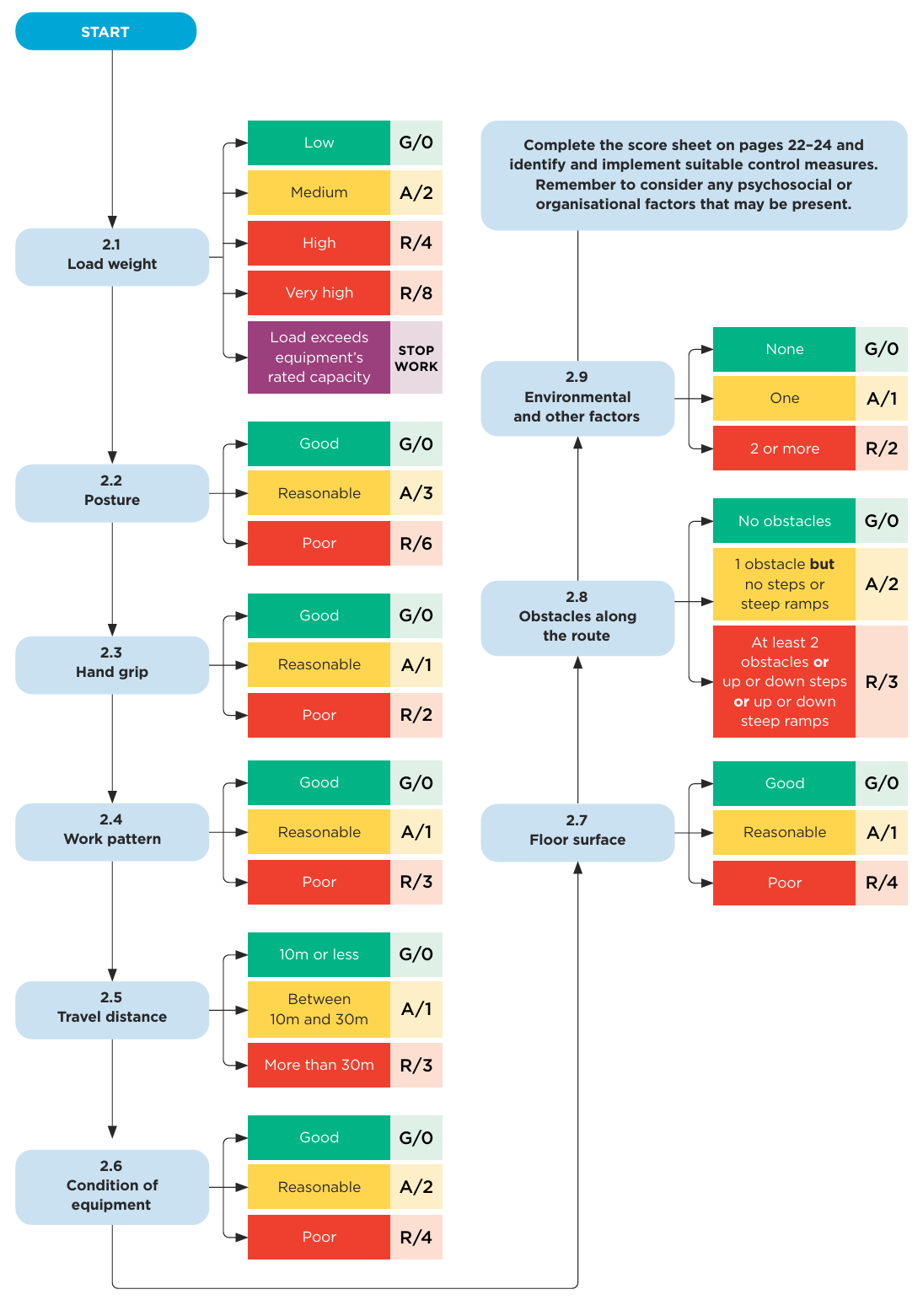
2.0 Pushing or pulling loads on non-powered wheeled equipment
2.1 Type of equipment/load weight (kg)
- Identify the type of equipment used to move loads: small, medium, or large (listed below). If different types of equipment are used, do an assessment for each type.
- If more than 1 piece of loaded equipment is moved at a time (for example, 2 trolleys are pushed at the same time), assess the total load moved.
- Find out the total load moved. This includes the weight of the equipment and the weight of load on the equipment. Check the equipment or load labels, ask the workers, or weigh.
- If the same equipment is used to move different loads, then assess the equipment with the heaviest load that is likely to be moved.
- The illustrations in each section are only a guide that show examples of small, medium, or large-sized equipment. Use them to help you identify the size of the equipment used in the pushing or pulling task you are assessing.
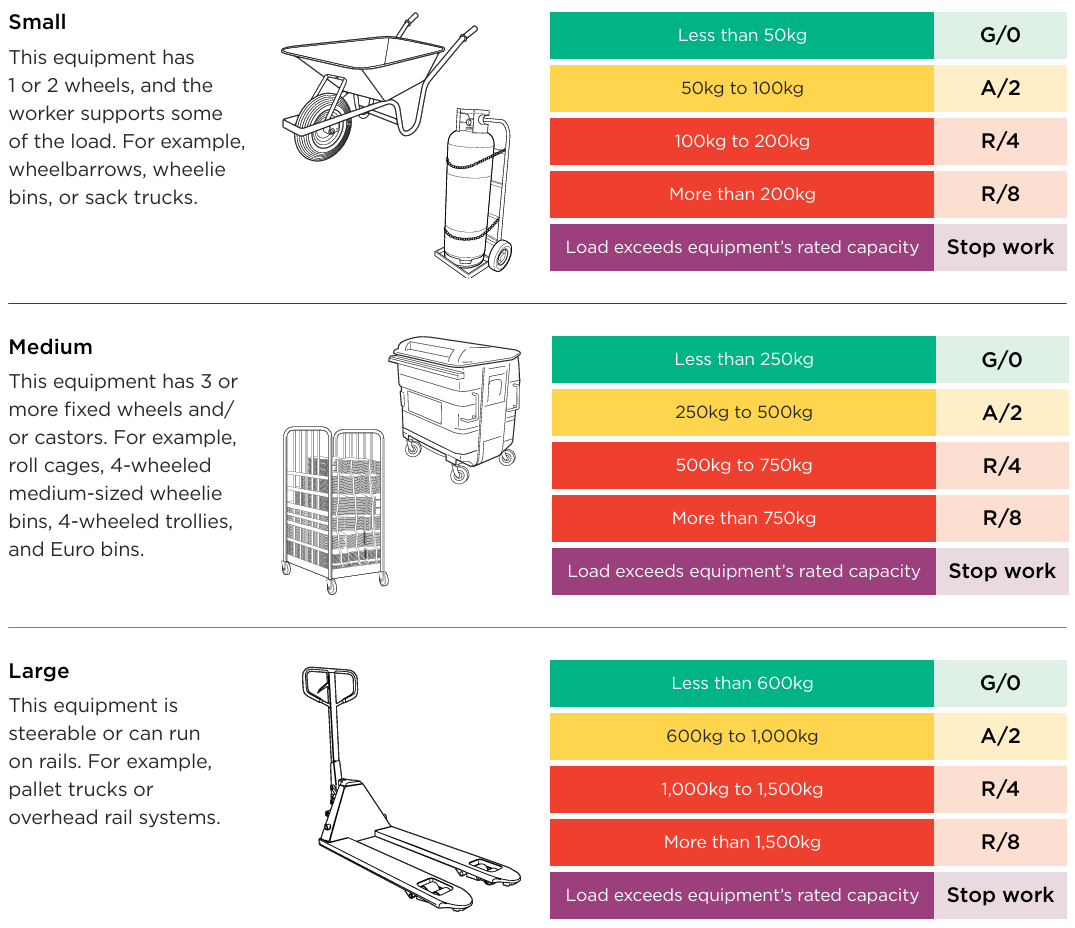
The image is a table showing load weight bands and risk scores for three sizes of non-powered wheeled equipment:
Small: this equipment has 1 or 2 wheels, and the worker supports some of the load, for example wheelbarrows, wheelie bins, or sack trucks. Less than 50kg is G/0. 50kg to 100kg is A/2. 100kg to 200kg is R/4. More than 200kg is R/8. Load exceeds equipment's rated capacity is Stop work.
Medium: this equipment has 3 or more fixed wheels and/or castors, for example roll cages, 4-wheeled medium-sized wheelie bins, 4-wheeled trollies, and Euro bins. Less than 250kg is G/0. 250kg to 500kg is A/2. 500kg to 750kg is R/4. More than 750kg is R/8. Load exceeds equipment's rated capacity is Stop work.
Large: this equipment is steerable or can run on rails, for example pallet trucks or overhead rail systems. Less than 600kg is G/0. 600kg to 1,000kg is A/2. 1,000kg to 1,500kg is R/4. More than 1,500kg is R/8. Load exceeds equipment's rated capacity is Stop work.
End of text alternative.
WARNING
- Do not proceed if the load exceeds the rated capacity of the equipment. This is considered to be 'unacceptable' and is coloured purple.
- You need to stop work and urgently consider if the weight of the load can be reduced or if suitable equipment can be used to move the load.
- Do not proceed until this has been improved.
2.2 Posture
- Observe the general positions of the hands and the body during the pushing or pulling task.
- The descriptions will also help you decide which score to select.
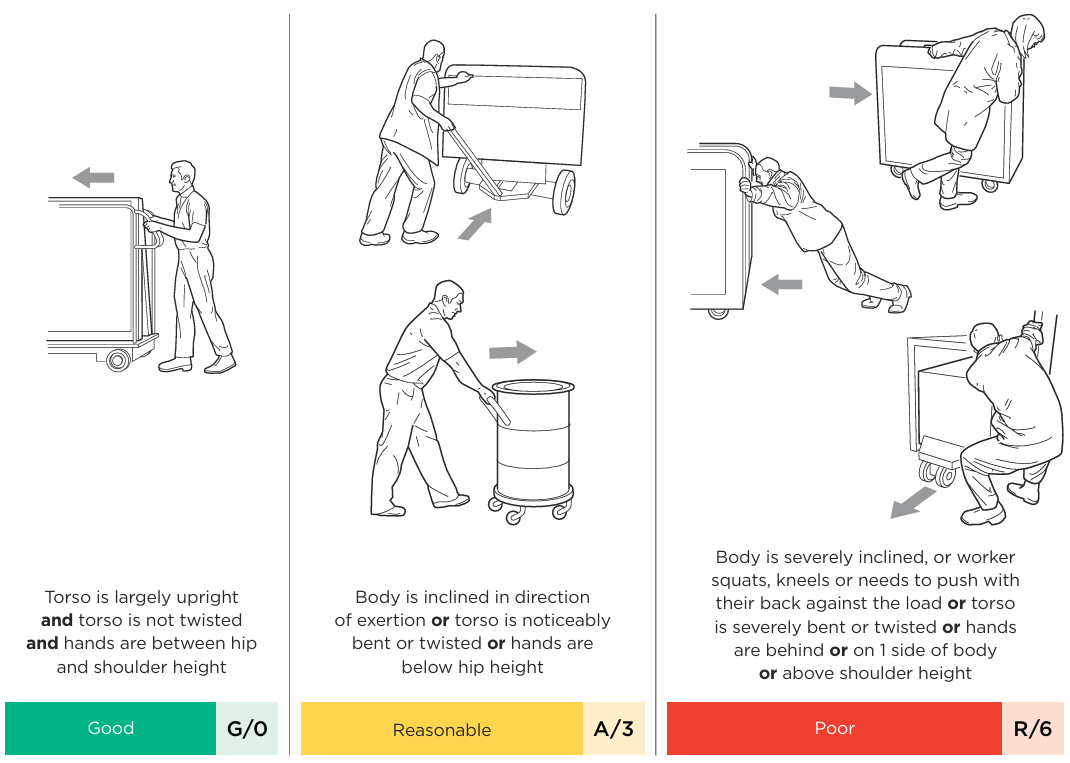
The image is a table showing posture ratings and risk scores for pushing or pulling tasks:
Good: torso is largely upright and torso is not twisted and hands are between hip and shoulder height. Score is G/0.
Reasonable: body is inclined in direction of exertion or torso is noticeably bent or twisted or hands are below hip height. Score is A/3.
Poor: body is severely inclined, or worker squats, kneels or needs to push with their back against the load or torso is severely bent or twisted or hands are behind or on 1 side of body or above shoulder height. Score is R/6.
End of text alternative.
2.3 Hand grip
- Observe how the hand(s) grip or contact the equipment during pushing or pulling.
- If the task involves both pushing and pulling, assess the hand grip for both actions.
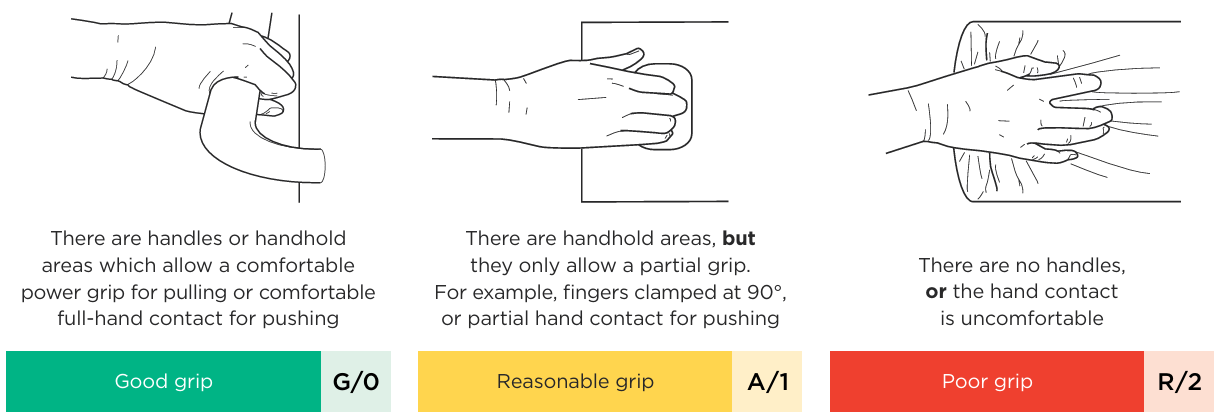
Good grip — there are handles or handhold areas which allow a comfortable power grip for pulling or comfortable full-hand contact for pushing. Score: G/0.
Reasonable grip — there are handhold areas, but they only allow a partial grip. For example, fingers clamped at 90°, or partial hand contact for pushing. Score: A/1.
Poor grip — there are no handles, or the hand contact is uncomfortable. Score: R/2.
End of text alternative.
2.4 Work pattern
- Observe the work, and decide whether:
- the task is repetitive (for example, 5 or more transfers occur per minute), and
- whether the worker sets the pace of work.
- Ask workers about their pattern of breaks and other opportunities to rest or recover from the work.
| Work pattern | Score | |
|---|---|---|
| The work is not repetitive. For example, there are fewer than 5 transfers per minute and the pace of work is set by the worker | Good | G/0 |
| The work is repetitive but there is opportunity for rest or recovery through formal and informal breaks or job rotation | Reasonable | A/1 |
| The work is repetitive and no formal/informal breaks or job rotation opportunities are provided | Poor | R/3 |
2.5 Travel distance
- Determine the distance from start to finish for a single trip:
- if the task is not repetitive, do an assessment for the longest trip
- if the task is repetitive, determine the average distance for at least 5 trips.
| Travel distance | Score |
|---|---|
| 10m or less | G/0 |
| Between 10m and 30m | A/1 |
| More than 30m | R/3 |
2.6 Condition of equipment
- Ask about the maintenance programme and observe the general condition of the equipment. For example, do the wheels, bearings, and brakes require repair or maintenance?
| Condition | Score | |
|---|---|---|
| Maintenance is planned and preventive and equipment is in a good state of repair | Good | G/0 |
| Maintenance occurs only as problems arise or equipment is in a reasonable state of repair | Reasonable | A/2 |
| Maintenance is not planned (there is no clear system in place) or equipment is in a poor state of repair | Poor | R/4 |
2.7 Floor surface
- Look at the condition of the surfaces along the route travelled.
- Determine the level of risk using the following criteria.
| Floor surface | Score | |
|---|---|---|
| Dry and clean and level and firm and in good condition (not damaged or uneven) | Good floor surface | G/0 |
| Mostly dry and clean (damp or debris in some areas) or sloping (gradient is between 3° and 5°) or reasonably firm underfoot (for example, carpet) or in poor condition (minor damage) | Reasonable floor surface | A/1 |
| Contaminated (wet or debris in several areas) or steep slope (gradient is more than 5°) or soft or unstable underfoot (gravel, sand, mud) or in very poor condition (severe damage) | Poor floor surface | R/4 |
2.8 Obstacles along the route
- Count the number of obstacles that occur along the pushing/pulling route.
- Obstacles may include pushing or pulling:
- over cables
- across raised edges
- through closed doors, narrow doorways, screens, or confined spaces
- around bends and corners or objects
- up or down steps
- up or down steep ramps (for example, with a gradient of more than 5°).
- If there is 1 obstacle but it is not steps or a steep ramp, the colour band is amber and the score is 2.
- If there are at least 2 obstacles, or loads are pushed or pulled up or down steps or steep ramps, the colour band is red and the score is 3. For example, if you push a load over 3 cables this is considered as 3 different obstacles and would be scored as R/3.
| Obstacles | Score |
|---|---|
| No obstacles | G/0 |
| 1 obstacle but no steps or steep ramps | A/2 |
| At least 2 obstacles or up or down steps or up or down steep ramps | R/3 |
2.9 Environmental and other factors
Identify any other factors, for example:
- the equipment or load is unstable
- the load is large and obstructs the worker's view of where they are moving
- the equipment or load is sharp, hot or otherwise potentially damaging to touch
- there are extreme lighting conditions (dark, bright, or poor contrast)
- there are extreme hot or cold temperatures, or high humidity
- there are gusts of wind or other strong air movements
- personal protective equipment or clothing makes using the equipment more difficult.
| Factors | Score |
|---|---|
| No factors present | G/0 |
| 1 factor present | A/1 |
| 2 or more factors present | R/2 |
3.0 Pushing or pulling loads without wheels
3.1 Activity/load weight
- Identify the work activity. If 2 or more activities are performed (for example, rolling and churning), do an assessment for each type of activity.
- Find out the weight of the load moved. For example, is it written on the label, ask the workers, or weigh.
- If 2 or more loads are moved at a time, assess the total weight moved.
- If you are moving different loads, assess the heaviest load.
- The illustrations in each section are only a guide to help you – they are not comprehensive.
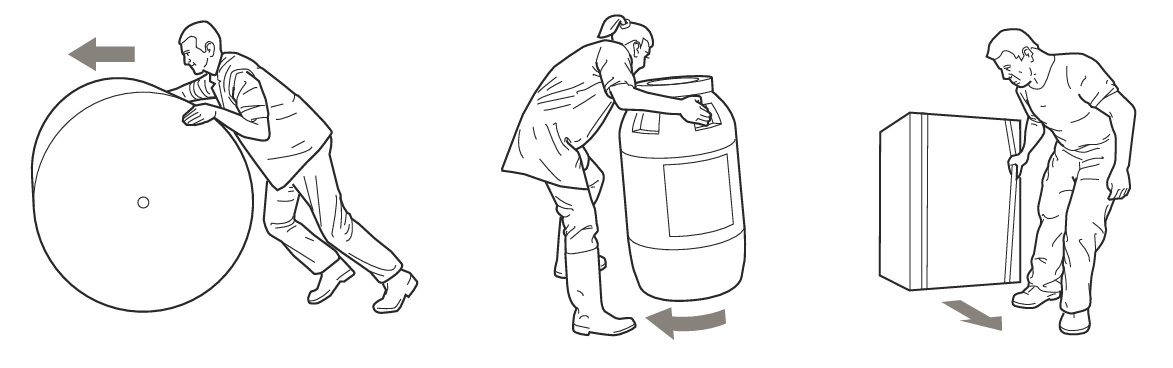
| Load weight | Score |
|---|---|
| Rolling | |
| Less than 400kg | G/0 |
| 400kg to 600kg | A/2 |
| 600kg to 1,000kg | R/4 |
| More than 1,000kg | R/8 |
| Churning | |
| Less than 80kg | G/0 |
| 80kg to 120kg | A/2 |
| 120kg to 150kg | R/4 |
| More than 150kg | R/8 |
| Dragging/hauling or sliding | |
| Less than 25kg | G/0 |
| 25kg to 50kg | A/2 |
| 50kg to 80kg | R/4 |
| More than 80kg | R/8 |
3.2 Posture
- Observe the general positions of the hands and the body during the activity.
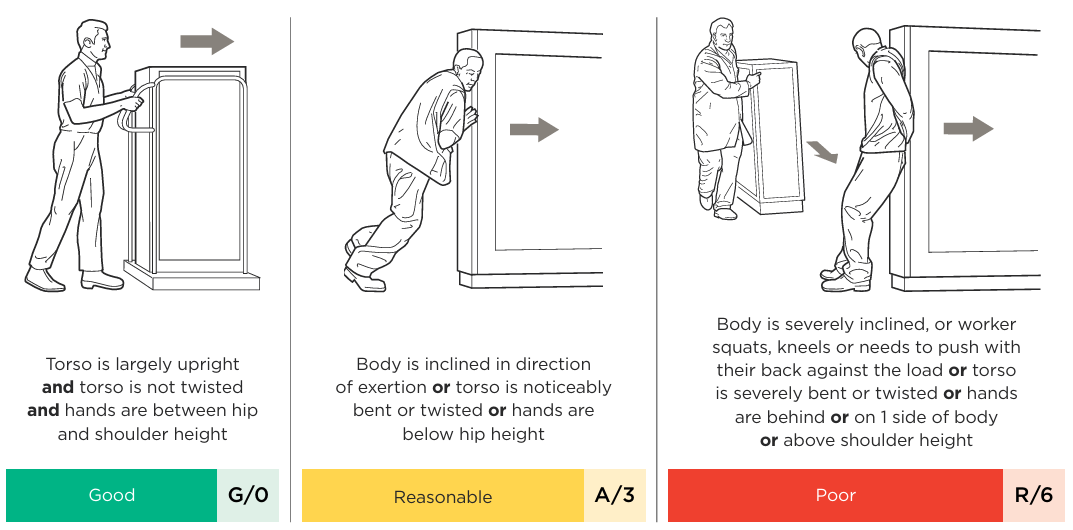
Good — torso is largely upright and torso is not twisted and hands are between hip and shoulder height. Score: G/0.
Reasonable — body is inclined in direction of exertion or torso is noticeably bent or twisted or hands are below hip height. Score: A/3.
Poor — body is severely inclined, or worker squats, kneels or needs to push with their back against the load or torso is severely bent or twisted or hands are behind or on 1 side of body or above shoulder height. Score: R/6.
End of text alternative.
3.3 Hand grip
- Observe how the hand(s) grip or contact the load during pushing or pulling.
- If the task involves both pushing and pulling, assess the hand grip for both actions.
Good grip — there are handles or handhold areas which allow a comfortable power grip for pulling or comfortable full-hand contact for pushing. Score: G/0.
Reasonable grip — there are handhold areas, but they only allow a partial grip. For example, fingers clamped at 90°, or partial hand contact for pushing. Score: A/1.
Poor grip — there are no handles, or the hand contact is uncomfortable. Score: R/2.
End of text alternative.
3.4 Work pattern
- Observe the work, and decide whether:
- the task is repetitive (for example, 5 or more transfers occur per minute), and
- whether the worker sets the pace of work.
- Ask workers about their pattern of breaks and other opportunities to rest or recover from the work.
| Work pattern | Score | |
|---|---|---|
| The work is not repetitive. For example, there are fewer than 5 transfers per minute and the pace of work is set by the worker | Good | G/0 |
| The work is repetitive but there is opportunity for rest or recovery through formal and informal breaks or job rotation | Reasonable | A/1 |
| The work is repetitive and no formal/informal breaks or job rotation opportunities are provided | Poor | R/3 |
3.5 Travel distance
- Determine the distance from start to finish for a single trip:
- if the task is not repetitive, do an assessment for the longest trip
- if the task is repetitive, determine the average distance for at least 5 trips.
| Travel distance | Score |
|---|---|
| 2m or less | G/0 |
| Between 2m and 10m | A/1 |
| More than 10m | R/3 |
3.6 Floor surface
- Look at the condition of the surfaces along the route travelled.
- Determine the level of risk using the following criteria.
| Floor surface | Score | |
|---|---|---|
| Dry and clean and level and firm and in good condition (not damaged or uneven) | Good floor surface | G/0 |
| Mostly dry and clean (damp or debris in some areas) or sloping (gradient is between 3° and 5°) or reasonably firm underfoot (for example, carpet) or in poor condition (minor damage) | Reasonable floor surface | A/1 |
| Contaminated (wet or debris in several areas) or steep slope (gradient is more than 5°) or soft or unstable underfoot (gravel, sand, mud) or in very poor condition (severe damage) | Poor floor surface | R/4 |
3.7 Obstacles along the route
- Count the number of obstacles that occur along the pushing/pulling route.
- Obstacles may include pushing or pulling:
- over cables
- across raised edges
- through closed doors, narrow doorways, screens, or confined spaces
- around bends and corners or objects
- up or down steps
- up or down steep ramps (for example, with a gradient of more than 5°).
- If there is 1 obstacle but it is not steps or a steep ramp, the colour band is amber and the score is 2.
- If there are at least 2 obstacles, or loads are pushed or pulled up or down steps or steep ramps, the colour band is red and the score is 3. For example, if you push a load over 3 cables this is considered as 3 different obstacles and would be scored as R/3.
| Obstacles | Score |
|---|---|
| No obstacles | G/0 |
| 1 obstacle but no steps or steep ramps | A/2 |
| At least 2 obstacles or up or down steps or up or down steep ramps | R/3 |
3.8 Environmental and other factors
Identify any other factors, for example:
- the equipment or load is unstable
- the load is large and obstructs the worker's view of where they are moving
- the equipment or load is sharp, hot or otherwise potentially damaging to touch
- there are extreme lighting conditions (dark, bright, or poor contrast)
- there are extreme hot or cold temperatures, or high humidity
- there are gusts of wind or other strong air movements
- personal protective equipment or clothing makes using the equipment more difficult.
| Environmental and other factors | Score |
|---|---|
| No factors present | G/0 |
| 1 factor present | A/1 |
| 2 or more factors present | R/2 |
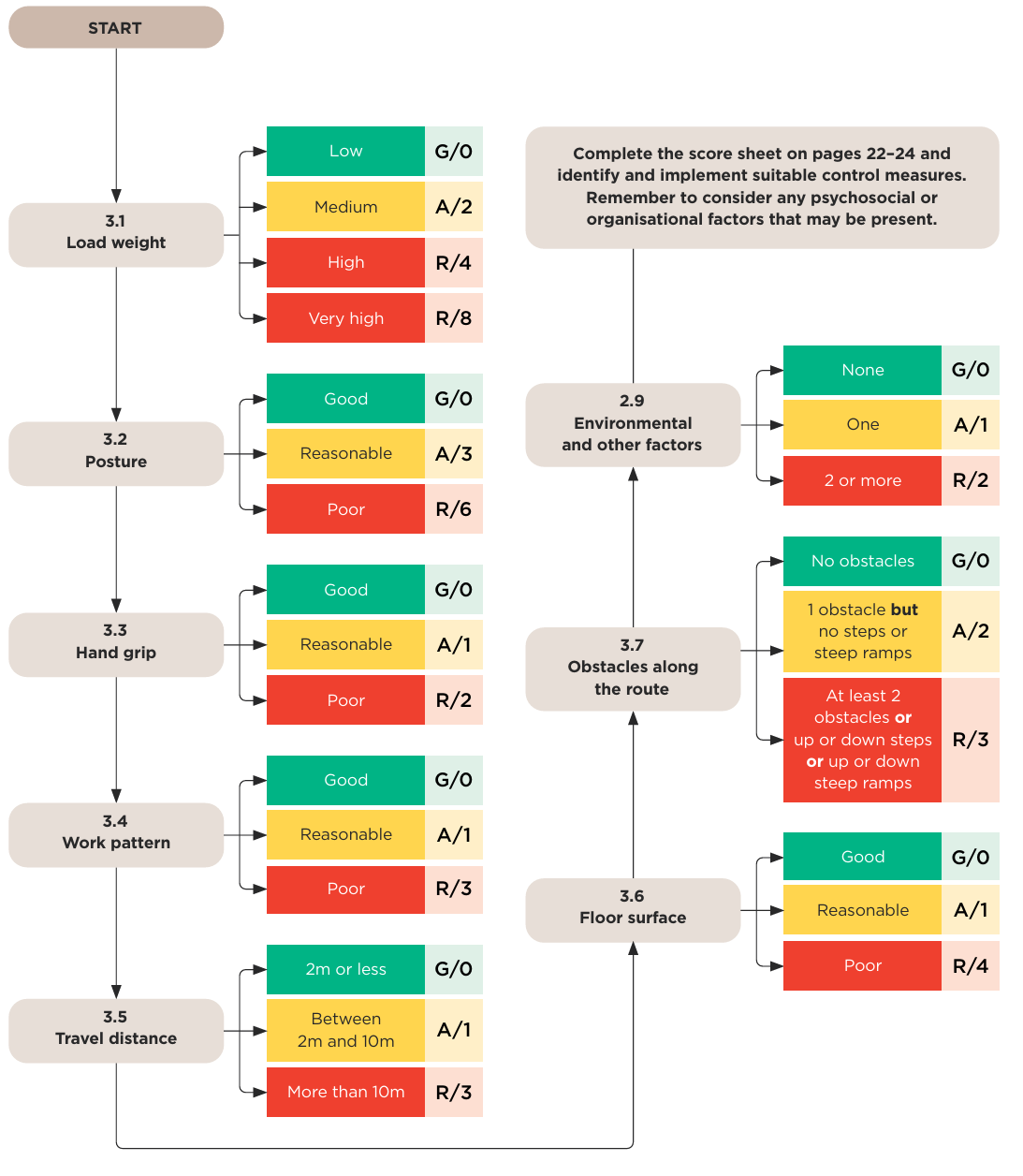
Appendices
Appendix 1: Further reading
- Health and Safety Executive (2016). Risk assessment of pushing and pulling (RAPP) tool Leaflet INDG478. Risk assessment of pushing and pulling (RAPP) tool (hse.gov.uk)(external link)
- WorkSafe New Zealand, (2023). Quick guide: Work-related musculoskeletal disorders and risk factors
- WorkSafe New Zealand, (2023). Our approach to musculoskeletal health
- WorkSafe New Zealand (2017). Identifying, assessing and managing work risks
- WorkSafe New Zealand (2025). New Zealand Assessment of Repetitive Tasks (NZART)
- WorkSafe (2024). Contributing factors for musculoskeletal risks checklist
- WorkSafe (2023). Worker engagement, participation and representation
Appendix 2: NZRAPP score sheet
Acknowledgements
This document contains public sector information published by the Health and Safety Executive (United Kingdom) and licenced under the Open Government Licence v3.0.
WorkSafe New Zealand has adapted the Health and Safety Executive’s (HSE, UK) Risk assessment of pushing and pulling (RAPP) tool (Ref 1) for use in Aotearoa New Zealand. To reflect these changes and to differentiate from the original United Kingdom version, WorkSafe have called this document The New Zealand risk assessment of pushing and pulling (NZRAPP). The risk factor categories, descriptions, and scoring system remain largely unchanged from the original tool.
Last updated