On this page
24.1 PPE
24.1.1
It is industry best practice for the following PPE to be used:
- high-vis helmet (including machine operators when outside of their machines)
- high-vis shirt, vest or jacket with day-night for added visibility
- hearing protection (see Section 3.5)
- lace-up safety footwear (or equivalent) providing good grip and ankle support
- protective legwear, chainsaw chaps or trousers – if cutting logs
- gloves – leather or thick cotton
- protective eyewear.
24.1.2
Section 10 explains the requirements you must meet if you are using PPE to minimise risks.
24.1.3
Appendix 7 contains relevant standards for PPE. Look for the mark/stamp on the PPE to check it is compliant with the relevant standard.
24.2 Safe practice
Entering the site
24.2.1
Make sure workers on the landing site understand the hazards and risks of the site particularly with mobile plant and the movement of logs and stems.
24.2.2
Every person entering an operational area:
- notifies the supervisor or foreman before entering the operational area
- wears the appropriate PPE as required by the PCBU
- only enters the operational area when they have been acknowledged or signalled that it is okay to enter
- takes care when approaching workers engaged in any operation
- stays aware that workers wearing hearing protection may not hear them.
24.2.3
Make sure workers stay in the designated safe area and clear of:
- all working machinery
- swinging or suspended logs or stems
- trucks and trailers being loaded or unloaded.
24.2.4
Before moving into another work area, make sure the affected machine operators are contacted, and that permission is signalled back.
Establish safe work areas
24.2.5
Establish exclusion zones and safe work areas:
- Put warning signs up at the entry to the site.
- Consider (where practicable) a physical barrier between machines and ground workers (for example, a log stack or another machine).
- While a machine is handling logs, manage the risks to any ground workers.
- Make sure there are no ground workers in the intended path of skidders or forwarders or any swinging logs.
- Do not swing logs above or within the reach of ground workers.
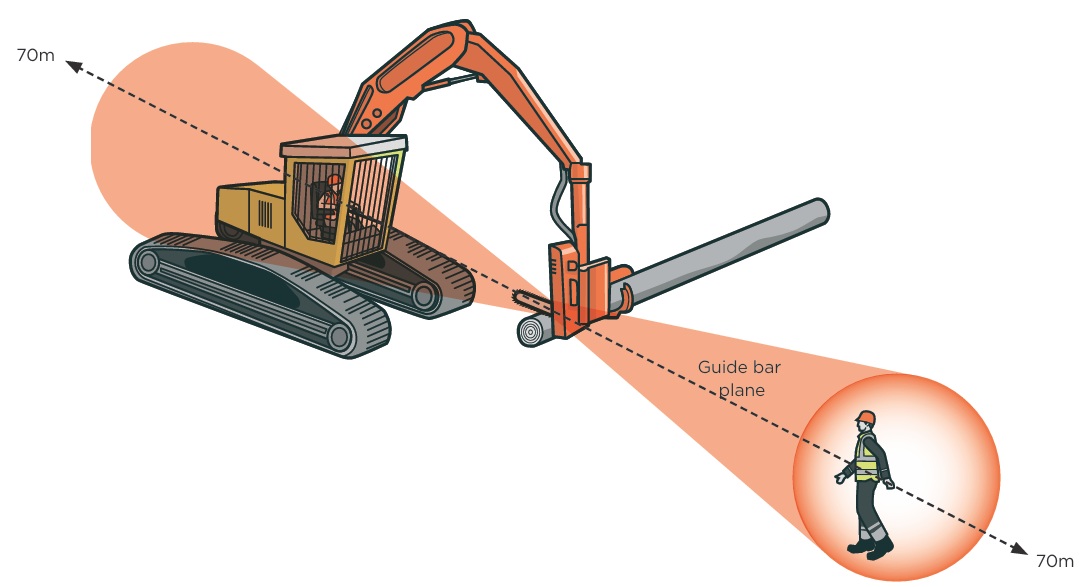
- If a mechanised processor is operating, make sure that there is at least a 70m exclusion zone to protect against chain shot injury (Figure 31). Consider the angling and placement of the mechanised processor to manage risk.
- Make sure ground workers always face operating machines.
Communications
24.2.6
Make sure all ground workers have effective and reliable communication with machine operators.
24.2.7
Make sure:
- mobile plant operators on the landing communicate when they are shifting on the landing, and skidders and forwarders radio in before entering the area. Make sure they do not enter unless they have received permission to do so
- operators of skidders and forwarders communicate with landing workers and reduce speed when entering the landing. Make sure that logs are fully grounded and stabilised before unhooking.
Mobile plant on landings
24.2.8
Mobile plant working within its designated area has the right-of-way.
24.2.9
If the mobile plant is moving to another area, the operator needs to let other workers – and other machine operators – know about the movement. Do not shift the mobile plant until the mobile plant operator has received acknowledgement from the workers.
24.2.10
Make sure:
- no load or logs are swung above or close to any worker on the landing
- the operator checks there is good clearance around the machine with both boom and tail
- ground workers only approach logs when they have been completely landed and, if necessary, stabilised
- when the mobile plant is parked, the machine's implements are rested on the ground
- workers do not walk under any implement that is supported only by the machine's hydraulics.
Manual processing on landings
24.2.11
When logs are being prepared, measured and cut at the landing site, ground workers are at risk from being hit or crushed.
24.2.12
It is important that precautions are put in place to ensure the safety of the ground workers, such as:
- the loader operator is aware of where the ground workers are at all times
- when laying logs out for manual processing, the loader operator makes sure that there is sufficient space between the stems or logs to allow for safe access and manual processing
- logs are stable and secure before cutting
- when a stem is being cut to length, no other person works on that stem at the same time
- when using a chainsaw, make sure no other worker is within 2m of the person using the chainsaw. If a worker's saw gets stuck and needs to be cut out, manage the risks when removing the stuck saw
- only use a chainsaw on logs and stems laid out for processing. Make sure no worker uses a chainsaw while standing on stockpiled, heaped or stacked stems or logs.
Machine processing on landings
24.2.13
Logs can be cut to length with custom-built processors or with excavators fitted with processing head. To manage the risks of these machines:
- have a defined working area for mechanical processors
- have defined separation distances to protect ground workers from chain shot injury. Have a minimum 70m exclusion zone unless effective protective barriers are used (Figure 31)
- make sure the mechanical processor has operator protective structures (OPS), approved chain shot guards and appropriate polycarbonate protective windshields as required
- make sure the processor operator is in communication with other workers and operators on the landing site
- make sure no worker approaches the processor without first contacting the operator to let them know of their intention. The worker only approaches when they have permission and the machine head is at rest.
Log stacks
24.2.14
To manage the risk when stacking logs:
- keep log stacks to a safe height on level ground and angled to ensure stability
- make sure the log stacks are not higher than the capacity of the log handling equipment
- place logs on bearer logs, where applicable, to avoid rocks and other contamination being loaded onto log trucks
- where possible, make sure the stacks are positioned end-on to the loading zone to stop logs rolling in the direction of the truck
- make sure there is enough separation between stacks and machines to minimise the risk of stacked logs being disturbed and falling
- avoid working at the base or downhill from a log stack
- avoid working in front of, climbing onto or working on logs placed in log stacks or dumps unless the risk is managed.
24.3 Loading and unloading
24.3.1
Loading and unloading is a high-risk activity. Before loading or unloading starts, coordination is needed between:
- the forest manager
- the harvesting contractor
- the haulage contractor.
24.3.2
This is to make sure that the loading process, and the entry/exit from the site are carried out as safely as possible.
Communication
24.3.3
Make sure the truck driver and the loader operator are in constant communication from when the truck arrives at the landing site.
24.3.4
If communication is lost, or not able to be established between the driver and loader operator at any point during the loading process, stop loading until communication resumes.
24.3.5
When loading and unloading, communication needs to be clear and concise and understood by all parties. A standard set of hand signals has been developed which will help with this. These signals can be found in the Loading and Unloading section of the Log Transport Safety Council Manual.
Responsibilities
24.3.6
The truck driver and loader operator work together to plan the load to maximise the load and vehicle stability.
24.3.7
The loader operator is responsible for:
- carrying out the loading/unloading in a safe manner
- making sure that the truck driver is safe and in a safe location
- making sure the logs are placed within the bolsters according to the driver's instructions and requirements
- adjusting the load if requested by the truck driver
- stopping if the truck driver's location is unknown or unsafe
- making sure that the immediate vicinity is clear of all people.
24.3.8
The truck driver is responsible for:
- accepting and approving the load in accordance with the Log Transport Safety Council manual
- making sure the logs are loaded and stowed safely
- following any instructions given by the loader operator
- staying in safe loading zones
- letting the loader operator know if they are moving to an alternative safe area such as a crew shelter.
Trailer lifting
24.3.9
Make sure that trailer lifting is only carried out by machines that are suitable for this purpose. The acceptable methods for lifting a trailer are:
- placing the load ring onto a hook on the lifting machine
- grabbing the load ring or chain
- using non-chain alternatives such as cross beams that can be gripped by the grapple, or forklift pockets built into the trailer.
24.3.10
Make sure no person is under a raised trailer.
24.3.11
Make sure the driver is standing on the opposite side of the drawbar from the loader operator while connecting.
24.3.12
When turning the drawbar, suspend the trailer with the drawbar at the driver's chest height for ease of control.
24.3.13
For industry guidance, see Resources webpage
Safe loading zones
24.3.14
All truck drivers (and any passengers) need to be in a designated safe area while loading takes place. Do not start loading until they are in the safe area.
24.3.15
Stop loading if the truck driver/passengers leave the safe area or cannot be contacted.
24.3.16
The designated safe areas are:
- inside the truck cab
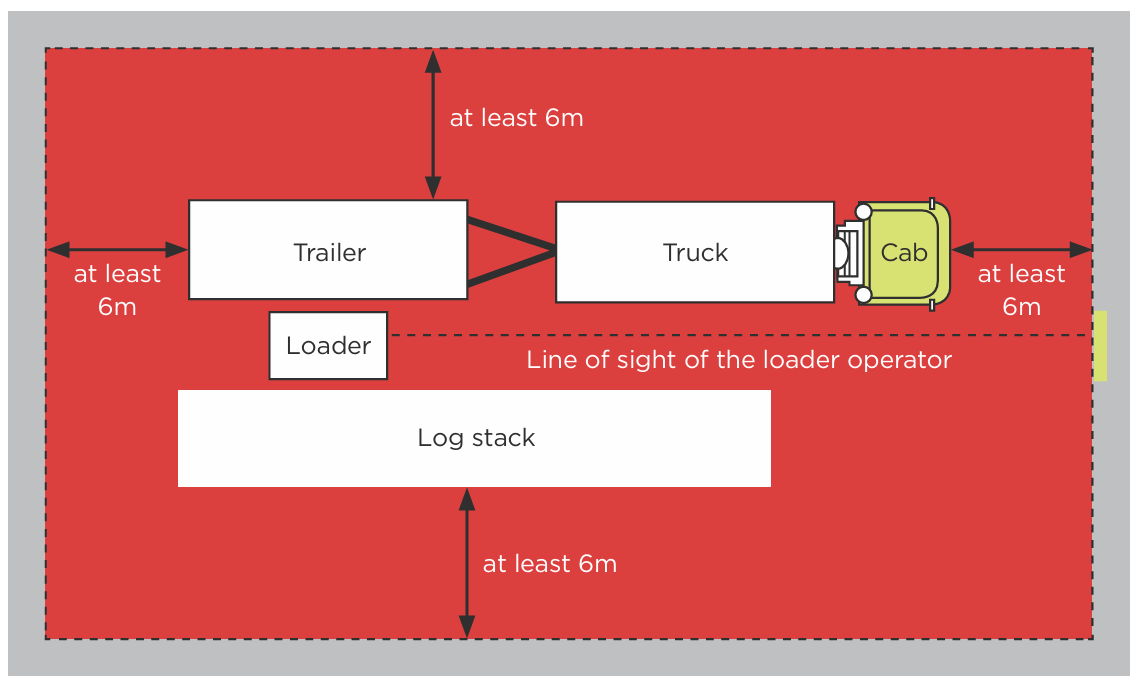
- outside the cab, but only if at least 6m from the front of the cab and visible to the loader operator
- an alternative safe area such as a crew shelter or smoko room.
24.3.17
Make sure designated safe areas are understood and agreed between the loader operator and the truck driver.
24.3.18
The loading zone where all persons on the ground are excluded from is shown in red (Figure 32). The loading zone is considered to be a minimum of 6m around the truck cab and trailer and log stack. If long logs are being loaded, this zone may need to be increased.
24.3.19
Do not load if there is anybody on the ground inside the loading zone.
24.3.20
The truck driver may direct the setting of bed logs on the trailer and to make adjustments to the final log positions only if:
- the loader operator has given permission to approach
- no logs are being suspended by the loader operator at the time.
24.3.21
If anyone needs to go into the loading zone, they need to first get the loader operator's approval.
24.3.22
Loading then stops and the grapple/forks are lowered to the ground. Loading only restarts when the person has moved out of the loading zone.
24.3.23
Make sure the loader never moves into or swings logs over the truck driver safe zone or cab.
Loading in the dark
24.3.24
When log loading takes place during the hours of darkness, extra precautions need to be taken:
- make sure drivers, loader operators and anyone else working on the landing wear day-night high-vis vests and helmets
- make sure loading is carried out in adequately illuminated areas. Lighting could be provided by:
- loading lights of the truck
- additional lighting fitted to the log loader over and above the driving lights to provide lateral as well as forward-facing illumination
- lighting systems on the log landing.
Load placement
24.3.25
Construct the load under the driver's direction so that:
- the load can be restrained effectively
- the load does not destabilise the vehicle
- the load remains stable when applying and removing lashings
- the load is not contaminated with items that can fall from the vehicle in transit.
24.3.26
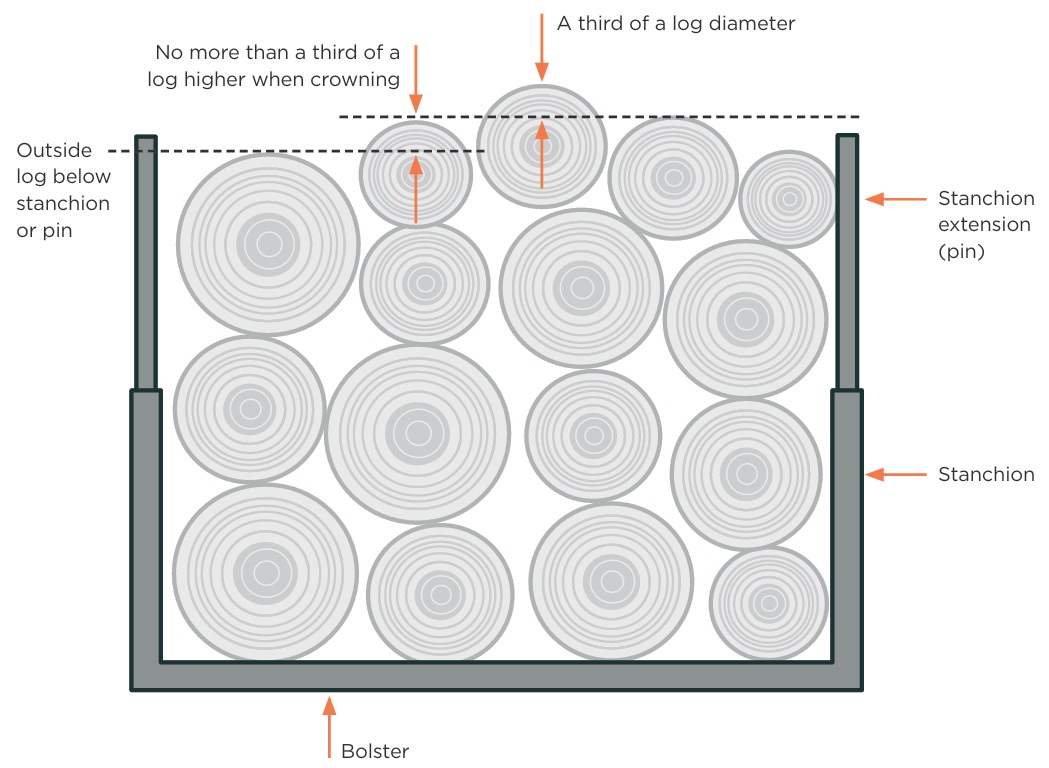
Make sure no more than one-third of the end diameter of any log is above the top of a cab guard, headboard, tailboard, or stanchion pin (Figure 33).
24.3.27
Make sure no part of outside logs (logs that are in contact with the stanchion) are above the height of the stanchion.
24.3.28
Crown all loads of logs to ensure load security. When crowning the load, make sure no log is more than 1/3 of a log diameter above the log it is adjacent to.
24.3.29
Make sure the outer ends of the outside logs extend the correct distance in accordance with the Log Transport Safety Council manual.
24.3.30
Secure all logs by at least two load restraints, either directly by contact with the stanchion or lashing, or indirectly, if bound by surrounding logs.
24.3.31
Drivers make sure that:
- logs are secured, from a safe position
- lashings are regularly checked during transit to correct the tensions (if needed)
- loose bark is identified and removed
- if necessary, adjustment to loading configuration is undertaken by suitable log handling equipment.
24.3.32
For more information on log placement and securing, see Resources webpage
Chaining up and exiting the skid
24.3.33
Drivers need to make sure that the load is restrained safely and in accordance with the Log Transport Safety Council manual.
24.3.34
Drivers can move up to 100m to a safe area away from the landing before securing the load.
24.3.35
Make sure restraints are checked before entering the public highway system and re-tensioned if required.
Self-loading trucks
24.3.36
Make sure self-loading trucks are fitted with outriggers and stabilisers that firmly stabilise the unit while loading.
24.3.37
Make sure the booms are designed so that the free fall of the boom is prevented if there is a malfunction.
24.3.38
Make sure all controls for the operation of a self-loading unit are 'detent' operation type.
24.3.39
Make sure drivers of self-loading trucks have established work-alone procedures and have an effective means of getting help in the event of an emergency.
Last updated