20.1 Introduction
20.1.1
Mechanised harvesting is where machines are used for felling and delimbing.
20.1.2
For further information on safe working practices, look at industry guidance, see Resources webpage
20.2 PPE and other equipment
Personal protective equipment (PPE)
20.2.1
It is industry best practice for the following PPE to be used:
- high-vis shirt, vest or jacket with day-night for added visibility
- high-vis helmet, when working outside a protected cab
- safety footwear
- hearing protection
- gloves (when working with wire ropes and chains).
20.2.2
Other useful equipment includes a small personal first aid kit.
20.2.3
Section 10 explains the requirements you must meet if you are using PPE to minimise risks.
20.2.4
Appendix 7 contains relevant standards for PPE. Look for the mark/stamp on the PPE to check it is compliant with the relevant standard.
20.3 Safe site
Managing worker/machine separation
20.3.1
Before planning any mechanised felling operation, think about:
- where the operation is taking place
- what other activities are happening nearby
- who else may be in the area.
20.3.2
Once you have this information, determine the hazard zone(s) considering the following.
Make sure workers on foot do not enter within two tree-lengths of a working felling machine
20.3.3
This is the minimum zone to protect workers from sailers or breakage from the felled or nearby trees (Figure 17). There may be circumstances when a larger zone is needed.
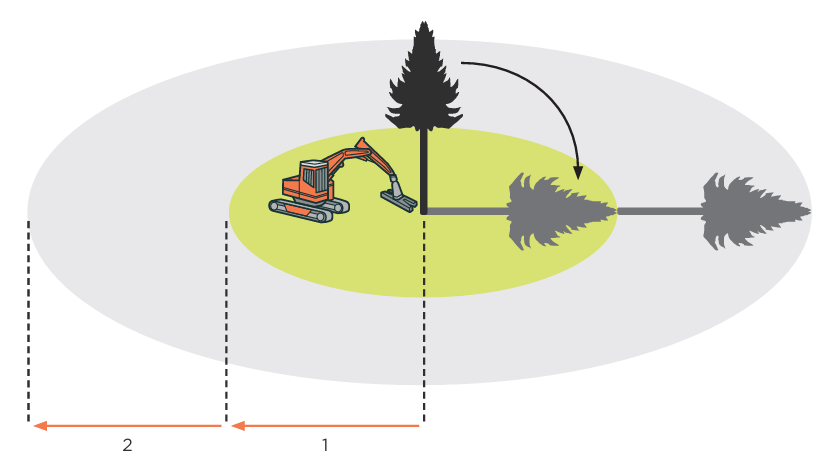
Make sure workers stay out of areas where stem movement could occur after felling, particularly if felling downslope of the machine
20.3.4
Figure 18 shows the danger zone.
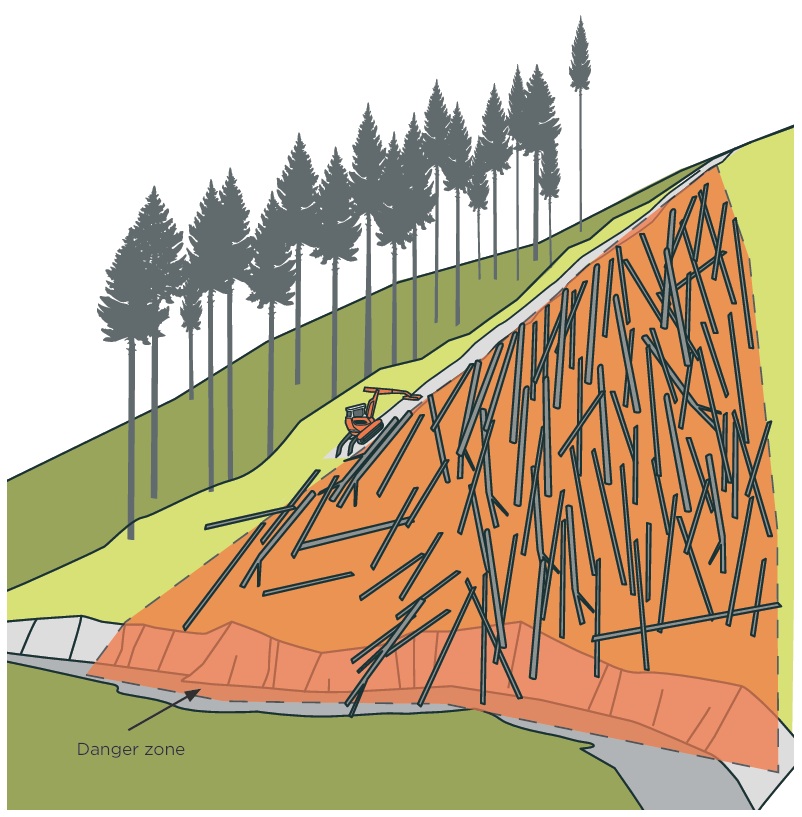
Machine separation
20.3.5
Make sure other machines maintain a safe distance unless the risk is well managed.
Workers approaching a machine
20.3.6
Make sure workers on foot:
- do not approach a machine without first contacting the machine operator and letting them know their intentions
- only approach when they have permission.
20.3.7
Before machine operators give permission to workers to approach (or get out of the cab), make sure the operator:
- stops the task they are doing
- lowers any raised implements
- locks out the hydraulic system
- applies the brakes.
Chain shot
Make sure workers are at least 70m away from the cutting direction of the saw chain. This is due to the risk of chain shot from the chain breaking (Figure 19).
20.3.9
If there is a natural or man-made barrier between the saw chain and workers, this distance could be reduced once a risk assessment is carried out.
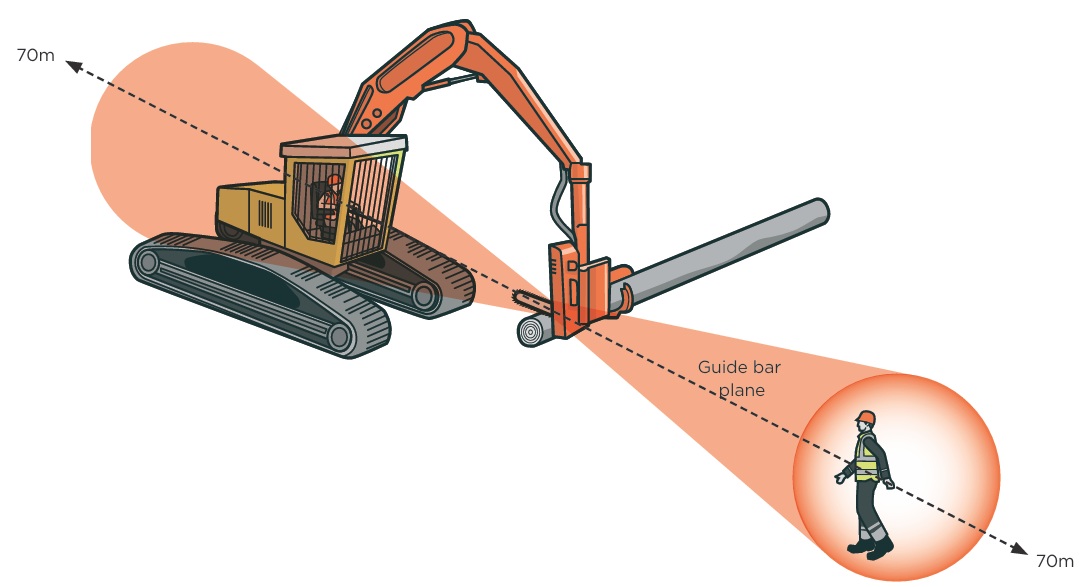
Figure 19 is adapted from OSHA Oregon’s Hazard alert Chain Shot Logging Hazard(external link).
20.3.10
Have a sign warning about entering a chain shot zone at the entrance to all working skid sites with processing machines working.
Managing terrain
20.3.11
Each machine make has its own unique features that will determine the exact slope limits for the machine.
20.3.12
When planning the work activity, carry out a risk assessment considering:
- the machine(s) to be used. Are they designed to be used on slopes? Will you use a winch?
- surface condition including slope and soil type, and soil moisture content
- operator experience
- any changes expected during the day.
20.3.13
To assess those limits, Safetree's Steep Slope Risk Assessment tool may be useful.
20.4 Safe practice
20.4.1
A PCBU who manages or controls plant at a workplace must, so far as is reasonably practicable, ensure that the plant is without risks to the health and safety of any person.
20.4.2
PCBUs must ensure, so far as is reasonably practicable, the provision and maintenance of safe plant and the safe use, handling, and storage of plant.
20.4.3
Table 18 shows examples of sources of harm from mechanised felling and possible control measures to consider when managing risk.
20.4.4
There may be hazards that are not identified in this table. You will need to identify and assess health and safety risks arising from your own work.
| Source of harm | Possible control measures |
|---|---|
| Unexpected tree movement |
|
| Working too closely to ground workers |
|
| Unplanned machine or component movement |
|
| Working too closely to other machines |
|
| Machine instability resulting in machines overturning |
|
| Broken saw chain resulting in chain shot |
|
| Difficult terrain and microslope conditions resulting in machines overturning |
|
| Overhead hazards (trees, sailors, broken heads) falling on workers |
|
| Contacting overhead power lines – electric shock |
|
| Slipping when exiting the main cab |
|
| Poorly maintained or defective safety equipment |
|
| Hydraulic equipment failing |
|
| Harm during maintenance of the felling head |
|
Table 18: Sources of harm from mechanised felling and possible control measures
20.5 Winch-assisted harvesting systems
20.5.1
Winch-assisted harvesting is a system that uses wire rope(s) attached to a harvester that is safely anchored uphill allowing operation on steep slopes.
20.5.2
These machines are used to provide winch assistance for a range of uses including:
- harvesters felling trees
- knuckle boom loaders/excavators engaged in shovel-logging stems
- skidders or bulldozers used for stem extraction
- standard excavators for land preparation
- forwarders moving up and down slopes
- assisting mobile plant to relocate.
20.5.3
For industry guidance, see Resources webpage
Winch-assist anchoring systems
The PCBU operating the plant needs to make sure:
- the winch braking system is designed and tested to ensure the machine holds if traction or stability is lost on the slope the machine is operating on
- it has Original Equipment Manufacturer (OEM) certification or a Chartered Professional Engineer (CPEng) has certified the winch-assisted steep slope harvesting system as designed, tested and demonstrated to be safe. This includes an assessment of:
- fail-to-safe design features
- safe operating procedures
- inspection and maintenance schedules
- a list of all rigging components and their breaking loads
- if a machine is significantly modified after the manufacturer's original certification, a CPEng has certified the modification is safe (for example, an excavator being re-purposed by attaching a winch for steep slopes)
- the tension on the wire rope is not greater than 33% of its breaking load at all times
- the maximum operating weight of the mobile plant does not exceed the rated breaking load of the wire rope. This applies to all rigging components. The maximum operating weight is the weight when fully loaded
- an emergency back-up system is incorporated into the operation to ensure the stability of the mobile plant if the winch, wire rope or anchor fails.
20.5.5
Make sure all winch-assist operations and mobile tailholds have a movement alarm to warn if the anchor moves and immediately alert the winch-assist machine operator.
Winch-assist systems safe practice
20.5.6
Carry out regular reviews to make sure new risks are identified and existing control measures are working effectively.
20.5.7
Include the following in the documented safe work practice as a minimum:
- hazard identification and risk management
- machine and wire rope inspection and maintenance routines (see Section 20.5.4), and who is competent to carry these out
- operator fatigue plans
- working alone procedures
- an emergency plan
- a map indicating slope and terrain features and areas of exclusion
- slope/soil condition operating guidance
- safe operating procedures
- training requirements
- daily prestart checks
- competency standards for operators and those responsible for safety checks and maintenance.
Safe winch systems
A competent person sets up and checks winch systems
20.5.8
Make sure a competent person sets up the winch system.
20.5.9
Make sure anchors and their locations are:
- selected and constructed by a competent person
- checked daily.
20.5.10
Make sure independent winch systems are positioned and anchored securely by a competent person.
Take care with wire ropes
20.5.11
Do not use joining splices to join broken or damaged winch ropes.
20.5.12
Visually inspect wire ropes regularly.
20.5.13
Check rigging daily.
20.5.14
Keep a record of inspections with the plant.
20.5.15
Do not re-use wire ropes used for winch-assisted harvesting for other purposes.
Make sure winch systems have appropriate inspections
20.5.16
Make sure mobile plant and winch systems have engineering and mechanical inspections appropriate to their age and use (see Section 20.5.4).
20.5.17
Make sure second-hand plant has a full engineering and mechanical inspection before it is deployed (see Section 20.5.4).
20.5.18
Make sure inspections are carried out by a competent person.
20.5.19
Keep a record of inspections with the plant.
Last updated