On this page
17.1 Managing the risks – weed control and spraying
17.1.1
Manual weed control involves frequent bending and heavy physical work using implements such as loppers and hand-held motorised plant (for example, brush cutters).
17.1.2
Chemical weed control involves application of herbicides which may be applied manually with spray units, by machines with spray units or booms, or by aerial means such as helicopters or drones.
17.1.3
Weed control can occur before planting or after planting (manual release). The following are good practices for carrying out manual and chemical weed control practices.
Manual weed control
PPE
17.1.4
It is industry best practice for the following PPE to be used:
- a safety helmet (as required)
- eye protection
- lace-up footwear (or equivalent) providing ankle support and a non-slip sole
- high-visibility clothing – day-night for added visibility
- leg protection
- wet weather gear
- sun protection.
17.1.5
Section 10 explains the requirements you must meet if you are using PPE to minimise risks.
17.1.6
Appendix 7 contains relevant standards for PPE. Look for the mark/stamp on the PPE to check it is compliant with the relevant standard.
Safe practice
Brush cutters
17.1.7
Take the following actions if brush cutters are used.
- Make sure appropriate PPE (including adequate eye protection) is worn.
- Use all brush cutters in accordance with manufacturer's specifications.
- Make sure all safety features are fitted and in working order.
Chemical weed control
PPE
17.1.8
It is industry best practice for the following PPE to be used:
- footwear providing ankle support and a non-slip sole
- wet weather gear
- sun protection
- PPE to protect workers from herbicide exposure – refer to the herbicide's safety datasheet (SDS) for what PPE to wear.
Section 10 explains the requirements you must meet if you are using PPE to minimise risks.
17.1.10
Appendix 7 contains relevant standards for PPE. Look for the mark/stamp on the PPE to check it is compliant with the relevant standard.
Safe practice
Working with hazardous substances
Take the following actions:
- First check if you can use a less toxic or non-toxic herbicide instead.
- Check the requirements in the SDS before deciding how you will transport, handle and store the herbicide.
- Use manufacturers and suppliers who can provide the herbicide in smaller, lighter packaging and provide lifting points or aids to minimise the use of force.
- Workers must be trained in the safe use of the herbicide.
- Make sure workers know how to correctly use spraying machines and safely mix and apply herbicides and other substances such as granulated fertilisers.
- Make sure the site and spray plan is accessible.
- Make sure that there is a suitable work–rest regime for the conditions if workers are wearing layered PPE (for example, protective overalls on hot days).
17.1.12
See Section 3.5.53 for information on managing the risks of harmful substances.
Mechanised spraying
17.1.13
Take the following actions:
- Where possible, select machines with enclosed cabins and air conditioning units with appropriate air filters.
- Use pumps to deliver herbicide and water into spray tanks where hoses are not available.
- Use herbicide-proof PPE when checking and calibrating nozzles.
Exclusion zones and safe work areas
17.1.14
Take the following actions after completing a risk assessment.
- Keep a safe working distance between machine-based spraying (heavy plant/tractor) and other operations.
- Keep a safe working distance between vehicles or trailers fitted with spray units and other ground workers.
- Keep a safe working distance between individuals using spray units and other ground workers.
Aerial spraying and drone spraying
17.1.15
The aerial spraying contractors, including drone operators, are responsible for meeting Civil Aviation Authority (CAA) requirements and permissions before spraying.
17.1.16
Take the following actions.
- Make sure you have a comprehensive spray plan that includes the spray area, target species and herbicides to be used.
- Make sure that sensitive areas such as waterways are identified and that processes are in place to ensure there is no off-target damage or water contamination.
- Make sure neighbours are informed.
- Make sure that there is a 'spray halt' plan if wind speed, direction or other weather event changes could cause harmful drift.
17.1.17
Check the SDS before handling, mixing or loading the herbicide.
17.1.18
Make sure that all workers involved in the handling, mixing and loading of herbicides wear the correct PPE.
17.1.19
Make sure that there are no workers in, or near, the spray exclusion zone during spraying.
17.1.20
Make sure that workers do not enter the spray zone after spraying until it is safe to do so.
17.1.21
Have a plan in place to address any potential emergencies if they occur (see Section 9).
17.2 Managing the risks – tree planting
17.2.1
The following are good practices for carrying out tree planting.
Personal protective equipment
17.2.2
It is industry best practice for the following PPE to be used:
- steel-toe lace-up footwear (or equivalent) providing ankle support and a non-slip sole
- cut-resistant gloves (for example, for blackberry)
- high-visibility clothing – day-night for added visibility
- wet weather gear
- sun protection
- helmet (if required).
17.2.3
Section 10 explains the requirements you must meet if you are using PPE to minimise risks.
17.2.4
Appendix 7 contains relevant standards for PPE. Look for the mark/stamp on the PPE to check it is compliant with the relevant standard.
Safe practice
Manual handing practices
17.2.5
To manage the risks of work-related musculoskeletal disorders, take the following actions.
- Make sure workers perform warm-up and warm-down exercises before and after planting sessions.
- Provide information and training on techniques to reduce risks (for example, neutral postures, change of hands)
- Make sure workers use planting tools (for example, purpose-built spades) that minimise or eliminate the need for bending and minimise forces.
- Make sure workers use carry frames, backpacks and harnesses that are ergonomically designed.
- Make sure workers restock carry frames on the ground or have someone else do it to avoid twisting and lifting while wearing the frame.
- Where possible, make sure workers use a machine to carry planting stock to the planting site.
17.2.6
The guidance for managing hazardous manual tasks is covered in Section 3.5.62.
Slips, trips and falls
17.2.7
To manage the risks of slips, trips and falls, take the following actions.
- Assess the site for hazards and risks before starting work. Consider setting setback distances from areas above bluffs where no planting occurs. Discuss at toolbox talks.
- Make sure workers have a suitable work-rest regime for the conditions to manage fatigue.
- Make sure workers wear non-slip safety footwear.
Safe site
17.2.8
Take the following actions.
- Do not work directly above or below other workers on steep slopes where there is risk of material coming down.
- Make sure workers stay a safe working distance from all-terrain vehicles and other machinery on site:
- while the machines are in operation
- until the operator has been contacted, equipment grounded, and the operator has called the worker in.
- Make sure workers comply with all warning signs on site.
17.3 Managing the risks – pruning
17.3.1
Pruning involves the removal of branches from the main trunk of a tree to improve the quality and value of the wood produced.
17.3.2
The following are good practices for carrying out pruning. For industry guidance, see Resources webpage
PPE
Personal protective equipment
17.3.3
It is industry best practice for the following PPE to be used:
- a safety helmet, eye protection, and cut-resistant gloves (as required)
- lace-up footwear (or equivalent) providing ankle support and a nonslip sole
- high-visibility clothing – day-night for added visibility
- wet weather gear
- sun protection
- chainsaw chaps and hearing protection when using a chainsaw.
17.3.4
Section 10 explains the requirements you must meet if you are using PPE to minimise risks.
17.3.5
Appendix 7 contains relevant standards for PPE. Look for the mark/stamp on the PPE to check it is compliant with the relevant standard.
Safe practice
Safe climbing practices
17..3.6
Take the following actions:
- Section 11 explains the requirements you must meet for training, information, instruction and supervision.
- Make sure workers work from ground level where practicable.
- Make sure workers are competent in tree assessment, particularly for prune height and access method.
- Make sure cutting methods do not cause limbs to fall into the ladder or climber.
- Do not carry out pruning operations during extreme weather conditions when the movement and dynamic loading on the tree can be unpredictable.
- Ensure a clear walking path before moving from one tree to the next.
Ladders
17.3.7
Take the following actions:
- Use a purpose-built ladder that fits to the tree trunk at its top and has its feet placed firmly.
- Make sure all ladders meet the appropriate industry standard (Appendix 7) and have their safe working load certified by the manufacturer or a suitably competent person such as a Chartered Professional Engineer (CPEng).
- For ultra-high pruning, use a ladder with:
- a working platform at least 400mm wide and 200mm deep
- a 'V' shape to fit against the tree
- the feet of the stiles pointed for stability of use
- a chain to secure the ladder when the pruner reaches working height.
Pruning from a ladder
17.3.8
To meet their duties under HSWA, PCBUs must, so far as is reasonably practicable, manage the risks of falling from any height. This applies to all work, including pruning from a ladder.
As well as these duties under HSWA, there are also specific requirements under regulations.
17.3.9
Where workers could fall more than 3m (measured from the person's feet above the ground), employers must, so far as is reasonably practicable, ensure that suitable means are provided to prevent them from falling.
These means could include a suitable fall restraint device or other suitable fall protection.
17.3.10
If this is not reasonably practicable, PCBUs will need to consider other ways to manage the risk.
17.3.11
Where workers are pruning greater than 4.5m or more above the ground (measured from their feet), make sure the worker wears a suitable fall restraint device.
Ultra-high pruning
17.3.12
Ultra-high pruning is when pruning is above 5.8m to 6.5m.
- When carrying out ultra-high pruning, make sure the worker wears a fall restraint device with an adjustable lanyard that is:
- of steel or wire core construction
- fastened around the tree when the worker reaches working height.
- The fall restraint device needs to have a 'D' ring on the chest of the harness for use in an emergency rescue.
- Fasten ladders used in ultra-high pruning with a chain around the tree at two to three rungs below the top of the ladder.
- If using chainsaws, make sure ultra-high pruners:
- carry and wear the standard equipment for chainsaw use
- wear a purpose-designed harness to carry tools, chainsaw fuel and water. This harness needs to be able to be used in an emergency to attach a rescue rope.
- Make sure workers:
- have demonstrated their competence at lower-level pruning before working on ultra-high pruning
- are trained in the use of fall restraints and work positioning devices
- are trained in rescue techniques in the event another ultra-high pruner becomes disabled up a tree.
- Make sure rescue equipment is available at the work location.
- Make sure ultra-high pruners keep sight or voice contact during ultra-high pruning work.
Pruning equipment
17.3.13
Take the following actions.
- Always use a scabbard or holster to carry pruning equipment (for example, secateurs, loppers, saws) and always pick up loppers using the handles.
- Make sure chainsaw operators observe safety precautions. For industry guidance, see Resources webpage
- Regularly maintain and sharpen pruning equipment to keep the equipment and any safety features in good working order.
Specialised safe climbing practices
17.3.14
There may be occasions where workers need to climb higher than any ladder would allow. This will require specialised skills and techniques.
- Assess the tree to determine suitability for climbing, extra precautions needed, or special techniques required.
- Assess the weather conditions to determine if it is safe to climb.
- Make sure that tree climbing is only done by workers with the relevant skills required.
- Have a minimum of two workers present:
- one climber
- one ground person who is also assessed as competent and able to climb if the first climber is injured and unable to descend the tree.
- If a climber needs to disconnect the climbing rope or strap in order to move past an obstacle, make sure there is a second climbing rope or strap to ensure continuous protection while passing the obstacle.
- Make sure there is only one climber working in a tree. In most situations this is the safest method.
- Make sure you have an emergency response and rescue plan that is documented and tested regularly.
Climbing equipment
17.3.15
Take the following actions.
- Make sure climbers use an approved tree climbing harness (Appendix 7).
- Make sure all climbing equipment is checked for safety and is in good condition prior to use and throughout the day.
- Make sure a climber uses:
- a safety belt
- a climbing rope or strap
- climbing spurs.
- If there is a possibility of a climbing rope or strap being severed in the conditions present at a climbing work site, make sure:
- the rope or strap is made of material that cannot be severed
- the climber has a second climbing rope or strap they can use.
- Make sure all points of attachment are correctly set and visually inspected before placing weight on them (knots are correctly tied and checked, carabiners are closed and locked).
- Make sure anchor points are sound, and suitably strong. Make sure they are positioned in such way that a slip or fall would swing the worker away from power lines or other potential hazards.
- Make sure the safety line is secured in such a way that the climber cannot fall more than 500mm (half a metre).
- Make sure a duplicate set of climbing equipment is available for immediate use at the climbing work site for emergency rescues.
Exclusion zones and safe work areas
17.3.16
Take the following actions.
- Make sure there is a distance of at least two tree-lengths between the climbing activity and other operations such as falling or road construction.
- Make sure there is a defined safe zone underneath the climber.
- If there are power lines in the vicinity, make sure there are safety observers to ensure safe separation distances from the power lines are maintained.
17.4 Managing the risks – chainsaw thinning
17.4.1
Thinning is the removal of trees to allow the best trees to grow without competition.
17.4.2
The following sections describe good practices for carrying out thinning work. For industry guidance, see Resources webpage
PPE and other equipment
Personal protective equipment
17.4.3
It is industry best practice for the following PPE to be used:
- a safety helmet with eye protection
- steel-toe lace-up footwear (or equivalent) providing ankle support and a non-slip sole
- high-vis clothing with day-night for added visibility
- chainsaw chaps
- hearing protection
- wet weather gear
- sun protection.
17.4.4
Section 10 explains the requirements you must meet if you are using PPE to minimise risks.
17.4.5
Appendix 7 contains relevant standards for PPE. Look for the mark/stamp on the PPE to check it is compliant with the relevant standard.
Other equipment
17.4.6
Other equipment to carry includes:
- a first aid kit with two wound dressings
- a fully charged fire extinguisher or fire blanket
- drink bottle
- spares kit
- wedge hammer, or mallet and a minimum of three wedges
- fuel and oil in approved containers
- RT.
Safe practices
17.4.7
Take the following actions.
- Section 11 explains the requirements you must meet for training, information, instruction and supervision.
- In case of an emergency, have at least two people on the site and equipped with an emergency locator beacon.
- Depending on the size of your crew, make sure an adequate number of people hold a current first aid certificate (see Section 8).
- Make sure thinners have a reliable communication method.
- Check the communication system before starting work, and periodically throughout the day.
- Make sure thinners check-in regularly with a contact person.
- Do not allow thinners to work away from the rest of the crew unless there are effective ways of getting help.
- See Section 21.12 for guidance on tree driving.
The two tree-length danger zone
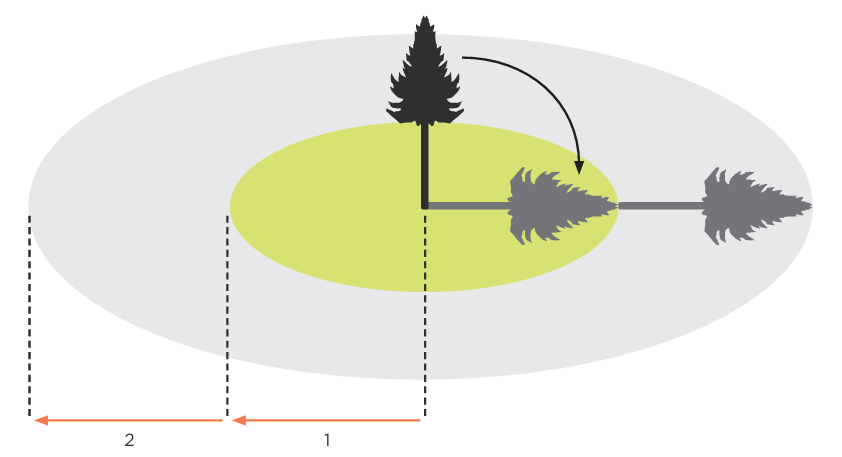
17.4.8
Anything within two tree-lengths of the tree being thinned is in the danger zone (see Figure 16).
- The crew owner/foreperson makes sure the two tree-length danger zone is calculated, understood, and obeyed by workers.
- Make sure thinners understand and manage the two tree-length danger zone from other thinners, roads, safe zones and any nearby work.
Safe thinning practice
17.4.9
Take the following actions.
- Take care when moving between trees:
- cut scrub only when not moving and with firm footing
- use the saw below shoulder height
- cut within reach and do not over-reach.
- Make sure all thinners understand and apply the five-step felling process (see Section 21.7).
- Make sure thinners are trained in and understand:
- using a chainsaw safely
- the different felling techniques according to trunk size
- the methods for dealing with hang-ups including any trees left standing after the back cut
- posting.
- If using tree driving or brushing to remove a hang-up, see Section 21.12.
- Keep equipment maintained and in good working order – including any safety features.
17.5 Managing the risk – chemical thinning
17.5.1
Chemical thinning involves using herbicides to selectively kill unwanted trees. Common practice is that a hole is drilled into the trunk of the tree and a dose of herbicide injected.
17.5.2
The following are good practices for carrying out chemical thinning work.
PPE and other equipment
Personal protective equipment
18.5.3
It is industry best practice for the following PPE to be used:
- lace-up footwear, or equivalent, providing ankle support and a non-slip sole
- wet weather gear
- sun protection
- PPE to protect workers from herbicide exposure – refer to the herbicide's safety datasheet (SDS) for what PPE to wear.
Other equipment
17.5.4
Other equipment includes:
- a spillproof container or backpack bladder for carrying herbicides
- a holster or backpack for carrying battery-operated drills and spare batteries
- a fire blanket in the event of a lithium battery fire.
Safe practice
17.5.5
For more information on working with harmful substances, see Section 17.1.9.
17.5.6
When drilling, and injecting the herbicide, always operate below eye level to minimise the risk of splashback.
17.5.7
For information about the safe use of lithium-ion batteries, see Resources webpage
17.6 Managing the risks – mechanised thinning
17.6.1
For guidance on managing the risks of mechanised thinning, see Section 20 – Mechanised felling.
17.7 Managing the risks – seed collection
17.7.1
Seed collection can take place at ground level after thinning.
17.7.2
There may be some instances where seeds are collected by climbing or using mechanised height equipment.
17.7.3
For more information on climbing, see Section 13.3.12 on specialised climbing practices.
Last updated