On this page
- 15.1 Duty of PCBUs who manage or control the workplace
- 15.2 Constructing and maintaining access roads
- 15.3 Constructing crossings
- 15.4 Constructing log landings or log loading areas
- 15.5 Traffic management and signage
- 15.6 Traffic entering and exiting the forest
- 15.7 Marking ropes rigged across roads
- 15.8 Controlling authorised visitors
15.1 Duty of PCBUs who manage or control the workplace
15.1.1
A PCBU who manages or controls a workplace must ensure that, so far as is reasonably practicable, the workplace, the means of entering and exiting the workplace, and anything else arising from the workplace are without health and safety risks to any person.
15.1.2
You do not owe this duty to anyone who is at the workplace for an unlawful purpose.
15.2 Constructing and maintaining access roads
Constructing access roads to harvesting sites, log landings or processing areas
15.2.1
Construct and maintain roads to the engineering standards appropriate for their intended use. See the New Zealand Forest Road Engineering Manual.
15.2.2
When constructing access roads:
- make sure the road is built to the correct width and gradient as outlined in the New Zealand Forest Road Engineering Manual
- consider waterways (dry or flowing) and the impact they might have on any roading in heavy rain
- check the initial road construction plan and remove overhead hazards from road, bridge and log landing construction areas
- if the road areas are adjacent to a moderate-steep slope:
- put in place control measures to prevent machinery slipping down the slope
- there may also be risks from upslope hazards to be managed
- remove hazardous trees
- make sure felled trees are clear of standing trees and left in a safe position
- mark or tape off any dangerous areas
- use safe systems of work such as traffic management plans which allow road users and adjoining landowners to pass through and around the road works when it is safe to do so.
Maintaining access roads
15.2.3
Unsealed access roads can deteriorate and put workers and other road users at risk.
15.2.4
Maintain roads to ensure a reasonable quality road surface.
15.2.5
Put in place traffic control measures as needed during maintenance. See the New Zealand Forest Road Engineering Manual.
15.3 Constructing crossings
15.3.1
Design and construct crossings and their approaches to engineering standards appropriate for their intended use. See the New Zealand Forest Road Engineering Manual.
15.4 Constructing log landings or log loading areas
15.4.1
Design and prepare log landing or loading areas to allow safe operations. This can be done by:
- managing the risk from surrounding trees
- managing the risk of earthflows
- minimising where workers and machinery interact.
15.4.2
There are many factors that can affect the size and shape of log landings, including the:
- terrain, soil types and underlying geology
- size and type of yarder and associated stem landing area (less than 3% fall)
- processing area needed
- loader configuration
- log capacity
- log size and length
- space available (topography).
15.4.3
Consider the size, location and layout of landings in the early harvest plan. Ideally all PCBUs (and their workers) work together to identify the most effective and safest sites and harvest systems when designing the landings.
15.4.4
Have landing areas that:
- have a solid and flat foundation (for example, for loading so logs will not slide or roll towards workers or equipment)
- have good water control (for example, good ground water drainage) so log trucks do not get stuck or require assistance to access or move about the landing
- are cleared of hazardous trees, particularly those trees:
- leaning towards the landing
- on the prevailing wind side
- disturbed during landing construction
- in or leaning into the corridor of the guyline
- are clear of any powerlines or have powerlines with specified safe zones under and around them.
15.4.5
Make sure landings:
- allow traffic to pass the operation safely
- allow operators to easily see anyone arriving at the landing
- have visitor control procedures
- allow for the safe entry and exit by all truck types
- allow for parking, turning and moving mobile plant and trucks (this may require berms)
- have space for inspecting, maintaining and repairing mobile plant
- have a safe and level loading zone for log trucks and trailers, and a safe area for drivers to view the loading process
- have separate working areas for each landing activity with suitable separation distances. For example, for activities like:
- loading
- stacking (logs to be turned and swung without hitting standing timber, rigging or other equipment or objects) and measuring
- log quality control checks
- saw sharpening by ground workers
- allow at least two-thirds of the stem/drag to be landed safely and securely (for hauler operations), or if this is not practicable have alternative means to manage the risk of stems sliding back down the hill
- have sufficient space for the number of products to be safely stored, loaded and for the volume of wood to be handled
- have sufficient space for any slash and processing debris to be held on site
- have compliant storage areas for chemicals and fuel
- have space for parking worker vehicles safely away from landing activities
- have space for a sheltered smoko/rest area
- have a safe location for the toilet. If there is no safe area on the landing, chose a reasonably accessible and safe location nearby.
15.4.6
Figure 14 shows examples of different landing sites.
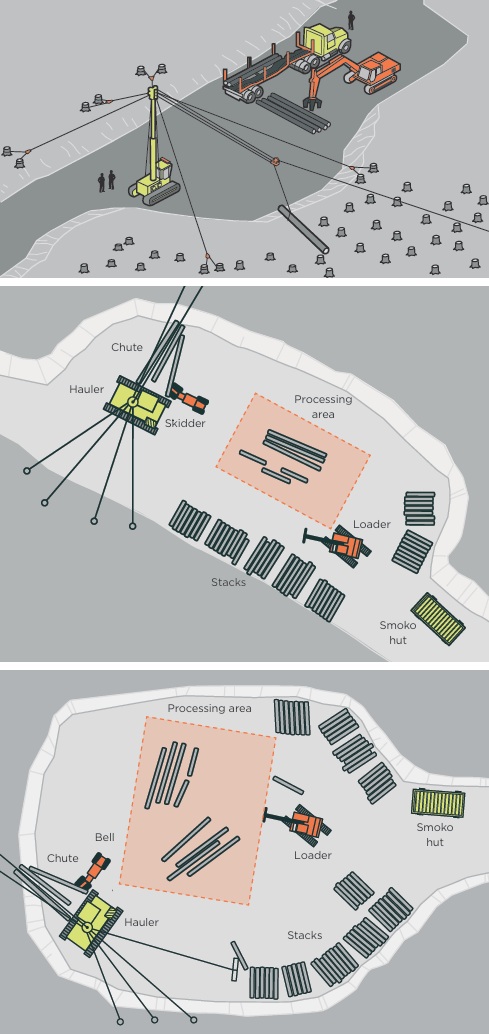
Figure 13 presents three examples of forestry landing site layouts, shown from an aerial perspective.
Example 1: Shows a hauler positioned on the left side of a landing site with cables extending upslope. On the right side of the landing, there is a loader next to a truck. Logs are arranged in front of the loader and stacked on the truck.
Example 2: Displays a more organised landing layout with distinct zones. On the left, a hauler is connected to a chute system with cables extending outward. A skidder is positioned near the hauler. The center features a large processing area containing organised logs. Below the processing area are multiple stacks of logs arranged in parallel rows. A loader is positioned between the processing area and stacks. A smoko hut is located on the right edge of the site.
Example 3: Shows an alternative landing configuration. On the left side, a bell and chute system connects to a hauler with cables radiating outward. A large processing area occupies the central-left portion, containing logs in various arrangements. A loader is positioned to the right of the processing area. Log stacks are arranged in groups around the perimeter, particularly on the right side. A smoko hut is located on the far right of the site.
End of text alternative.
Figure 13 is adapted from Safe Work Australia’s guidance: Forestry: Guide to managing risks in cable harvesting (2013)(external link) and Safetree Best Practice Guidelines for Cable Logging (2005)(external link)
15.4.7
For downhill yarding, make sure landings are large enough to have sufficient space between the base of the slope and the tower to allow for safe landing of logs without endangering the yarder. It is industry practice to have at least 1.5 tree lengths (Figure 14).
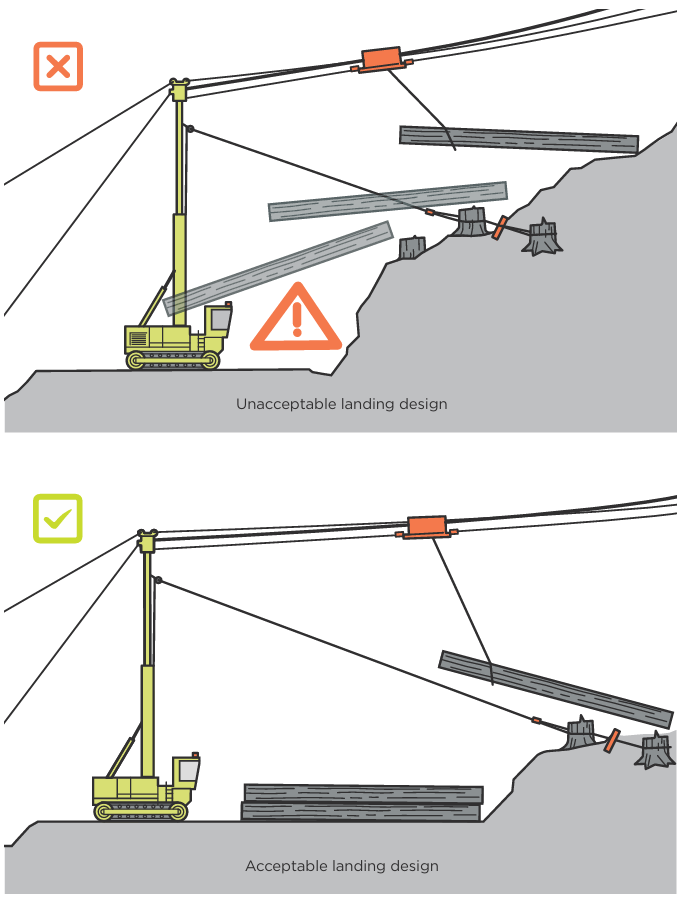
Figure 14 compares two landing design configurations for downhill yarding operations, showing one unacceptable and one acceptable layout.
Unacceptable landing design: Shows a hauler with a vertical tower positioned too close to the base of the slope. Cable lines extend upward from the hauler through a carriage on the mainline to tree stumps on the slope. There is insufficient space between the base of the slope and the tower, creating a risk that logs being yarded downhill could endanger the yarder and workers.
Acceptable landing design: Shows the same hauler and cable configuration, but the hauler is positioned with adequate distance from the base of the slope. Log stacks are safely positioned in the landing area. This configuration provides at least 1.5 tree lengths of space between the base of the slope and the tower. This spacing allows for safe landing of logs without endangering the yarder or workers.
End of text alternative.
Figure 14 is adapted from Safe Work Australia’s guidance: Forestry: Guide to managing risks in cable harvesting (2013)(external link).
15.4.8
For more information on different landing layouts, see the New Zealand Forest Road Engineering Manual.
15.5 Traffic management and signage
Managing traffic
15.5.1
Make sure you have a plan to manage traffic agreed to by the person or entity who controls the road.
15.5.2
Who this is will depend on the type of road. In general:
- for public roads, the road controlling authority (RCA) is usually a local council (for local roads) or the New Zealand Transport Agency (NZTA) (for state highways)
- for private roads, the person controlling the road could be the forest owner, the landowner or a utility owner.
15.5.3
The Best practice guidelines for temporary traffic control on private forest roads has specific guidance on:
- direction and protection signs, and usage
- banners and barriers used for road closures
- planning and application.
Signage
15.5.4
Make sure signage is clear and readable, and appropriate for the work being carried out. Use reflective signage for operations carried out in the dark.
15.5.5
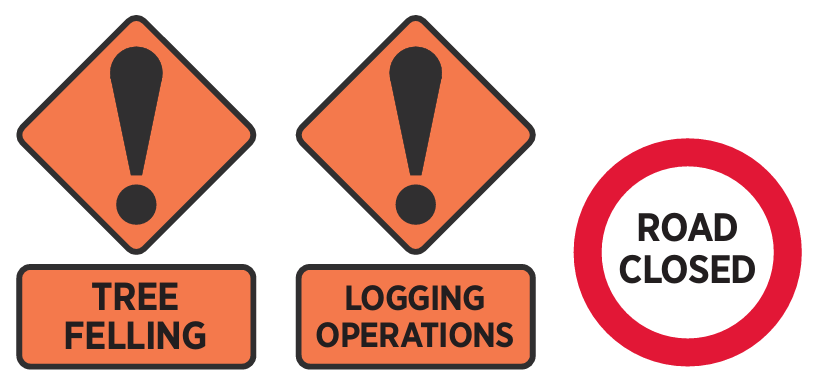
Examples of signs include 'Tree Felling', 'Logging Operations' and 'Road closed' (Figure 15).
15.6 Traffic entering and exiting the forest
15.6.1
Make sure that all traffic entering and exiting the forest on access roads or using forestry roads is managed safely by:
- using signage at the entrance to the forest to indicate the correct radio channel and to turn lights on
- including easily visible road markers at appropriate intervals so traffic using forest and access roads can call their position on the roads
- using correct signage to warn road users when they are approaching logging operations
- using signs including contact details and RT channel to instruct the driver to stop and contact a supervisor for authorisation to continue to the worksite.
15.7 Marking ropes rigged across roads
15.7.1
Clearly flag or mark any static ropes rigged across any road for road users.
15.7.2
Install signposts to warn of clearance restrictions where any overhead ropes are lower than 6m above the road surface when slack.
15.7.3
If any of the ropes rigged across the road are operating ropes, put traffic control measures in place.
15.7.4
Do not allow vehicles under operating ropes when the ropes are in use.
15.8 Controlling authorised visitors
15.8.1
Put in place arrangements to manage visitors to the work area including providing a site induction.
15.8.2
The site supervisor needs to ensure visitors:
- have been briefed on hazards that may impact their health and safety
- understand and comply with safe work procedures
- have and use PPE where it is required.
Last updated