10.1 Using PPE to manage risks
10.1.1
If you are required to, or choose to, use PPE as a way of managing risks, you must comply with certain requirements. This section provides guidance on these requirements.
10.2 Who can provide PPE
10.2.1
If PPE is being used to manage risks, a PCBU who directs the carrying out of work at a workplace must provide PPE to workers.
10.2.2
PPE can also be provided by:
- another PCBU (costs could be shared)
- the worker (if they genuinely and voluntarily choose to provide their own PPE).
10.2.3
You cannot pass on the cost of providing PPE (in full or part) to your worker.
10.2.4
You cannot make your worker provide their own PPE as a condition of employment.
10.2.5
If the worker chooses to provide their own PPE, you must still make sure the PPE will provide appropriate protection. Workers can change their mind about providing their own PPE. They must give you reasonable notice of this.
10.3 PPE must be fit-for-purpose
10.3.1
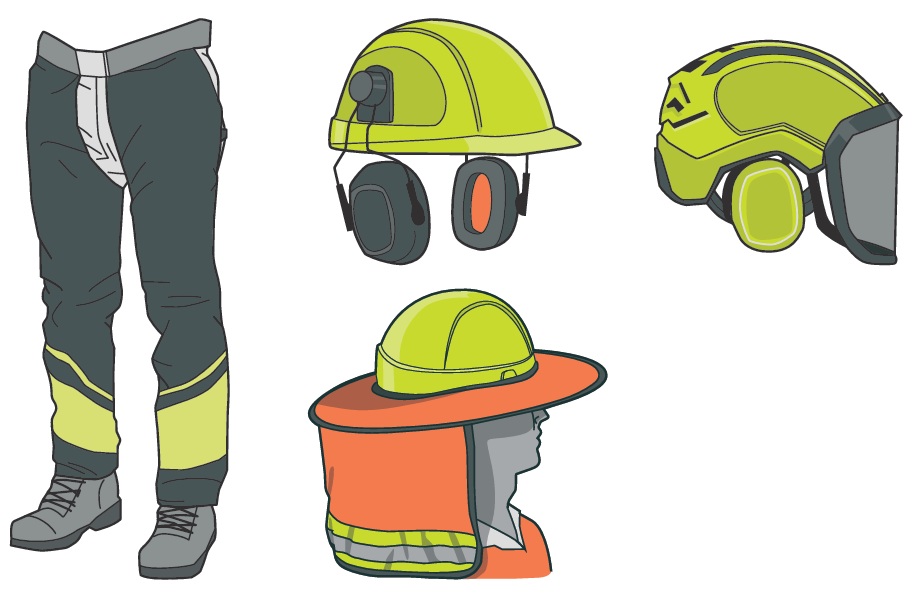
For forestry work, PPE may include:
- hard hat or helmet
- eye protection/face shields
- protective clothing (such as chainsaw chaps and wet weather clothing)
- gloves
- protective or steel-toed boots
- high-visibility clothing - day-night for added visibility
- lone worker (man-down) alarms
- hearing protection (Grade 5)
- fall-arrest or restraint equipment when working at heights.
10.3.2
When selecting PPE, you must make sure it is:
- suitable for the nature of the work and any hazards associated with the work
- a suitable size and fit and reasonably comfortable (for example, does your worker wear prescription glasses, have facial hair or other features that could affect how well PPE fits?)
- compatible with any other PPE your worker is required to wear or use.
10.3.3
You must engage with your workers when making decisions about ways to eliminate or minimise work risks and when proposing changes that may affect their health or safety.
10.3.4
Workers must receive training in how to wear or use their PPE.
10.4 Industry standards for PPE
10.4.1
Industry has accepted standards for different PPE such as for high-vis clothing, leg protection and safety helmets (Appendix 7). Look for the mark/stamp on the PPE to check it is compliant with the relevant standard.
10.4.2
While these standards are not mandatory under HSWA, they may indicate an adequate level of protection in prescribed circumstances. However, as a PCBU, you decide what PPE is suitable under your circumstances.
10.5 Make sure PPE does not create new risks
10.5.1
When assessing PPE needs, discuss with your workers what new risks the proposed PPE may create and how you can eliminate or minimise those risks. The following are examples of risks associated with different types of PPE:
Hearing protection
10.5.2
Some types of hearing protection can affect workers' situational awareness (for example, preventing them from hearing approaching mobile plant).
10.5.3
There are types of hearing protection that can protect workers hearing without compromising situational awareness.
Heavy or thick clothing
10.5.4
Heavy or thick clothing may cause workers to overheat, affect their mobility, or create entanglement risks. Talk with your workers about alternative clothing options (such as lighter more breathable fabrics or closer fitting options).
10.5.5
Make sure workers only wear approved beanies under helmets.
Long sleeves and trousers
10.5.6
Long sleeves and trousers can provide good protection. However, having blanket site rules requiring long sleeves and trousers may lead to unnecessary discomfort for workers (especially during summer months).
10.5.7
Consider if alternative protection may be appropriate. For example:
- for work under shade from trees, it may be suitable for chaps and gaiters to be worn over shorts
- if workers are exposed to UV radiation, it may be more suitable for lighter, more breathable fabrics to be worn.
10.6 Keep PPE in good working order
10.6.1
PPE must be clean, hygienic, and in good working order.
10.6.2
You must make sure that PPE is maintained, repaired, or replaced so that it continues to minimise risk to the worker who uses it, including PPE provided by workers.
10.6.3
Workers must receive training in how to maintain and store their PPE correctly.
10.6.4
Replace PPE whenever it becomes worn out, is no longer providing adequate protection, or is past its use-by date. Assess when PPE needs to be replaced – replacing PPE on a yearly basis may not be sufficient.
10.6.5
You must not charge workers for providing PPE.
10.7 Worker duties for PPE
10.7.1
Workers must wear or use PPE in accordance with any information, training or reasonable instructions by the PCBU.
10.7.2
Workers must not intentionally misuse or damage PPE. Workers must inform the PCBU when PPE is damaged, not working properly or needs to be cleaned/decontaminated.
10.8 More information
10.8.1
For more information, see Resources webpage
Last updated