3.1 Who are the duty holders?
3.1.1
HSWA sets out the work health and safety duties that duty holders must comply with.
3.1.2
There are four types of duty holder under HSWA:
- a person conducting a business or understanding (PCBU)
- an officer
- a worker
- an 'other person' at the workplace.
3.1.3
Most duties under HSWA relate to how work is carried out. However, some duties are linked to where work is carried out: the workplace.
A workplace is a place where work is being carried out or usually carried out for a business or undertaking. It includes any place where a worker goes or is likely to be while at work (section 20 of HSWA(external link))
| Duty holder | Who are they? | Examples | What are their duties? |
|---|---|---|---|
| Person conducting a business or undertaking (PCBU) | A PCBU may be an individual person or an organisation. The following are not PCBUs:
|
|
A PCBU has many duties. Key duties are summarised below. Primary duty of care (section 36 of HSWA(external link)) PCBUs must ensure, so far as is reasonably practicable:
For more information:
Managing risks (section 30 of HSWA(external link)) Risks to health and safety arise from people being exposed to hazards (anything that can cause harm). A PCBU must manage work health and safety risks. A PCBU must first try to eliminate a risk so far as is reasonably practicable. This can be done by removing the source of harm – for example, removing faulty equipment or a trip hazard. If it is not reasonably practicable to eliminate the risk, it must be minimised so far as is reasonably practicable. For more information, see Appendix 6(external link). Overlapping duties: working with other PCBUs (section 34 of HSWA(external link)) A PCBU with overlapping duties must, so far as is reasonably practicable, consult, cooperate and coordinate activities with other PCBUs they share duties with. For more information, see Section 3.3(external link) and Appendix 3(external link). Involving workers: worker engagement, participation and representation (Part 3 of HSWA(external link)) A PCBU must, so far as is reasonably practicable, engage with their workers (or their workers' representatives) about health and safety matters that will directly affect the workers. A PCBU must have worker participation practices that give their workers reasonable opportunities to participate in improving health and safety on an ongoing basis For more information, see Appendix 4(external link). |
| Upstream PCBU | A PCBU in the supply chain |
|
Upstream PCBU (sections 39–43 of HSWA(external link)) An upstream PCBU must ensure, so far as is reasonably practicable, that the work they do or the things they provide to other workplaces do not create health and safety risks. For more information, see Appendix 5(external link). |
| Officer | A specified person or a person who exercises significant influence over the management of the business or undertaking (section 18 of HSWA(external link)) |
|
Officers (section 44 of HSWA(external link)) An officer must exercise due diligence that includes taking reasonable steps to ensure that the PCBU meets their health and safety duties. For more information, see Resources webpage(external link) |
| Worker | An individual who carries out work for a PCBU (section 19 of HSWA(external link)) |
|
Workers (section 45 of HSWA(external link)) A worker must take reasonable care of their own health and safety, and take reasonable care that they do not harm others at work. A worker must cooperate with reasonable policies and procedures the PCBU has in place that the worker has been told about. A worker must comply, as far as they are reasonably able, with any reasonable instruction given by the PCBU so the PCBU can meet their legal duties. For more information, see Resources webpage(external link) |
| Other person at the workplace | An individual present at a workplace (not a worker) |
|
Other person at the workplace (section 46 of HSWA(external link)) An 'other person' has a duty to take reasonable care of their own health and safety, and not adversely affect the health and safety of anyone else. They must comply, as far as they are reasonably able, with reasonable instructions relating to health and safety at the workplace. For more information, see Resources webpage(external link) |
Table 2: HSWA duty holders and certain duties
3.2 Introduction to contracting chain PCBUs
3.2.1
Contracting is when a PCBU (called the contracting PCBU), hires another PCBU (called a contractor) to do work for them.
3.2.2
The forestry industry has traditionally referred to these roles as ‘principals’ and ‘contractors’ so these terms are used in this guidance.
3.2.3
In a contracting chain, and for HSWA purposes, employees of the contractor are workers of the principal (as well as being workers of their employer) (Figure 1).
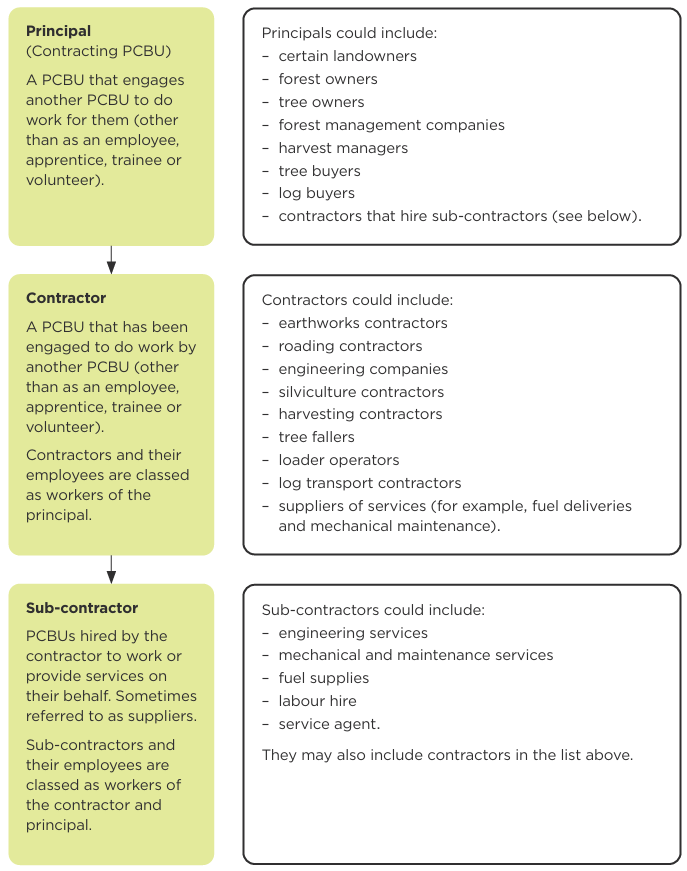
Figure 1 illustrates a hierarchical contracting chain structure, showing three levels of PCBU.
Level 1: Principal (Contracting PCBU). A PCBU that engages another PCBU to do work for them (other than as an employee, apprentice, trainee or volunteer). Principals could include certain landowners, forest owners, tree owners, forest management companies, harvest managers, tree buyers, log buyers, and contractors that hire sub-contractors.
Level 2: Contractor. A PCBU that has been engaged to do work by another PCBU (other than as an employee, apprentice, trainee or volunteer). Contractors and their employees are classed as workers of the principal. Contractors could include earthworks contractors, roading contractors, engineering companies, silviculture contractors, harvesting contractors, tree fallers, loader operators, log transport contractors, and suppliers of services (for example, fuel deliveries and mechanical maintenance).
Level 3: Sub-contractor. PCBUs hired by contractor to do work or provide services on their behalf. Sometimes referred to as suppliers. Sub-contractors and their employees are classed as workers of the contractor and principal. Sub-contractors could include engineering services, mechanical and maintenance services, fuel supplies, labour hire, and service agent. They may also include contractors in the previous list.
The diagram uses arrows to show the flow of contractual engagement from Principal down through Contractor to Sub-contractor.
End of text alternative.
3.3 Working with other PCBUs to manage health and safety through the contracting chain
What are overlapping duties?
3.3.1
As a PCBU, you must:
- ensure, so far as is reasonably practicable, the health and safety of your worker(s) and other workers you influence or direct
- ensure, so far as is reasonably practicable that the health and safety of other persons is not put at risk from the work that you do.
3.3.2
PCBUs operating in a contracting chain are likely to have shared health and safety duties with other PCBUs in that contracting chain in relation to the same matter. They all have a duty for keeping workers safe. This is known as overlapping duties.
3.3.3
Examples of overlapping duties could include:
- managing shared health and safety risks
- notifying WorkSafe when notifiable work is to begin or when a notifiable event occurs.
3.3.4
Overlapping duties are explained next.
3.3.5
If you are new to risk management, see Section 3.4 for guidance.
How can PCBUs work together?
3.3.6
Where there are overlapping duties, all PCBUs must, so far as is reasonably practicable:
- consult with each other
- cooperate with each other
- coordinate their activities.
3.3.7
Each PCBU is responsible for making sure their own duties are met. PCBUs cannot contract out of their health and safety duties or transfer responsibility for meeting their duties to others in the contracting chain.
3.3.8
The extent of the duty depends on the ability of each PCBU to influence and control the matter.
How can PCBUs work out the extent of their duty?
3.3.9
The extent of each PCBU's responsibility to carry out their duties will most likely be different. This will depend on what ability the PCBU has to influence and control the health and safety matter. The more influence and control a PCBU has over a health and safety matter, the more responsibility it is likely to have.
3.3.10
A PCBU can have influence and control over health and safety matters through:
- control over work activity: A PCBU in control of the work activity may be in the best position to control the health and safety risks.
- control of the workplace: A PCBU who has control over the workplace (and/or plant and structures at the workplace) will have some influence and control over health and safety matters relating to work carried out by another PCBU.
- control over workers: A PCBU will have more influence and control over its own employees and contractors than those of another PCBU.
3.3.11
A PCBU with a higher level of influence and control (and with the greatest share of the responsibilities) will usually be in the best position to manage the associated risks.
3.3.12
A PCBU with less control or influence may fulfil their responsibilities by making arrangements with the PCBU with the higher level of influence and control.
3.3.13
The size of the PCBU or its financial resources (for example, a large company versus a sole trader) does not equal a PCBU's ability to have control or influence over health and safety matters. This means that the PCBU with the most financial resources does not automatically have most of the responsibilities.
One simple way of understanding overlapping duties
3.3.14
Stand back from what you are doing and look at what is going on around you, and who is going to do what.
3.3.15
Talk to the other PCBUs involved. Agree on how risks are going to be managed:
- talk about what is going on – and what will be going on in the future – and who is going to be doing it
- discuss the level of control that each PCBU has over the activity
- agree on who will manage what and how it will be managed
- agree on shared facilities, if applicable
- talk about how they are going to monitor and check on things.
3.3.16
For more information:
Example: Notifying WorkSafe
An example of a shared overlapping duty is the duty to notify WorkSafe in the event of:
- the commencement of hazardous work
- a death
- a notifiable injury or illness or
- a notifiable incident (for example, a hazardous substance spill, an electric shock, or engineering failure).
The PCBUs in the contracting chain decided which PCBU would notify WorkSafe. They agreed on the process to be followed:
- If there is a death at the workplace, WorkSafe will be called immediately on 0800 030 040.
- For other events, WorkSafe will be notified through the Notify WorkSafe page of the WorkSafe website.
- The notifying PCBU would then tell the other PCBUs that a notification had been made.
While only one PCBU has been nominated to notify the regulator, all PCBUs are responsible for ensuring a notification has been made.
Example: PCBUs in a forestry contracting chain working together to create a fatigue management policy or agreement
The PCBUs agreed not to create situations where there is pressure on PCBUs further down the contracting chain to meet requirements that are likely to result in fatigue or unhealthy work pressures for workers.
They developed a fatigue management agreement that included:
- minimum hours of sleep opportunity between shifts and at least two full nights between each week of work
- maximum shift length, considering:
- time of day
- type of work
- maximum travel time before and after a shift
- maximum hours to be worked in a week
- maximum hours to be worked in a month
- procedures for detecting, reporting, and addressing fatigue.
The PCBUs together monitored and reviewed the agreement to make sure fatigue is being managed effectively. If needed, the PCBUs would together investigate incidents where fatigue may be involved.
3.4 How to manage risk
Overall duty to manage risk
3.4.1
PCBUs have the duty to manage work-related health and safety risks.
3.4.2
You must eliminate risks so far as is reasonably practicable. If you cannot eliminate the risk, you must minimise it so far as is reasonably practicable. You must do this to the extent to which you have, or would reasonably be expected to have, the ability to influence and control the matter to which the risks relate.
3.4.3
You must consult, cooperate and coordinate activities with other PCBUs you have overlapping duties with (see Section 3.3).
3.4.4
An approach to managing risk is covered in Appendix 6.
3.4.5
In addition to their HSWA duties, PCBUs must follow specific requirements for managing certain risks. These include risks from remote or isolated work, and risks from falling objects and working under raised objects.
Requirements for managing remote or isolated work
3.4.6
Work can be remote or isolated from the assistance of other people because of location, time, or the nature of the work.
3.4.7
Remote or isolated work includes:
- working alone or separated from colleagues
- working in an isolated or inaccessible area – where the nearest emergency help (for example, fire service or hospital) is some distance away
- working outside normal business hours or shift/night work
- working in locations where communication is difficult.
3.4.8
PCBUs must follow the prescribed risk management process to manage the health and safety risks to workers who carry out remote or isolated work.
3.4.9
The PCBU must provide a system of work that includes effective communication with workers.
3.4.10
For more information about the prescribed risk management process, see Resources webpage
Requirements for managing the risks of falling objects and working under raised objects
3.4.11
A lot of your day-to-day practice on a forestry site is about stopping things falling on people. PCBUs have specific steps to take when deciding how to manage the risks from falling and raised objects.
3.4.12
PCBUs must follow the prescribed risk management process to manage the health and safety risks from raised or falling objects.
3.4.13
If it is not reasonably practicable to eliminate the risks, the PCBUs must take specified steps to minimise risk.
3.5 Managing work-related health risks
How can worker health be harmed?
3.5.1
More workers will be affected by work-related health issues than acute injuries.
3.5.2
A worker's health might be harmed by:
- physical factors such as the repetition of a task, the length of time doing a task, and stresses and strains on the body
- environmental factors such as noise, temperature, and sun exposure
- organisational factors such as rosters and shifts, training and levels of experience, and worksite communication
- individual factors such as fitness, fatigue, and previous injury
- psychological factors such as production pressure, job demands, stress, workplace relationships, and workplace support.
3.5.3
There is a two-way relationship between work and health. Work can affect a worker's health and a worker's health can affect their work.
Example
A worker is part of the breaking-out crew. Their job requires fitness and stamina. The crew needs to be agile and to concentrate on what they are doing.
Usually, the crew take breaks or swap tasks with co-workers so they do not get fatigued.
But this day:
- the crew is short-handed so workers cannot swap tasks
- the crew is running behind so workers take shorter breaks.
Because the crew is working faster, workers are more fatigued. One worker strains a muscle.
The head breaker-out does not notice it and the injured worker does not tell them. Instead, the injured worker keeps working because of the pressure to get the job done. But the muscle discomfort gets worse and becomes a distraction.
Because the injured worker is not paying full attention to the job, the risk of making a mistake increases considerably.
The individual factors alone may not cause a risk but added together they increase the risk of causing harm.
How can exposure monitoring and health monitoring be used to effectively manage health risks?
3.5.4
Figure 2 explains what exposure monitoring and health monitoring are.
3.5.5
Monitoring is not a control measure. It does not replace the need for control measures to eliminate or minimise worker exposure to harm.
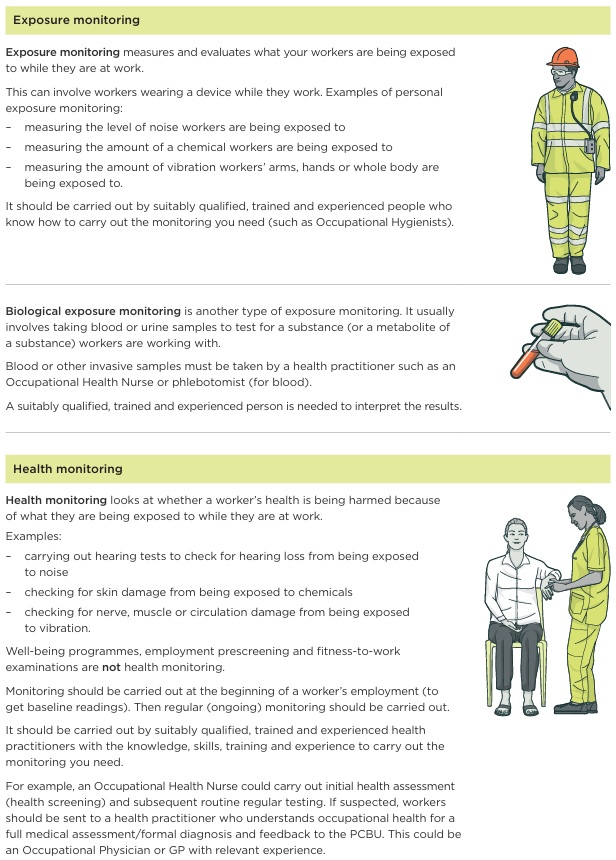
Exposure monitoring
Exposure monitoring measures and evaluates what your workers are being exposed to while they are at work.
This can involve workers wearing a device while they work. Examples of personal exposure monitoring:
- measuring the level of noise workers are being exposed to
- measuring the amount of a chemical workers are being exposed to
- measuring the amount of vibration workers' arms, hands or whole body are being exposed to.
It should be carried out by suitably qualified, trained and experienced people who know how to carry out the monitoring you need (such as Occupational Hygienists).
Biological exposure monitoring is another type of exposure monitoring. It usually involves taking blood or urine samples to test for a substance (or a metabolite of a substance) workers are working with.
Blood or other invasive samples must be taken by a health practitioner such as an Occupational Health Nurse or phlebotomist (for blood).
A suitably qualified, trained and experienced person is needed to interpret the results.
Health monitoring
Health monitoring looks at whether a worker's health is being harmed because of what they are being exposed to while they are at work.
Examples:
- carrying out hearing tests to check for hearing loss from being exposed to noise
- checking for skin damage from being exposed to chemicals
- checking for nerve, muscle or circulation damage from being exposed to vibration.
Well-being programmes, employment prescreening and fitness-to-work examinations are not health monitoring.
Monitoring should be carried out at the beginning of a worker's employment (to get baseline readings). Then regular (ongoing) monitoring should be carried out.
It should be carried out by suitably qualified, trained and experienced health practitioners with the knowledge, skills, training and experience to carry out the monitoring you need.
For example, an Occupational Health Nurse could carry out initial health assessment (health screening) and subsequent routine regular testing. If suspected, workers should be sent to a health practitioner who understands occupational health for a full medical assessment/formal diagnosis and feedback to the PCBU. This could be an Occupational Physician or GP with relevant experience.
End of text alternative.
3.5.6
Exposure monitoring and health monitoring – along with verifying that control measures are working effectively – can be used to manage health risks (Figure 3). Health monitoring can also confirm that control measures are preventing harm.
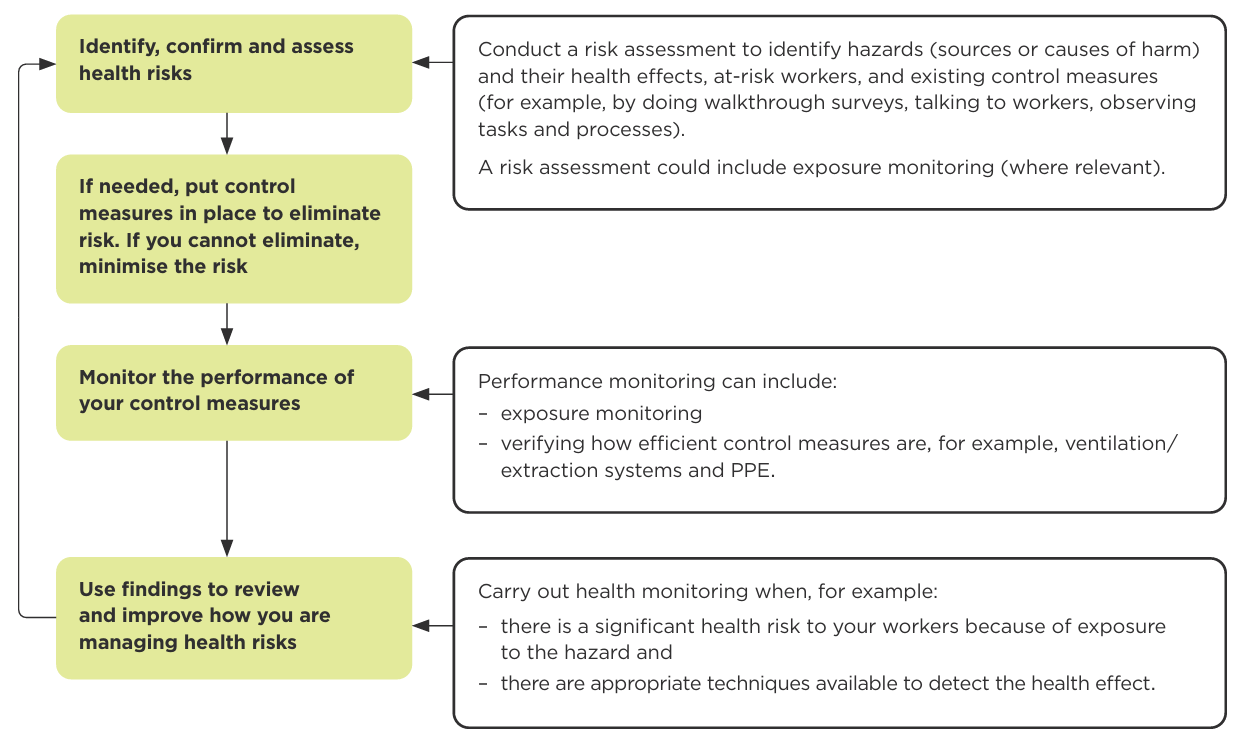
Figure 3 illustrates a continuous cycle for managing health risks and exposure monitoring in the workplace, consisting of four interconnected steps:
Step 1: Identify, confirm and assess health risks. Conduct a risk assessment to identify hazards (sources or causes of harm) and their health effects, at-risk workers, and existing control measures (for example, by doing walkthrough surveys, talking to workers, observing tasks and processes). A risk assessment could include exposure monitoring (where relevant).
Step 2: If needed, put control measures in place to eliminate risk. If you cannot eliminate, minimise the risk.
Step 3: Monitor the performance of your control measures. Performance monitoring can include exposure monitoring and verifying how efficient control measures are, for example, ventilation/extraction systems and PPE.
Step 4: Use findings to review and improve how you are managing health risks. Carry out health monitoring when, for example, there is a significant health risk to your workers because of exposure to the hazard and there are appropriate techniques available to detect the health effect.
The diagram shows arrows connecting each step in sequence, with a return arrow from Step 4 back to Step 1, emphasizing the cyclical and continuous nature of health risk management.
End of text alternative.
When to monitor?
3.5.7
You must ensure, so far as is reasonably practicable, the health and safety of workers, and that other persons are not put at risk by your work. In some circumstances, this could mean monitoring worker exposure and/or the health of workers.
3.5.8
You may be required to monitor worker exposure or worker health in circumstances specified in HSWA regulations.
3.5.9
WorkSafe could also request you carry out monitoring to meet your primary duty or HSWA regulation requirements.
3.5.10
For further information see Resources webpage
What type of monitoring?
3.5.11
The type of monitoring depends on the kind of work you do.
3.5.12
You will need to talk to a suitably qualified and experienced health and safety professional to advise if monitoring is appropriate for you - and if so, what type and how often. You could need initial monitoring carried out, and then regular (ongoing) monitoring.
3.5.13
For more information on selecting external monitoring providers, putting in place monitoring programmes including what to do if workers do not take part, see Resources webpage
What are common hazards that can harm workers' health?
3.5.14
Health hazards that forestry workers could be exposed to include:
- fatigue
- mental health harm
- noise
- vibration
- temperature extremes (hot and cold)
- UV/sun exposure
- harmful substances
- hazardous manual tasks (work-related musculoskeletal disorders).
3.5.15
These may not be the only health hazards your workers are exposed to, but they are a good place to start. These topics are addressed next.
Fatigue
What is fatigue and how can it harm?
Fatigue is a state of physical and/or mental exhaustion.
3.5.17
Forestry work relies on workers being physically and mentally alert. A worker's fitness to work can be affected by fatigue. This can create a risk to their health and safety and the safety of those around them.
3.5.18
The more fatigued a worker gets, the more likely they are to be affected and make bad decisions.
3.5.19
Fatigue can also cause micro-sleeps, where the person briefly falls asleep. Micro-sleeps can be dangerous if they occur at the wrong time (for example, when the person is in control of mobile plant).
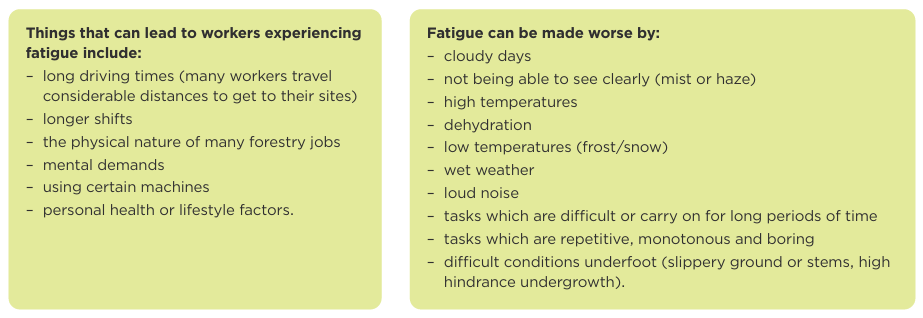
Figure 4 consists of two side-by-side text blocks listing causes and worsening factors of fatigue.
Things that can lead to workers experiencing fatigue include: long driving times (many workers travel considerable distances to get to their sites); longer shifts; the physical nature of many forestry jobs; mental demands; using certain machines; and personal health or lifestyle factors.
Fatigue can be made worse by: cloudy days; not being able to see clearly (mist or haze); high temperatures; dehydration; low temperatures (frost/snow); wet weather; loud noise; tasks which are difficult or carry on for long periods of time; tasks which are repetitive, monotonous and boring; and difficult conditions underfoot (slippery ground or stems, high hindrance undergrowth).
End of text alternative.
What are possible control measures?
3.5.20
Table 3 describes control measures that can be used to reduce the chances of workers experiencing fatigue.
| Possible control measure | Examples |
|---|---|
| Create work schedules that allow for sufficient rest during work shifts and between shifts (in consultation with your workers) |
|
| Schedule tasks suitably throughout a work period A worker's ability to remain alert and focused can be reduced between 3.00am and 5.00am, and between 3.00pm and 5.00pm |
|
| Limit periods of excessive mentally or physically demanding work |
|
| Make sure workloads are manageable |
|
| Provide workers with training and information on fatigue management so they can self-manage outside of work hours |
|
| Provide a process for workers to report fatigue-related issues to management |
|
| Develop a fatigue management plan |
|
| Use technology to monitor for fatigue |
|
Table 3: Possible control measures for fatigue
3.5.21
For more information, see Resources webpage
Mental harm
How can mental health be harmed?
Harm to mental health may be immediate or long-term. It can come from a single event or repeated exposure.
3.5.23
Harm to mental health can decrease workers' mental wellbeing resulting in, for example, increased stress, reduced work performance and increased risk of self-harm and suicide.
What are risk factors for mental harm and possible control measures?
3.5.24
You must manage risks to your workers' mental health as well as risks to their physical health and safety.
3.5.25
Many potential risks to worker mental health can be minimised by PCBUs working together at the planning and design stages of work.
3.5.26
Table 4 shows causes and possible control measures.
| Cause of mental health harm | Possible control measures include: |
|---|---|
|
|
|
|
|
|
Table 4: Cause of mental health harm and possible control measures
3.5.27
For more information, see Resources webpage
Noise
How can noise be harmful?
Noise is a common hazard on forestry sites. The biggest noise risks come from chainsaws and mobile plant.
3.5.29
Noise is considered hazardous when it reaches 85 decibels (dBA) or more. If people have to raise their voices or shout to be heard in a conversation, then the noise level may be too high.
3.5.30
Working in or near machinery can expose workers to continual or excessive noise. If the noise levels are too high, or prolonged, they can lead to hearing loss.
3.5.31
Noise induced hearing loss is permanent. It can have a significant impact on a worker's life. Loud noise can also lead to tinnitus – a persistent ringing or buzzing in the ears.
3.5.32
You must, so far as is reasonably practicable, make sure that workers are not exposed to noise levels that are:
- equivalent to 85 decibels averaged over 8 hours, or
- a peak noise level over 140 decibels.
3.5.33
This always applies, whether or not your workers are wearing hearing protection.
What are possible control measures
| Control measure | Examples |
|---|---|
| Eliminate the source of the noise |
|
| Minimise exposure of workers to excessive noise |
|
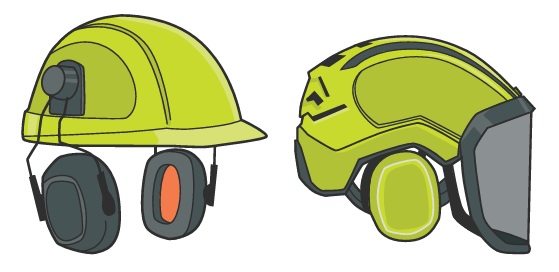
| Provide hearing protection for workers to use (Grade 5) Only rely on hearing protection when you have taken all other reasonably practicable steps to minimise exposure to noise. |
|
Table 5: Possible control measures for noise
What about exposure monitoring and health monitoring?
3.5.34
Exposure monitoring checks the amount of noise your workers are exposed to. It can be used to inform you:
- if control measures are needed
- what level of hearing protection is required
- whether existing control measures are being effective at minimising the risk.
3.5.35
Consider including health monitoring (hearing tests to check for hearing loss) into your health monitoring programme.
3.5.36
For more information, see Resources webpage
Vibration
What is excessive vibration and how can it harm?
Exposure to excessive vibration can cause permanent and disabling damage to forestry workers.
3.5.38
Forestry workers can be exposed to harmful levels of vibration through various sources. For example, from:
- spending long periods of time sitting on or operating mobile plant, vehicles, or machinery that vibrates
- using tools or machinery that vibrate for long periods of time.
- working in cold conditions can increase the harmful effects of vibration on the body.
3.5.39
There are two main types of vibration that can harm workers - whole body vibration and hand-arm vibration (Figure 6).
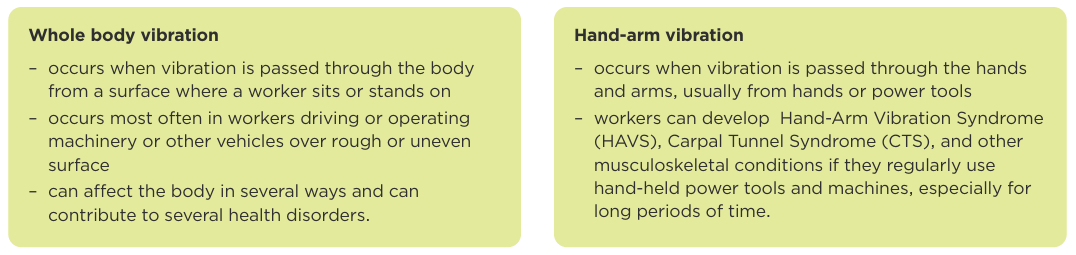
Whole body vibration
- occurs when vibration is passed through the body from a surface where a worker sits or stands on
- occurs most often in workers driving or operating machinery or other vehicles over rough or uneven surface
- can affect the body in several ways and can contribute to several health disorders.
Hand-arm vibration
- occurs when vibration is passed through the hands and arms, usually from hands or power tools
- workers can develop Hand-Arm Vibration Syndrome (HAVS), Carpal Tunnel Syndrome (CTS), and other musculoskeletal conditions if they regularly use hand-held power tools and machines, especially for long periods of time.
End of text alternative.
What are possible control measures
| Control measure | Examples |
|---|---|
| Eliminate the source of the vibration |
|
| Minimise exposure of workers to excessive vibration |
|
| Provide PPE for workers to use Only rely on PPE when you have taken all other reasonably practicable steps to minimise exposure to vibration. |
|
Table 6: Possible control measures for vibration
What about exposure monitoring and health monitoring?
3.5.40
Exposure monitoring checks the amount of vibration your workers are exposed to. It can be used to inform you:
- if control measures are needed
- whether existing control measures are effective at minimising the risk.
3.5.41
Consider including health monitoring (that looks for signs and symptoms of vibration-related illness or injury) into your health monitoring programme:
- For hand-arm vibration, health monitoring checks for nerve, muscle or circulation damage in hands, wrists and arms.
- For whole body vibration, health monitoring checks for lower back, neck or shoulder pain or other signs of discomfort.
3.5.42
For more information, see Resources webpage
Extreme temperatures
How can working in extreme temperatures harm workers and when can it happen?
The outdoor nature of forestry means forestry workers are particularly vulnerable to the effects of working in extreme temperatures.
3.5.44
Exposure to extreme hot or cold temperatures can cause serious harm to forestry workers.
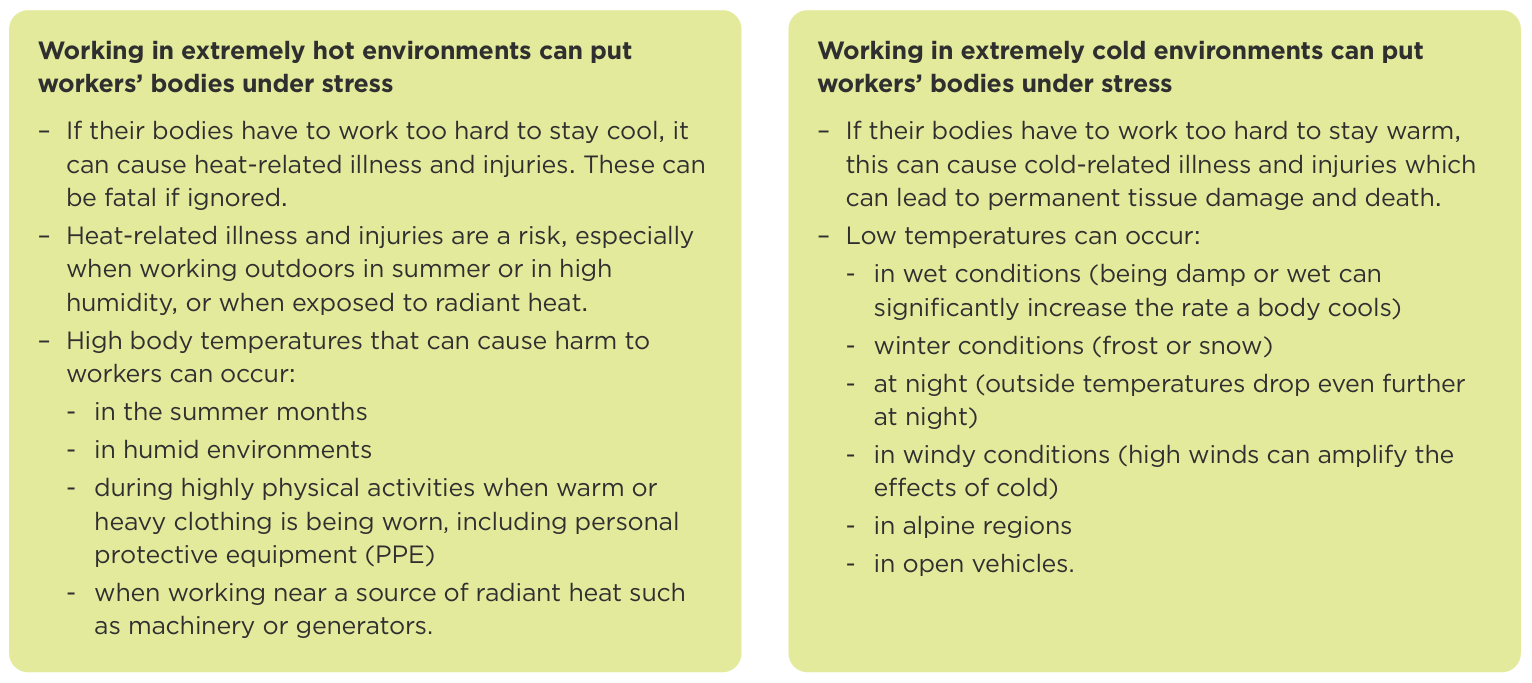
Working in extremely hot environments can put workers' bodies under stress
- If their bodies have to work too hard to stay cool, it can cause heat-related illness and injuries. These can be fatal if ignored.
- Heat-related illness and injuries are a risk, especially when working outdoors in summer or in high humidity, or when exposed to radiant heat.
- High body temperatures that can cause harm to workers can occur:
- in the summer months
- in humid environments
- during highly physical activities when warm or heavy clothing is being worn, including personal protective equipment (PPE)
- when working near a source of radiant heat such as machinery or generators.
Working in extremely cold environments can put workers' bodies under stress
- If their bodies have to work too hard to stay warm, this can cause cold-related illness and injuries which can lead to permanent tissue damage and death.
- Low temperatures can occur:
- in wet conditions (being damp or wet can significantly increase the rate a body cools)
- winter conditions (frost or snow)
- at night (outside temperatures drop even further at night)
- in windy conditions (high winds can amplify the effects of cold)
- in alpine regions
- in open vehicles.
End of text alternative.
What are possible control measures?
3.5.45
Table 7 shows possible control measures for work at extreme temperatures.
| Control measure | Examples of control measures for extreme heat | Examples of control measures for extreme cold |
|---|---|---|
| Minimise sources of heat |
|
|
| Use plant appropriate for the conditions |
|
|
| Schedule the work to minimise exposure to extreme temperature |
|
|
| Provide training to workers |
|
|
| Provide PPE to workers Only rely on PPE when you have taken all other reasonably practicable steps to minimise the risk. Section 10 explains the requirements you must meet if you are using PPE to minimise risks. Appendix 7 contains relevant standards for PPE. Look for the mark/stamp on the PPE to check it is compliant with the relevant standard. |
|
|
Table 7: Possible control measures for work at extreme temperatures
Dehydration
It is important that workers drink water regularly and drink well during the day. It is recommended:
- workers carry enough water to drink regularly throughout the day
- workers drink enough water that they have to urinate regularly during the workday
- workers avoid drinking energy drinks or soft drinks and cordials during the workday
- workers drink plenty of water at night to recharge the body for the next day
- for machine operators, make sure the air conditioning (if it is fitted) in the cab is working effectively. If it is not working, tell workers to let the foreman know so it can be fixed.
What about exposure monitoring and health monitoring?
3.5.46
Exposure monitoring checks the thermal conditions your workers are exposed to. It can be used to inform you:
- if control measures are needed
- whether existing control measures are effective at minimising the risk.
3.5.47
Consider including health monitoring (that looks for signs and symptoms of heat or cold-related illness or injury) into your health monitoring programme.
3.5.48
For more information, see Resources webpage
UV/sun exposure
How can UV/sun exposure harm workers?
Exposure to ultraviolet (UV) radiation from the sun can increase the chance of workers developing serious health conditions. UV radiation can harm a worker in several ways, including skin cancer and eye damage (such as cataracts). All skin types can be damaged by UV rays.
3.5.50
The total amount of UV radiation that a worker may be exposed to when working outside depends on the factors described in Table 8.
| Factors affecting UV exposure | Things to consider |
|---|---|
| The time of day and the time of year | UV levels are highest when the sun is high and during summer when the sun is in the sky for longer |
| The weather conditions | UV levels are generally higher on a cloudless day. However, UV radiation can pass through cloud cover and reach harmful levels even on a cloudy day. |
| Work surfaces | Workers can be exposed to UV radiation as it reflects off lighter colour surfaces. The lighter the colour of the surface, the more UV radiation will be reflected. |
| Medication and chemical exposure | Certain medication and chemical exposures can increase the chance of UV damage because they cause photosensitivity, which makes a person more sensitive to UV radiation. |
Table 8: Factors that can affect UV exposure
What are possible control measures
| CONTROL MEASURE | EXAMPLES |
|---|---|
| Provide shelter |
|
| Schedule the work to minimise exposure to UV |
|
| Provide training to workers |
|
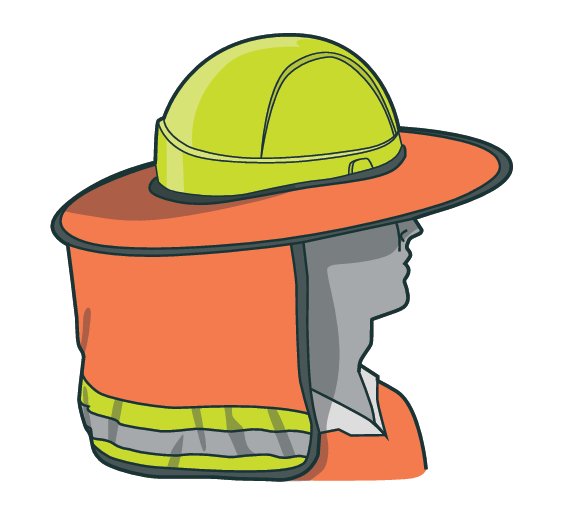
| Provide PPE to workers Only rely on PPE when you have taken all other reasonably practicable steps to minimise the risk. Section 10 explains the requirements you must meet if you are using PPE to minimise risks. Appendix 7 contains relevant standards for PPE. Look for the mark/stamp on the PPE to check it is compliant with the relevant standard. |
When considering what PPE options are appropriate, check that the proposed PPE is not going to introduce new risks. Examples include:
|
Table 9: Possible control measures for UV radiation
What about health monitoring?
3.5.51
Consider including a system that checks workers for the risks from sun exposure. This could include:
- encouraging workers to regularly check their own skin. Encourage workers to get an abnormal mole, freckle or spot checked by their doctor (consider funding this expense)
- providing annual skin checks by a doctor or nurse trained in skin cancer detection
- offering yearly vision checks
- encouraging workers to report incidents of sun exposure and sunburn.
3.5.52
For more information, see Resources webpage
Harmful substances
What kinds of harmful substances could workers be exposed to?
Exposure to harmful substances can cause serious harm to forestry workers. Harmful substances include:
- substances classed as 'hazardous substances' (for example, flammable, explosive and toxic substances such as fuels, oils and hydraulic fluid, weed spraying chemicals (herbicides), explosives)
- other substances such as the lithium inside batteries or diesel exhaust.
3.5.54
For those harmful substances that are classed as 'hazardous substances', you must follow the Hazardous Substances Regulations that set out the rules for hazardous substances including for transporting, storage, handling and training.
3.5.55
For more information, see Resources webpage
What risk management process must you follow?
3.5.56
You must follow this process when managing risk associated with substances hazardous to health
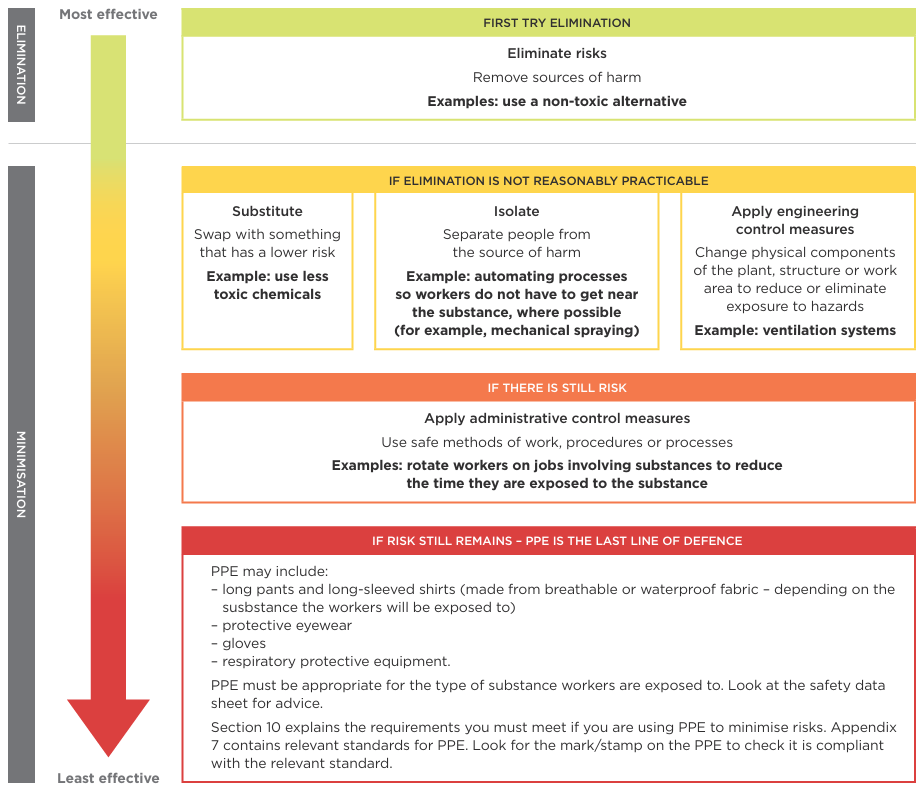
Figure 9 shows a hierarchy diagram divided into two main sections: Elimination and Minimisation, arranged from most effective at the top to least effective at the bottom.
At the top, under 'First try elimination': Eliminate risks - Remove sources of harm. Examples: use a non-toxic alternative.
Below that, under 'If elimination is not reasonably practicable', there are three control measures shown side by side:
Substitute - Swap with something that has a lower risk. Example: use less toxic chemicals.
Isolate - Separate people from the source of harm. Example: automating processes so workers do not have to get near the substance, where possible (for example, mechanical spraying).
Apply engineering control measures - Change physical components of the plant, structure or work area to reduce or eliminate exposure to hazards. Example: ventilation systems.
Below those, under 'If there is still a risk': Apply administrative control measures - Use safe methods of work, procedures or processes. Examples: rotate workers on jobs involving substances to reduce the time they are exposed to the substance.
At the bottom, under 'If risk still remains – PPE is the last line of defence': PPE may include: long pants and long-sleeved shirts (made from breathable or waterproof fabric – depending on the substance the workers will be exposed to); protective eyewear; gloves; respiratory protective equipment. PPE must be appropriate for the type of substance workers are exposed to. Look at the safety data sheet for advice. Section 10 explains the requirements you must meet if you are using PPE to minimise risks. Appendix 7 contains relevant standards for PPE. Look for the mark/stamp on the PPE to check it is compliant with the relevant standard.
End of text alternative.
What about exposure monitoring and health monitoring?
3.5.57
You may be required to monitor worker exposure or worker health if your work involves certain harmful substances. For more information about what harmful substances this applies to, see Resources webpage
3.5.58
Exposure monitoring to check the amounts of harmful substances in the work environment can help to inform you whether the control measures are being effective at minimising the risk.
3.5.59
Any exposure monitoring and health monitoring recommended will depend upon the harmful substance workers are being exposed to.
3.5.60
For example:
- for airborne particulates (for example, wood dust, welding fumes), exposure monitoring could involve measuring the amount of the substance in the air. Health monitoring could involve checking for loss of lung function.
- for substances that can irritate the skin (for example, wood dust), exposure monitoring could involve measuring the amount of substance on the skin. Health monitoring could involve checking for skin inflammation/dermatitis.
3.5.61
For more information, see Resources webpage
Hazardous manual tasks
What are manual task risks and what harm can occur?
Some manual tasks may cause musculoskeletal disorders (hazardous manual tasks). This includes muscle sprains, back and joint injuries. Examples of manual tasks in forestry include:
- lifting gear in or out the back of a truck
- carrying heavy loads
- dragging gear, chains, wires or vegetation
- operating machinery
- tree planting.
What are possible control measures?
3.5.63
Table 10 shows possible control measures.
| Control measure | Examples |
|---|---|
| Eliminate hazardous manual tasks |
|
| Buy equipment that meets ergonomic standards |
|
| Adjust equipment to the user |
|
| Climb in or out of machine or mobile plant carefully |
|
| Care when hooking and unhooking logs |
|
| Choose tools and machinery with built-in controls to reduce physical impacts on the operator |
|
| Limit the amount of heavy lifting required by workers |
|
| Move workers between tasks to vary the physical demands |
|
| Schedule regular breaks/microbreaks |
|
| PPE Only rely on PPE when you have taken all other reasonably practicable steps to minimise the risk. |
|
Table 10: Possible control measures for manual risks
What about health monitoring?
3.5.64
Consider including health monitoring (checking workers for signs of discomfort, pain, or injury to muscles, ligaments, bones, tendons, blood vessels, and nerves) into your health monitoring programme.
3.5.65
For more information, see Resources webpage
Last updated