Managing risk across a system
If you are new to managing risk, read this Appendix.
The following section looks at the principles of risk management. Most of them will be familiar to you but they are worthwhile repeating.
Think about how you will manage risk across the whole system. This applies equally if you are a principal or a contractor.
If you are a forest manager, for example, think about the whole project, from establishment and planting, through roading and landings, to harvesting, and replanting.
If you are a harvesting contractor, think about all the parts and processes and actions that go into the job over the duration of the contract.
Think about the risks and the control measures that you might apply but also think about what those control measures could do further down the line. If they create potential risks, then you need to weigh those up and look for a solution that provides the least total risk for all parties.
Forestry operations involve different businesses working on the same site operating at different times in a forestry cycle that is measured in years.
It is complex.
All PCBUs involved in the forestry and harvesting contracting chain have health and safety responsibilities.
Managing risk in dynamic environments
Things change and sometimes they can change fast.
Take into account the dynamic nature of your work and work environment when identifying hazards, assessing risks and deciding what control measures to use.
Train workers to recognise unanticipated risks and what control measures to use. For example:
- What do they do if they are manual felling and the wind comes up, or it changes direction? At what point are they to stop work and reassess the risks?
- What do they do if there is an electrical storm?
Workers need to be able to recognise when a situation has become unsafe, and stop work until the risks can be adequately managed.
Approach to managing risk
Step 1: Identifying the hazards
The first step is to consider all the things in your work and workplace that could cause injury or harm. These could be physical objects, foreseeable actions or particular situations; or less tangible things such as fatigue, weather events, and 'wild-cards' like unexpected worker actions.
There is a number of ways that you can do this.
- Talk with your workers. Get them to think about what they do and what hazards they see.
- Follow a worker through a task. Look for where things might go wrong.
- Think about the step-by-step process of a particular activity. What actually happens when a task is done?
- Walk around the workplace. Look for hazards. Think about what could go wrong and how you might prevent that.
- Talk with other forestry operators and the industry body about any incidents, accidents or near misses that you could learn from.
- Search online for any incidents that have happened internationally and show what could happen in a similar situation for your business.
- Always ask yourself, 'What could go wrong?'
Why you must talk with your workers about health and safety
- It is compulsory. Under HSWA (the Health and Safety at Work Act) you must, so far as is reasonably practicable, engage with your workers and their representatives when identifying hazards.
- It is good practice. Your workers know about things that you may not. They know how they do their jobs, and they know when things can be done better. They also know the short-cuts and workarounds. This is work as it is in real life rather than work as you might think it should be.
- It is the workers who are at risk of being hurt or being killed. They have a very real interest in making sure that they are not hurt or killed.
Examples of things that could go wrong
The table below gives examples of common hazards for forestry workers and operations. They are by no means a complete list. Use them as a starting point for developing your own list of hazards.
Something to think about. When you are identifying hazards, think about the length of a contract and, also, the lifespan of a forest. Think about risks that might come up in the future or things that might increase risk such as severe weather and storms.
| How could people be harmed? | Examples |
|---|---|
| Difficult landscape or terrain could result in workers being injured through slips, trips or falls |
|
| Poor or extreme weather conditions could expose workers to physical harm |
|
| Using plant that exposes workers to harmful fumes, excessive noise or vibration, cutting edges for example |
|
| Poorly built tracks and forestry roads or poor traffic management could expose road users to harm |
|
| Poor landing layout resulting in congestion and vehicles/people working closely together |
|
| Workers exposed to harmful substances while working |
|
| Workers contacting overhead power lines and services resulting in electric shock |
|
| Workers falling while working at height |
|
| Workers being hit by falling objects |
|
| Workers working excessive hours/shift work resulting in fatigue/impairment |
|
| Workers being injured carrying out manual tasks |
|
| Workers in isolated or remote locations not having access to immediate help if injured |
|
| Unauthorised persons at worksites being hurt by plant or harvesting activities. |
|
| Workers who are impaired or distracted making mistakes |
|
| Workers being harmed by poor work relationships |
|
Step 2: Assessing the risks
Once you have identified the hazards, you will need to work out what risks they present.
You must, so far as is reasonably practicable, engage with your workers when assessing risks.
With every hazard that you have identified, think about:
- What is the likelihood of the risk? (Is it reasonable to expect that it will eventually happen if the task/activity is repeated numbers of times?)
- What harm could happen? How serious is the harm and what is the worst-case scenario?
- How many people are likely to be exposed to the risk? Do their skill or experience levels influence the likelihood of the harm occurring?
All risks need to be managed. Risks that have the potential for causing serious injury or death, or chronic ill-health have priority. Just because a risk has lower likelihood of occurring or lower potential for harm does not mean that it can be ignored.
An example. The likelihood of someone being struck by falling branches during manual felling is high. The potential consequences are likely to be severe – in the worst case, death. Every worker involved in manual felling is exposed to that risk. Manual felling is high-risk/high consequence, so you would give priority to managing the risks.
Step 3: Managing the risk
The essential rules of risk management are:
1. You must eliminate risks so far as reasonably practicable.
2. If you cannot eliminate the risk, you must minimise it so far as is reasonably practicable.
The extent of the duty to manage risk depends on the ability of each PCBU to influence and control the matter.
You must, so far as is reasonably practicable, engage workers when making decisions about ways to eliminate or minimise those risks.
There are certain risks that must be dealt with in a certain way. These are specified in the health and safety regulations.
Certain risks require you to use the prescribed risk management process (including the hierarchy of controls) to manage them. For example, remote or isolated work, falling objects and working under raised objects.
If the risk is not specified in regulations, you decide how to manage the risk.
For more information, see Resources webpage
Use the hierarchy of control measures to minimise risk. These operate from the highest level of protection and reliability to the lowest.
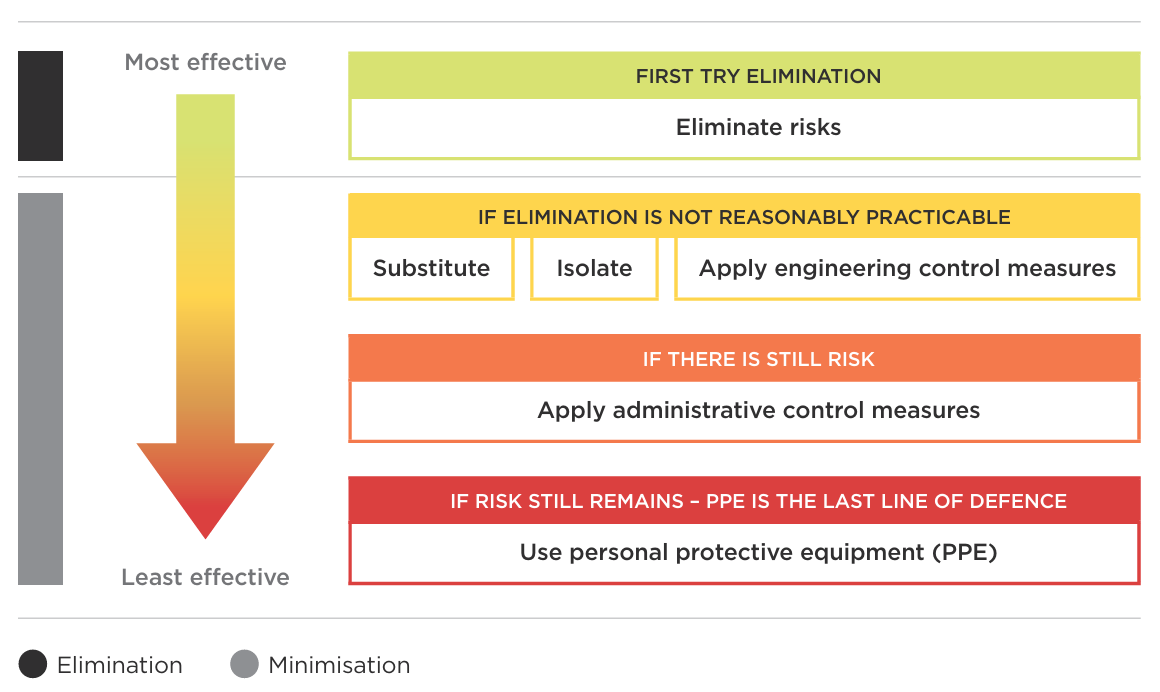
The above image shows a hierarchy diagram divided into two main sections: Elimination and Minimisation, arranged from most effective at the top to least effective at the bottom.
At the top, under 'First try elimination': Eliminate risks.
Below that, under 'If elimination is not reasonably practicable', there are three control measures shown side by side:
Substitute, isolate, and apply engineering control measures.
Below those, under 'If there is still a risk': Apply administrative control measures.
At the bottom, under 'If risk still remains – PPE is the last line of defence': Use personal protective equipment.
End of text alternative.
Think about it like this
Eliminate (get rid of the hazard)
Change or redesign the way you do a job so that the hazard is removed or eliminated. For example, the risk of felling on steep slopes can be eliminated at the establishment stage by not planting those slopes.
Substitute (replace)
Replace a process or a material with a less hazardous one. For example, replacing manual felling with mechanised felling or using mechanised grapples for breaking out.
Isolate (prevent access)
Use physical control measures or equipment to keep people away from the hazard.
Apply engineering control measures
Change the physical components of plant, structure or work area to reduce or eliminate exposure to hazards.
This could include such things such as enclosing or guarding dangerous items of machinery and equipment. Another example of an engineering control would be using chain catchers and chain shot guards on harvesting heads and installing thick polycarbonate windshields on harvesters.
Administrative control measures (organise)
Put in place procedures to make sure that the work can be done safely.
Examples are:
- using job rotation to reduce the time workers are exposed to hazards
- prohibiting the use of cellphones when involved in hazardous work
- having daily toolbox talks.
Standard Operating Procedures (SOPs) are an administrative control. They do not eliminate or minimise risks but once risks have been eliminated or minimised, they can be used to manage the remaining risk.
PPE
Personal protective equipment (PPE) is the last line of defence. PPE is only used when other control measures alone cannot adequately manage the risk.
Putting the control measures in place
Once you have worked out what the most effective control measures are, put them in place as soon as possible.
Engage with your workers. Make sure that they understand:
- the risks that you have identified together
- the control measures that have been chosen and put in place
- how to apply the control measures (what they have to do)
- why it is important to use the control measures.
Monitoring the control measures
Control measures are not 'set and forget'. Situations change, as will your business and processes. It is important that you monitor how your control measures are working, to make sure that they remain fit-for-purpose, they are suitable for the work, and that workers are using them correctly.
If you are required to use the hierarchy of controls, then you must make sure the control measures remain effective and review the control measures.
Engage with your workers and their representatives to see if the control measures are eliminating or minimising work risks.
Check incident reports and near miss reports (and encourage your workers to report incidents and near misses).
Carry out inspections of the work and the site(s), paying particular attention to known risks and risk control measures.
Monitor regularly. Make sure all policies, processes and systems have a scheduled date for a review or audit to check that they are being followed and are still fit-for-purpose.
Acting on lessons learnt
If you find that your control measures are not working effectively, or if your workers have suggestions for improving them, take action.
If there is an incident or near-miss, investigate. Find out what caused it and what needs to change to make sure it does not happen again. If need be, go through the risk management steps again and look at how and where you might adapt or improve control measures.
Look outside your own business. Observe what is happening in the industry from the industry association and other forestry operations. Look internationally, too. There are always things that you can learn and improve to make for better health and safety.
A quick summary of risk assessment.
Follow these steps:
- identify what could go wrong
- identify who might be affected and how they might be harmed
- identify controls that are needed to stop it going wrong
- show that any remaining risk after all reasonable controls are in place is low enough to be acceptable
- record all of your findings and keep these records
- tell everyone what they need to know and do
- make sure it all gets done
- ensure that if anything changes, you check you have got the right things in place. If not, stop the activity and review what is needed.
Last updated