This regulatory clarification explains when groups of LPG cylinders in storage can be considered adequately separated.
WorkSafe New Zealand, in regulatory clarification RC–25–01 has provided clarification on when two or more areas at a workplace where there are hazardous substances of the same subclass can be considered to be ‘adequately separated’ for the purposes of establishing a hazardous substance location under the Health and Safety at Work (Hazardous Substances) Regulations 2017 (HS Regulations).
This regulatory clarification expands on that clarification when there are groups of LPG cylinders in storage, in particular, how to determine the separation distances required for regulations 11.6 and 11.20. By in storage we mean that the LPG cylinders are not manifolded or connected for use.
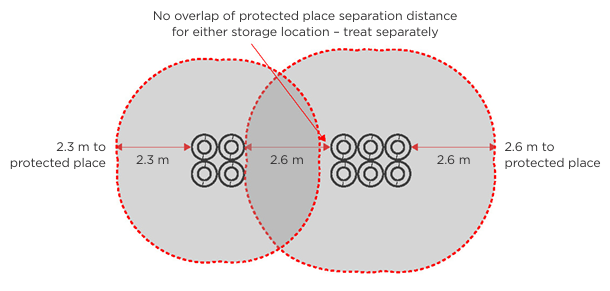
If the distance between two groups of LPG cylinders is equal to or greater than the protected place separation distance specified in column 2 of Table 2 Schedule 12(external link) of the HS Regulations for the larger group of cylinders (larger quantity, kg), the two groups can be considered to be adequately separated. In this instance, the quantities do not need to be aggregated, and they should be treated as separate hazardous substance locations (HSL).
The separation distance to a protected or public place should be determined for each separate HSL from the quantity of LPG present at that HSL.
This is illustrated in Figure 1.
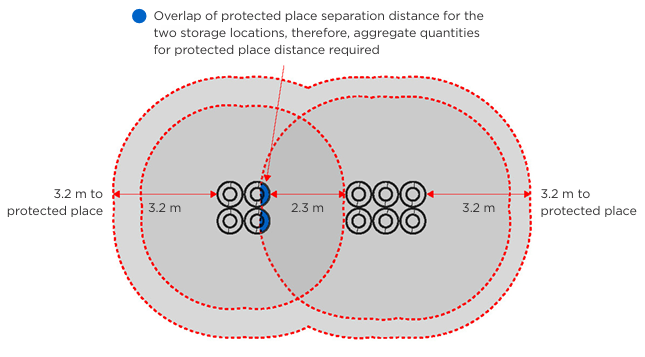
If the distance between two groups of cylinders is less than the protected place separation distance specified in column 2 of Table 2 Schedule 12(external link) for the larger group of cylinders, they are not considered to be adequately separated. In this instance, the total quantity of LPG present must be aggregated and the two groups of cylinders considered as a single HSL.
The separation distance to a protected or public place should be determined from the total quantity of LPG present across the two groups of cylinders.
This is illustrated in Figure 2.
Storage in exchange facility for portable cylinders (swap a bottle cages)
This regulatory clarification excludes swap-a bottle cages. Refer to AS/NZS 1596:2026 for specific requirements that apply to this type of storage. Refer to Appendix G.
For consideration of LPG that is manifolded for use refer to the guidance published by GasNZ LPGA guidance on groups of cylinders installed for use – Cylinder and tank security and Signage(external link) issued Feb 2022
Acknowledgements
WorkSafe would like to acknowledge and thank Genesis Energy Limited for the use of Figures 1 and 2.
Last updated